Irish Examiner view: Energy grid in need of investment
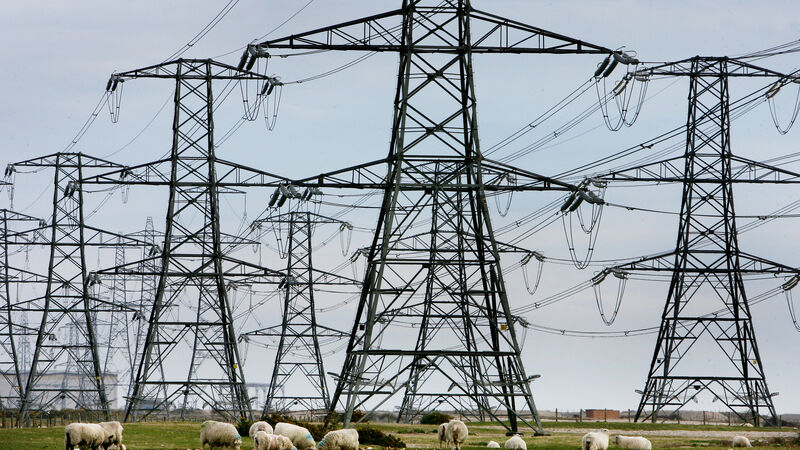
'Ireland has created vast quantities of renewable energy in recent years, and yet there is one data centre in Dublin that consumes energy equivalent to 200,000 homes — and Irish energy policy has been revised to attract more such centres.' Stock picture
The news that 2025 was the third hottest year on record likely came as no surprise. Indeed, the last 11 years have been the hottest since records began, which is a damning legacy of our inability, or rather unwillingness, to as a species act as we need to act.
The Paris climate deal had set a threshold of 1.5C to stave off the worst effects of environmental change, but we are already close to that with no indication things are going to halt.
Only in recent weeks did our own Government concede, to the shock of nobody, that Ireland would do well to hit 50% of its emission targets by 2030, let alone meet them.
Ireland has created vast quantities of renewable energy in recent years, and yet there is one data centre in Dublin that consumes energy equivalent to 200,000 homes — and Irish energy policy has been revised to attract more such centres.
There is a disconnect between the reality of our environmental obligations and our pursuit of investment (and the number of jobs is not insignificant).
In the case of that Dublin centre, it uses so much power that the substation it’s connected to has practically no capacity for anything else, either domestic or industrial. This case may well be an outlier, but it is nonetheless another fine example of how legacy plans (or lack thereof) continue to derail future ambitions.
As it is our energy grid is in dire need of investment, even as our water network hits capacity in many communities which are crying out for new homes.
A report at the end of last week suggested the country is missing out on billions in investment due to its inadequate energy infrastructure, but we can’t keep chasing inward investment if we don’t have anywhere for people to live.
EirGrid estimates demand for power in this country will surge 45% between 2023 and 2034, fuelled in part by data centres. The explosion in AI may well make that estimate as obsolete as our existing energy grid or climate ambitions.
There were some modest indications of hope globally. The use of coal for energy in India and China has declined for the first time in decades as they transition to green energy, while sales of EVs appear to have rebounded. We’ll take any win we can. After all, rebellions are built on hope.
Although, in our case, perhaps it’s an extinction rebellion.
In an era when age is increasingly no more than a number, and with workers looking to do more with their lives than just collect a payslip, various newer ways of working are emerging. These include what’s known as fractional employment where somebody is — you’ll have guessed from the name — employed by a company for only a fraction of the time.
This is different to the gig economy as typically thought, though it’s somewhat similar and has its own array of issues. In essence, fractional employment allows companies to employ an individual for part of a week or month, while giving the individual freedom to work for multiple companies. It’s not for the fainthearted, though it has been gaining traction in recent years, in particular with startups or companies that need high-level expertise some, but not all, of the time.
For some, this might seem like a Kafkaesque nightmare, a genteel rebranding of part-time work. But for others, particularly those who may have been in managerial or executive roles for some time and are now looking to either wind down or explore other opportunities, it offers a balance between income, meaningful work, and flexibility. What for some might be strategic consultancy could be value adding for others, or offer the opportunity to make use of valuable skills without the responsibility of helming whole departments or teams.
The drawback is, as you might have guessed, that the work is not necessarily guaranteed, and that it usually benefits people who have well-established credentials in an industry or a particular role. But with work-life balance increasingly important as many companies push back against remote working, it offers, for some, a way forward.
There is always something to be said for reimagining the workplace, even if there is no magic bullet (and for those about to chime in, AI is absolutely no magic bullet, even if it may help redefine certain jobs). For a maturing workforce, especially those realising that flexibility is as important as employment, fractional employment is simply one possibility. And in this, as with everything else, we must remain alive to the possibilities.
It’s sometimes said that you don’t know what you’ve got until it’s gone, but thanks to one tireless Kinsale woman, Co Cork looks to be getting some of its heritage back before it’s lost forever.
Charlotte Cargin, profiled in the on Monday in print and online, has uncovered more than 100 ancient wells in her hometown, and has restored 30 of them alongside some like-minded volunteers.
Some of those may simply have been for the provision of fresh water to locals, but she notes, for instance, the legacy of holy wells and sacred waters in our island’s history.
This pre-dates the coming of Christianity but taking on a different form during it as well. Celtic-speaking peoples on the continent were known to make votive offerings to sacred lakes, including swords and other examples of craftsmanship.
Hers may be a labour of love, but there is a real lesson for all of us in it.
She began her mission — which is now expanding beyond Cork — after finding a 1932 ordnance survey map that showed 100 or so wells in Kinsale, only to find that by 2020 nobody living had even heard of them. So in the space of a generation or two, a whole built landscape had been forgotten. How much more are we at risk of losing, just through the passing of a small span of years?
The work of Charlotte, and others like her in other fields, are a demonstration not only of how we can recover some of our past, but how we can restore it as well. And perhaps, given our planet’s environmental woes and the degradation of its natural resources, the restoration of water sources is a timely reminder that hope is not lost.
Read More
CONNECT WITH US TODAY



Be the first to know the latest news and updates