Gareth O’Callaghan: Why Ireland needs to be ‘emergency ready’ in an increasingly unstable world
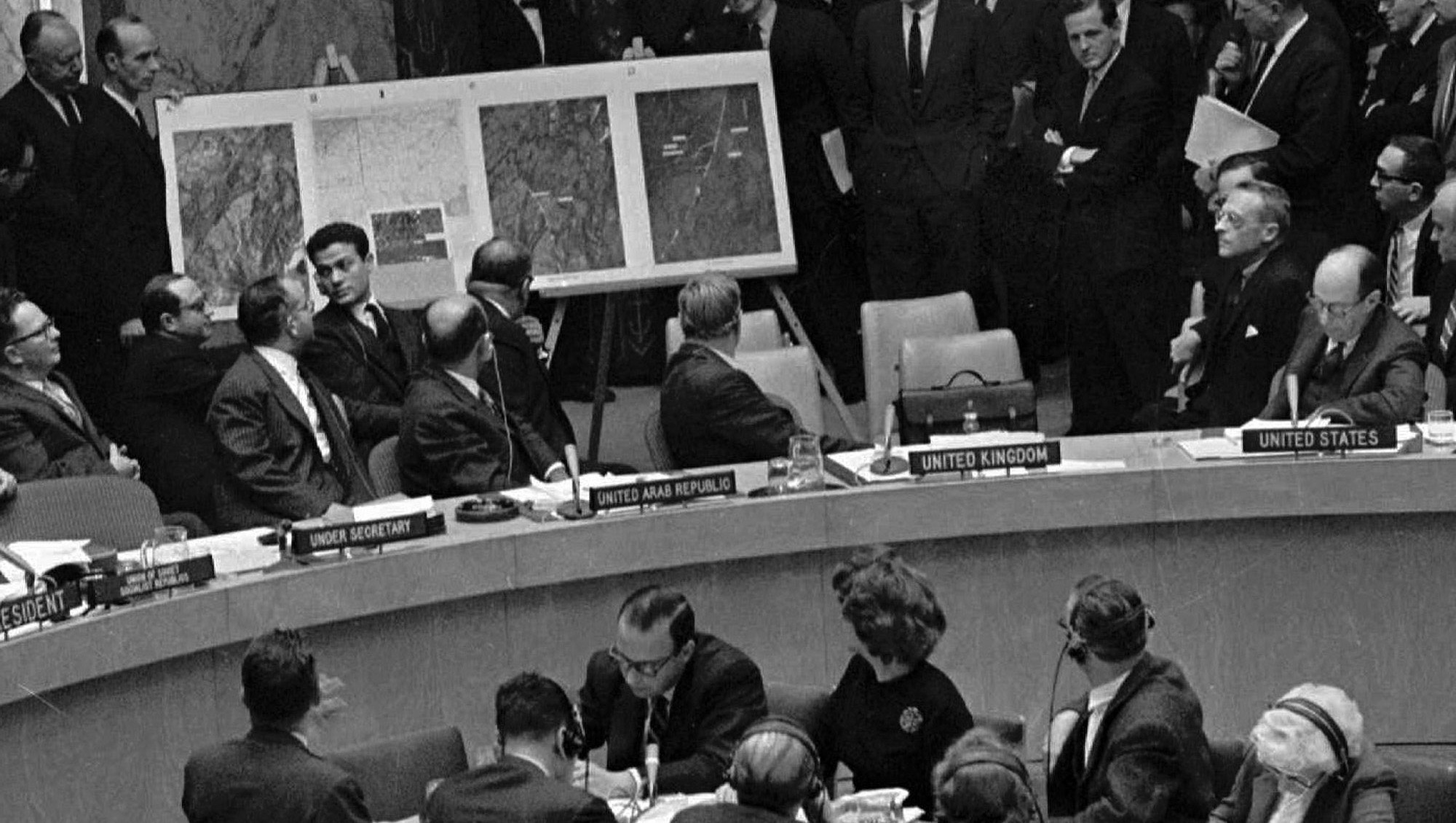
US ambassador Adlai Stevenson, seated at right, describes aerial photographs of launching sites for intermediate range missiles in Cuba during an emergency session of the United Nations Security Council in October 1962, at the height of the Cuban missile crisis, during which the world came its closest ever to nuclear war. File photo: AP

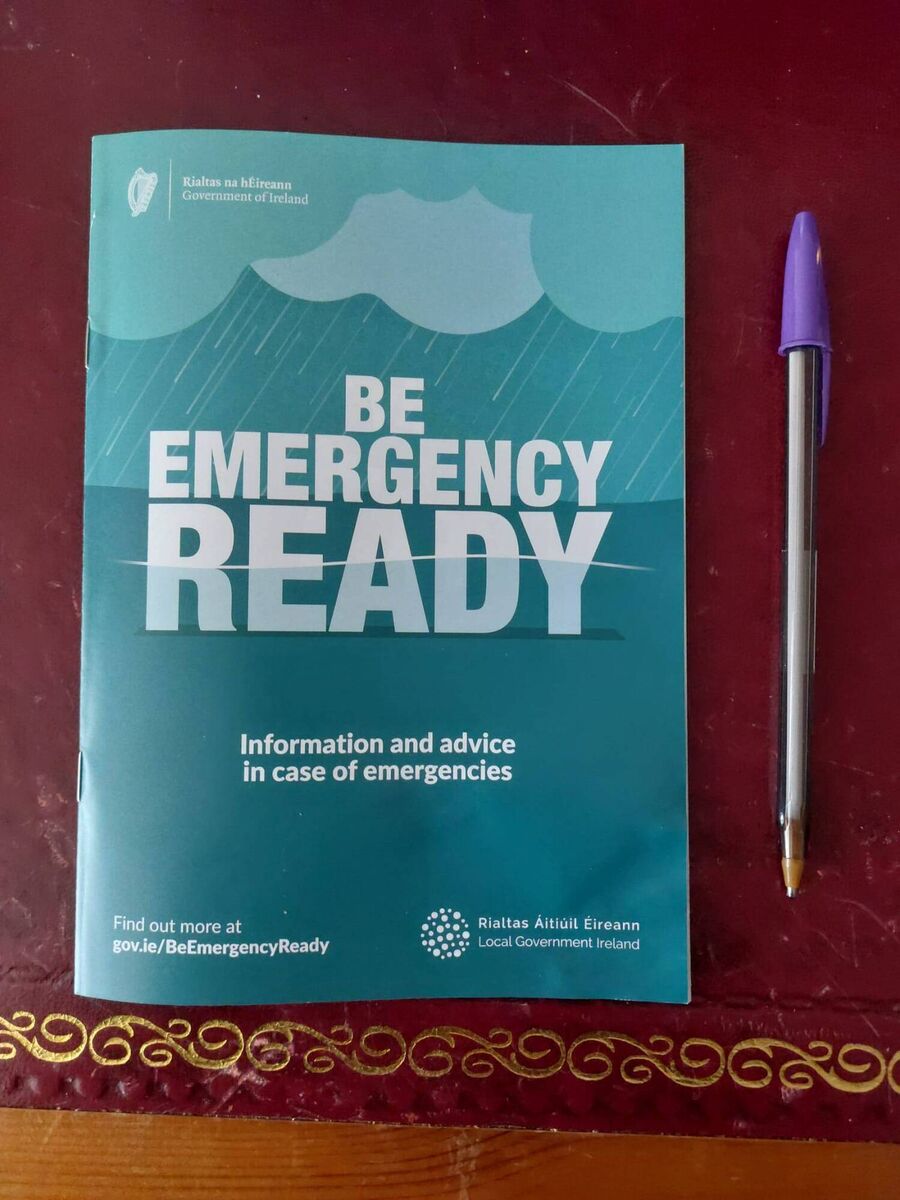
is the title of a new booklet that’s due for delivery to every Irish household in the coming days.
My mother, a sprightly well-informed nonagenarian, or wise elder as I call her, with whom I’m staying while working in the Big Smoke this month, handed it to me last week. It bears the official harp insignia. It looks ominous. Information and advice in case of emergencies. I’m intrigued.
Within minutes, she locates another booklet she had preserved for posterity, well worn and dated 1965, with a mushroom cloud on the cover, and a house with a family safe inside a single room. Its title, — translated as ‘Death of Life’ — is as grim as its subtitle:
In the aftermath of the Cuban missile crisis, the government issued the booklet to each household with advice, in the event of a nuclear war, on how to build and stock a single refuge room with non-perishable food and fresh water, to remain there for two days and to expect not to leave the house for two full weeks to avoid radioactive dust.
It also explained how to deal with radiation sickness. A farmer had also to consider the dangers not only to “his family, but also his livestock and crops”. As a nation we were urged, in the event of an attack, to listen to RTÉ radio at all times for updates from the authorities.
To call us naïve was an understatement.
Between 1954 and 1992, the “four-minute warning” became a talking point as a result of the Cold War, in terms of the approximate length of time it might take a Soviet nuclear missile attack on the UK — most likely the cradle of its nuclear industry at Sellafield — to be confirmed and to reach its intended target.
In reality, it would have taken less than two minutes. Despite our military neutrality, such an attack would still have made Ireland a sitting duck.
Little did the US Navy know on October 27, 1962, when it dropped depth charges on Soviet submarine B-59 in international waters near Cuba to force it to the surface, that it was carrying a nuclear-armed torpedo. The sub’s captain, Valentin Savitsky, ordered the torpedo to be armed and loaded into its launcher, but his more senior in command, Vasily Arkhipov, refused consent to launch.
Arkhipov prevented a cataclysmic exchange between Russia and the US that day.
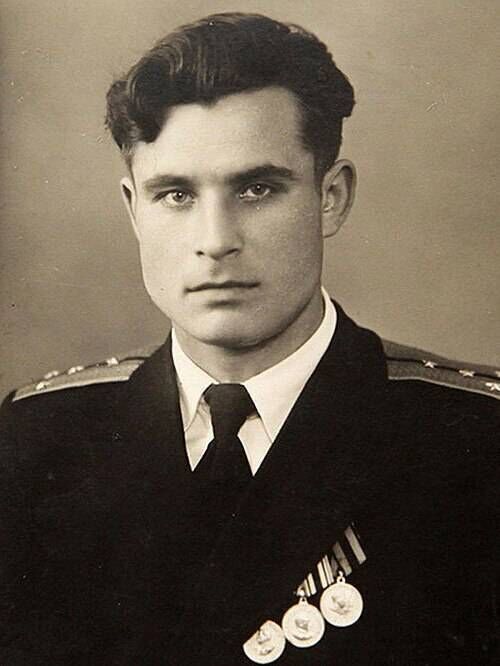
Black Saturday, as the date became known, is regarded by both scientists and historians as the closest the world has ever come to nuclear war. His split-second decision saved millions of lives and generations of devastation.
Leafing through the new booklet with the wise elder, we talked about what has changed since . Judging by the current seismic fractures in world politics and the advance in computer technology to the point where it is now close to — if not soon to surpass — human intelligence, life is more precarious than it has been in almost a century.
“Today. I heard the voice of Adolf Hitler,” American journalist Edward Robb Ellis wrote in his famous diary on this day, September 26, 1938. “His oratory is so menacing that he chills one’s blood.”
Ellis is regarded as one of the most prolific diarists in US history. His words are prophetic and timely. History is repeating itself in terms of more modern blood-chilling oratories.
The sacredness of humanity is at its lowest since those dark evil days of the Nazi genocides. Life has never been so cheap and expendable. At least 77,036 lives have been exterminated in the Gaza genocide since October 7, 2023.
The world is on an unsustainable trajectory, in the hands right now of the most dangerous men this generation has ever known — all men, all megalomaniacs — who can’t be trusted to act in the interest of those they have power over. Might makes right is the code of survival in the jungle, as we are witnessing. Politics drives disruption.
We are approaching what’s known as G-Zero world, as popularised by Ian Bremmer in his 2012 book , where there will no longer be a superpower prepared to drive a global agenda or maintain international order.
That day feels like it has already come and gone. A world crisis combined with a global war is closer now than at any time in the past 60 years.
Let’s assume that an emergency is a sudden, urgent, usually unexpected occasion that requires immediate action. avoids specific types of calamities — predicting future disasters is somewhat futile and leads only to doomsday scrolling.
Being emergency ready means being aware, making a plan, and staying connected. Some preparation is better than no preparation at all. If that’s all you take from the booklet, then that alone is worth the time reading it. Knowledge is power.
It’s also worth the time having the conversation about the possibility of a global emergency, as I did with the wise elder, considering that only this week Nato leader Mark Rutte warned that right now we are facing “the most dangerous and complex” security environment in a generation.
Russia is driving through more policies that are rapidly weakening the US-led global order. Nato member Lithuania shares a land border with the Russian exclave of Kaliningrad.
It was believed that Russia would not threaten Nato until 2029 but it appears the gloves are off. A crisis is looming with Moscow expanding its presence along Nato borders in an effort to undermine European unity.
Leaving the possibility of land wars aside, how might AI feature when it comes to the need for us to be emergency ready? In a hierarchy of threats, I wouldn’t be controversial if I were to place the unstoppable march of artificial intelligence right at the very top.
If AI researcher Jacob Coxon, who resigned from Anthropic (which builds advanced AI assistants) recently after just four months stated that “the people building AI earnestly believe that it could kill us all by the end of the decade”, it’s difficult to argue with that, considering how little the rest of us really know about the dangers of AI.
The most likely scenario for super AI to kill off the entire human race would be by creating a new bioweapon and releasing it into the atmosphere. Researchers at Stanford University announced only last month they had used a genetic language AI model to synthesise 16 new viruses.
On a positive note, it’s not possible (so far) to kill everyone with a single virus. Covid killed less than 1%, so the less sleep lost on that one the better.
For good measure, the wise elder wonders if it could be possible for AI to cause a nuclear war? Interesting. We’re led to believe that the control of nuclear weaponry is disconnected from the internet, and can only be implemented manually through verification codes. So that’s good news, isn’t it?
Well, actually, it’s not because we’re still facing the possibility of G-Zero world, and those unpredictable leaders who carry those nuclear-primed briefcases.
Who remembers the attempted coup in the Soviet Union in 1991? Mikhail Gorbachev lost control of his nuclear briefcase for three days after it found its way into the hands of one of the coup leaders, namely minister of defence Dmitry Yazov. It took three long days before the codes were changed and secured.
On the other hand, maybe it was government strategy to release the booklet this week as a distraction technique, considering it’s less than a fortnight to the budget.
That was the wise elder’s thinking; at which point the chat draws to a close, and the new booklet is tucked away in a drawer beside the old one for safe keeping — hopefully for another 60 years.
CONNECT WITH US TODAY



Be the first to know the latest news and updates