Fergus Finlay: The Before we Die campaigners are resolute — because they have no choice
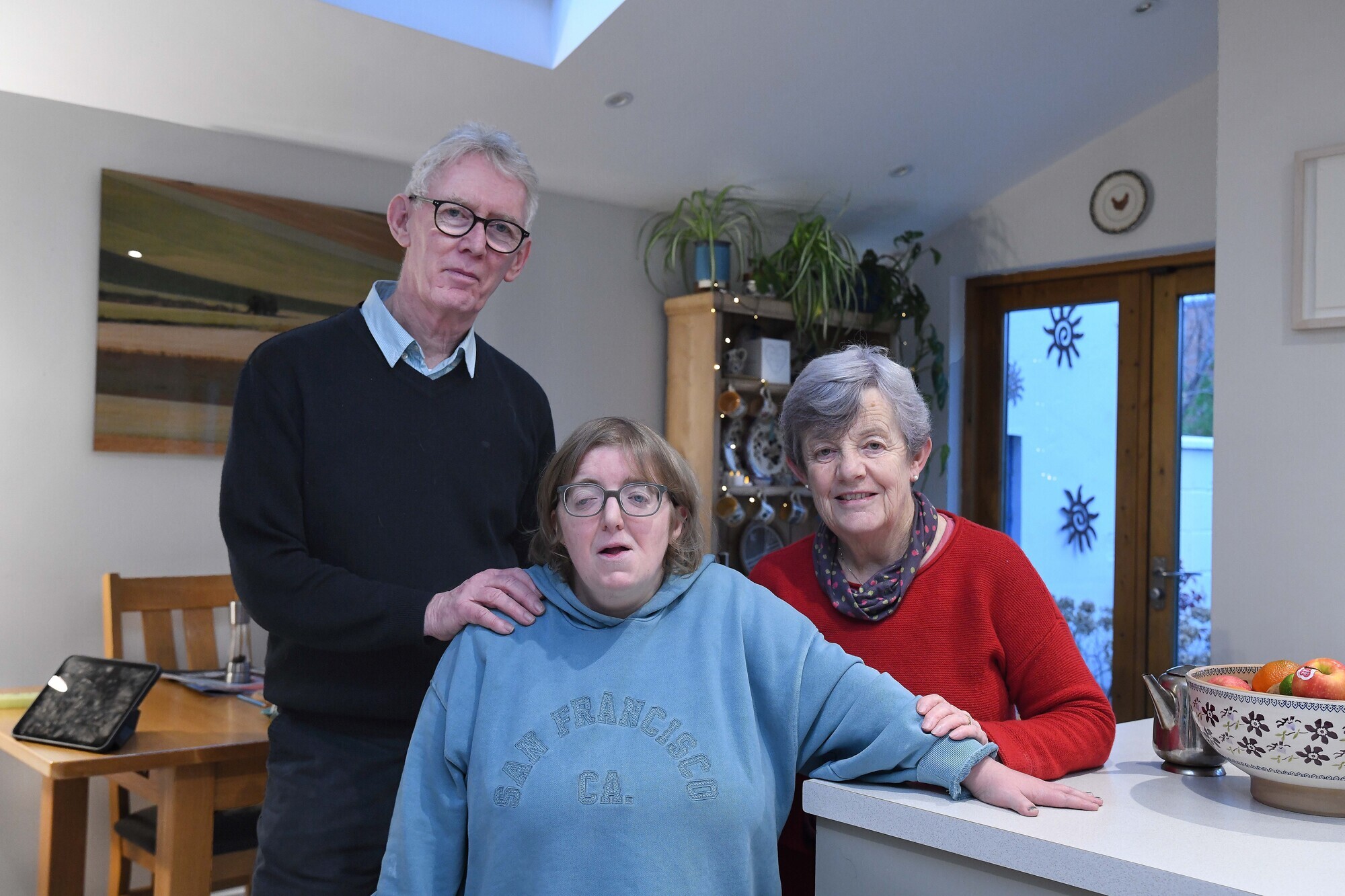
Founder of Before We Die Tony Murray, with his wife Susan and their 42-year-old daughter Aoife who has an intellectual disability and is cared for full-time by her parents. Picture: Moya Nolan

I turned up at The Helix auditorium in Glasnevin last Saturday morning for a meeting about intellectual disability.
I’ve been doing that most of my life, working with and supporting campaign groups trying to raise awareness, trying to impress politicians and governments about the urgency of the situation facing individuals and families.
The meetings I go to, and the groups I meet, are always somewhere between anger and despair.
They fight until they are worn out. They fight until there is no fight left.
They fight until the needs of their children (because it’s always their children they’re fighting for) overwhelm their time and energy. As a result, meetings tend to get smaller over time.
Read More
So you can imagine my surprise when I arrived at The Helix to find a large queue at the door, in the drizzling rain, waiting to get in.
By the time everyone was seated, the auditorium was packed.
Without any exaggeration, this was the largest gathering of people associated with intellectual disability I’ve ever been at in nearly half a century of campaigning. Ever.
It was organised by Before We Die, started just over a year ago, in their kitchen, by Tony and Susan Murray.
They are older parents of an older adult daughter, Aoife, and in starting to worry and think about her future they quickly realised that there was a pretty massive crisis facing older parents all over Ireland.
The little group they started is now well on its way to becoming a national movement.
And a very determined one. Not angry, not despairing. Resolute.
The gathering in The Helix — of at least 1,000 family members — wasn’t a celebration. It was a beginning.
It was the launch of a major campaign that will last until the next general election — and if necessary, I hope, well beyond. In the hall,
Before We Die outlined a lot of statistics, and eight demands.
I’m not going to list out the eight demands here — I think in time we, and the political system, will become very familiar with them.
There is a heavy emphasis on housing and good residential services, but in essence, they are about providing for older people with an intellectual disability and enabling them to live with dignity.
Doesn’t sound like a big deal, does it, for a country like ours? Not just the richest country in the world, but a country with a long tradition of talking the talk about care and compassion.
We even, sometimes, talk about rights. I’ve talked to hundreds of politicians over dozens of years about intellectual disability and believe me when I say that I’ve never met one who doesn’t care, genuinely and sincerely, about people with disabilities.
The only problem is, the choices they make at the end never, ever, reflect that.
A couple, maybe. Brendan Howlin put a multi-year plan in place, Brian Cowen provided multi-year funding. After that? Let me tell you what it looks like. If you think I’m exaggerating, you’re wrong.
In Ireland, one person in every 50 of us has an intellectual disability. The other 49 don’t.
Forty-nine of us live in a country where bureaucracy impinges on our lives every now and again. One lives in a world that seems to be owned, trained, and ridden by bureaucracy.
Forty-nine of us have rights, some written into the Constitution, some that are just effective — like the right, for example, to be supported through education until at least adulthood.
For instance, three of my four children, because they’re part of the 49, were made welcome into third level education — offered places, grants, opportunities, and they thrived on it until their early 20s.
One of my daughters was told that her right to an education stopped dead on her 18th birthday.
That’s the law of the land, and the Supreme Court interpretation of the Constitution, for one in every 50 of our so-called citizens.
She and her mother fought her way back in, but with no support whatever from the State that had supported the other three.
Then there is the wave of bureaucracy underpinned by other laws.
I wrote here recently about a struggling mother who sought residential support for an adult child with severe disabilities.
She was greeted by a cold and unfeeling assertion by the HSE, based on (in my view) a deliberate misinterpretation of an old law, that she (the mother), whether she could cope or not, was legally obliged to provide accommodation for her daughter until the day she died.
Then there is assisted decision-making, one of those laws probably a good idea on paper, but an absolute disaster in practice.
It works, essentially, this way. I might have been born non-verbal, unable to feed myself, terribly disturbed by sudden noises or lights, completely needing the support of my family to do the most basic things.
The moment I become 18, I am deemed in the eyes of the law to be fully competent to manage my own affairs and make all my own decisions, unless it can be proved otherwise to the satisfaction of a court.
You have no idea how much stress that places on the shoulders of the primary carer.
When you add assisted decision-making to (God help us) GDPR, parents and primary carers end up feeling the entire system is weaponised against them.
But the biggest crisis is housing. The core rationale behind Before We Die is the question, what happens to my child if I fall under a bus?
Right now, because of a complete absence of planning, the answer is that my child becomes someone else’s emergency.
The State will cope with that emergency by uprooting my child. He or she will lose the home they have lived in all their lives. They’ll lose the community around them, the friendships they have, their sense of place, everything.
Of course it will be said that if parents die, what about the rest of the family? That question is never asked about the other 49, only about the one in 50.
The utter absurdity of the lack of planning is that if my child needs an emergency placement, the State will end up paying nearly €400,000 for it.
That’s about three times what a planned placement costs. And somebody gets to make a huge profit.
The 1,000 people who turned up in The Helix on Saturday, to represent one in 50 of all of us, are not demanding residential places for their children now.
However, one of their leaders, Kevin Hodnett, told the conference that one of the great frustrations of all of this is “not only is there not a plan, there isn’t even a plan to have a plan.
The white paper they have produced includes this stark message.
“We have recorded the words of parents who have come to hope, in their exhaustion, that their child might die before them, so that neither will have to face a crisis decision made by strangers.”
There are maybe 1,000 days between now and the next general election. Before We Die intends to make sure that message will be heard on every single one of those days.
For the sake of one in 50 of us.
CONNECT WITH US TODAY



Be the first to know the latest news and updates