Jennifer Horgan: Donald Trump's united Ireland talk could have derailed the North's fragile peace
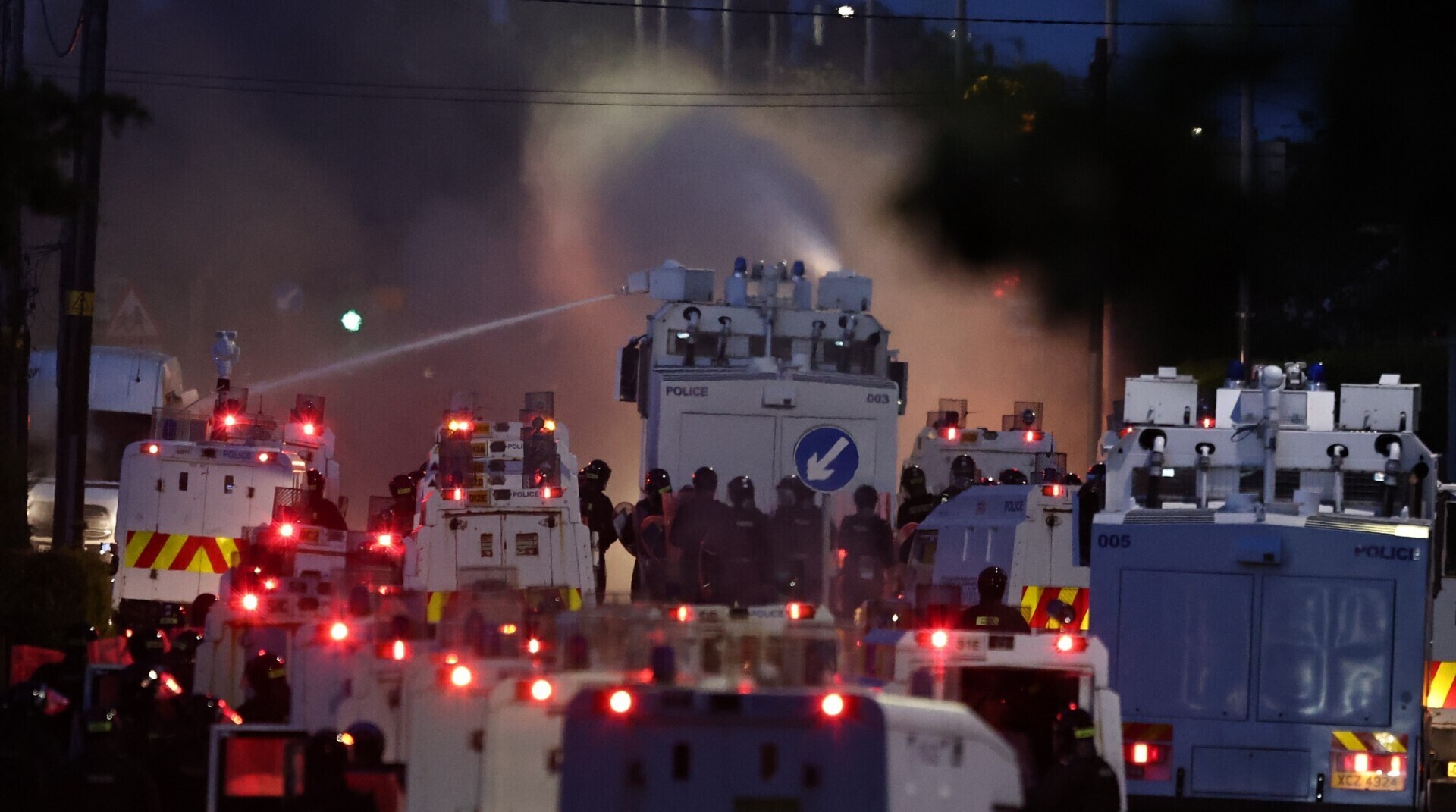
Police fire a water cannon during riots in Newtownabbey in the summer. The last two summers have seen violent riots in Northern Ireland around immigration. There is still considerable unrest around marching season, and most schools are still segregated by religion. Picture: PA

A lot of people need to pipe down about a united Ireland, not just Donald Trump.
I’m currently reading Órfhlaith Foyle’s new short story collection, , in preparation for the Cork Short Story Festival next month. The opening story centres on Irish woman, Josie Dolan, a teacher in East London.
When a horrific act of violence is carried out within the community, another teacher, an Englishman, says he would have thought Josie would be used to violence, being from Ireland and all. Josie reminds him that she’s from the Republic; he doesn’t seem to understand the correction.
The exchange, in this brilliantly conceived story, echoes remarks I heard working as a teacher in East London and later in a British school abroad. Small slips would reveal giant holes in English people’s geographical and historical knowledge about Ireland.
Your average English person knows nothing about Ireland because they’ve been taught nothing about it, unless they once ended up in a classroom with an immigrant teacher like Josie Dolan, or yours truly.
Read More
The ignorance of the English is irritating but they can’t help it, and honestly, I’d take their ignorance over the nonsense of starry-eyed republicans hailing from, oh, I don’t know, Killarney in Kerry, or Rochestown in Cork.
As Josie Dolan says, most people in the Republic didn’t suffer violence during the Troubles like the people in Northern Ireland. That simple fact should make a difference in how much of a right we have to discuss a united Ireland.
As far as I’m concerned any opinion offered on the topic should be prefaced by a clear assertion that the opinions of people in Northern Ireland matter more. Because we never felt their fear, their terror, living on one street, viscerally aware of those living on the next.
For the most part, bar some truly devastating exceptions, we didn’t lose our loved ones to violence. Along with the rest of the world, we watched the Troubles from a distance; often, we looked away.
Close to half of the thousands killed as a result of the Troubles in Northern Ireland were killed in Belfast. Following peace, the horror continued.
More people have died by suicide in Northern Ireland since the Troubles than those who killed by violence during the period. The place is marked by the deep psychological scars left by violence, by trauma.
It is not the same here. Here, too much time has passed for us to have living relatives who fought in the earlier, violent struggle for independence. Our interest in a united Ireland is therefore a far more academic one, and it should be treated as such.
It’s not just Trump who is too loose-lipped about it. The Good Friday Agreement makes clear that a border poll must only be called when the Secretary of State for Northern Ireland feels it is likely that there is a majority wish for a united Ireland. We have no definitive evidence of that.
Earlier this year, polls hit the headlines, indicating that 63% of people in Northern Ireland would vote for “a united Ireland in the EU”. Later analysis revealed there may have been considerable confusion about the wording, and in particular the inclusion of the reference to the EU.
Other local surveys find far more people opposing a united Ireland. A poll on Irish unity from the ARINS Project in December 2022 stated that 27% of respondents in the North supported Irish unity while 50% said they wanted to stay in the UK.
Yes, there are more Catholics than Protestants in Northern Ireland now, and in old money that should mean more support for unity, but the population is more complex, with a whole new section identifying as neither, with just over 17% of the population identifying as having ‘no religion’.
Everybody’s primary concern should be to maintain the fragile peace in Northern Ireland, and it is fragile.
A peace index released last year from Queen’s University Belfast, in partnership with the Institute for Economics and Peace (IEP) found that Northern Ireland has made “significant progress” in reducing violence since 2019. However, the index also found that the foundations needed in order to sustain long-term peace are improving “much more slowly”.
Dr Thomson, leading the research, said: “The findings in this report give us both reasons for optimism and reasons to carefully assess what might come next.” He goes on: “Northern Ireland is much less violent than before, but the foundations for peace have not consolidated at the same rate.”
The last two summers have seen violent riots in Northern Ireland around immigration. There is still considerable unrest around marching season, and most schools are still segregated by religion. It is the most dangerous place in Europe to be a woman.
It is in its infancy when it comes to peace. To speak loosely about a huge political change, an event that could re-open old sectarian wounds, without adequate qualification, and without acknowledging Northern Ireland’s proximity to past violence, is reckless.
How anyone is surprised that the buffoon from America brought up a united Ireland is beyond me. Ill-informed Americans often weigh in on matters they don’t understand. Teddy Kennedy called for a united Ireland during a visit in 1971, infuriating the British and doing little to help the situation.
SDLP leader John Hume became so vexed by such interference from America that he travelled there to ask Irish Americans to desist from supporting violent republicanism, encouraging them to support constitutional reform instead.
A year after Kennedy made his unhelpful united Ireland comment, he finally listened to Hume. He joined Hume’s efforts to bring about peace, and ended up playing a meaningful role in the process.
There will be no such eureka moment for Donald because he doesn’t care about Ireland and he has no interest in the Good Friday Agreement. He describes the possibility of a united Ireland as a merger, as if it has to do with asset management, not lives.
But Trump is not the problem. The more surprising thing is how enthusiastically his comments have been reported. I’m irritated by all of it. I’m irritated by Mary Lou MacDonald running off to meet with first ministers in Scotland and Wales. Micheál Martin is right to accuse her of “setting back unity”.
A united Ireland is something to be decided upon, first and foremost, by people living in Northern Ireland. Everyone else, including Andy Burnham, with his blistering comments about border polls being off the table, and Gordon Brown, and Peadar Tóibín, need to shut the hell up about it.
The actual people who have suffered most, or live in the shadow of the most recent suffering, should be given the primary say in matters relating to their home: Republicans and Unionists; Catholics and Protestants — and those of no religion.
In all of this I agree with the DUP leader Gavin Robinson when he says Northern Ireland’s future “will be decided by the people of Northern Ireland, not by commentary in London, Dublin or Washington”.
He could throw in Rochestown for good measure.
CONNECT WITH US TODAY



Be the first to know the latest news and updates