Fergus Finlay: There must be accountability for the €50m Irish Rail IT fiasco

I can still remember the joy of making the 7.30am out of Cork and, as soon as the train was moving, heading to the dining car for a full Irish breakfast. File picture: Larry Cummins

There was a time in my life when I travelled a lot between Cork and Dublin, and I always took the train.
I can still remember the joy of making the 7.30am out of Cork and, as soon as the train was moving, heading to the dining car for a full Irish breakfast. Sometimes you had to wait, because first-class passengers were served in their seats before the dining car was opened for us plebs.
The wait was agony because the smell of frying bacon had begun to waft through the corridors. But then it would open and John would welcome you.
He must have run that dining car for years. He was a portly gent (like me) and was courteous, brisk and efficient. And the full Irish was simply the best in the country. What a way to pass an early morning journey and prepare for a day’s work.
It’s long gone, of course, replaced by a trolley. I hope John lives in elegant retirement somewhere. No doubt he, like me, sometimes wonders about the benefits of modernisation.
Read More
That’s not a thought bothers anyone else in Irish Rail. The only rule, it seems, is a simple one. If modernisation is the end result, let’s throw as much money as we can at it. And when it all goes wrong, we’ll put our heads down and hope nobody notices.
Because if they do, of course, somebody might want to make us accountable for it.
Somebody (or maybe many somebodies) in Irish Rail has owned up to losing €50 million in a failed IT project. That’s a mess, isn’t it? But I’m guessing as the full story emerges, it’s going to look like less of a mess and more of a full-blown fiasco, if not a scandal.
By the time it all comes out we will have discovered that we — you and I, taxpayers all — will have to cough up at least €100 million. And ultimately, almost certainly, a lot more.
There have been a number of news stories, in this paper, and others, revealing the harsh truth that Irish Rail has written off the €50 million on a software system that doesn’t work (and that has never worked anywhere else in the world apparently).
We’ll come back to that. But nobody, as far as I can find, has written about the building.
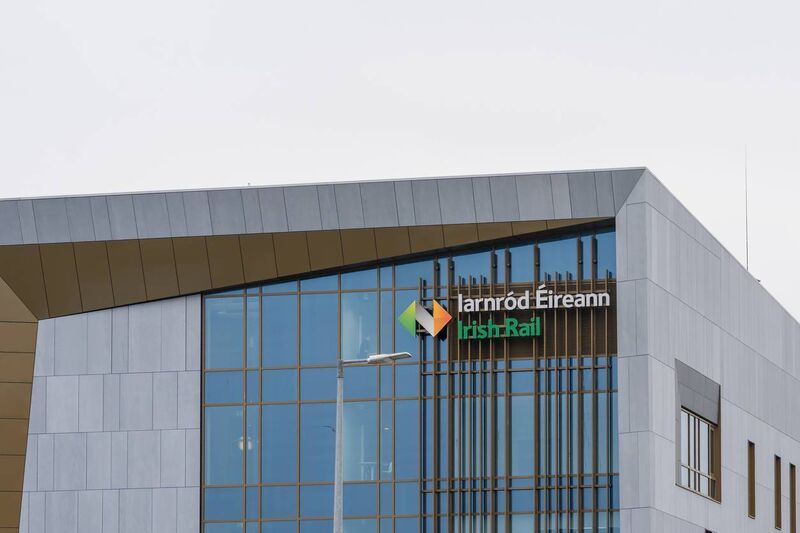
If you get the Cork train out of Heuston, and keep an eye out to your left as you pull out of the station, you’ll see a modern grey building, featuring a lot of glass, looking every inch like a space-age super-duper National Train Control Centre.
Sadly, the only thing super-duper about it was its cost, an eye-watering €57 million (including VAT, naturally).
The only thing this lovely building, which was commissioned about four years ago, will not hold is the equipment, software and staffing necessary for a national train control centre, because all of that is down the toilet.
It does have to be said that the building is being staffed by some gardaí involved in Garda communications and there is talk of moving some Dublin traffic control in there. Train control is still being run (with old-fashioned but still working software) from a centre in Connolly Station.
But here’s the thing. All us taxpayers give Irish Rail just under a billion euros a year. About half of that, every year, goes to support rail services that we want the company to run but can’t break even without charging exorbitant fares.
That funding covers mainline rail, some commuter services (the Cork to Cobh train, for example), and the DART. (The Luas gets a separate state subsidy of around €40m.) And the other half is for improvements to the system.
I approve of these subsidies. I believe, and I’ve always believed, that a decent rail network is important for the whole country. I’ve written here before about the importance and value of a western rail corridor.
A decent and affordable national railway system isn’t just good for the environment and the economy, it enhances the quality of life of all of us.
It’s worth supporting and investing in. (I was pained to discover years ago that the dining car on the Cork train was never allowed to be part of the subsidy. That, I think, is why it was closed down, to the detriment of my quality of life!)
If we’re being truthful, I think we have to admit that our railway service, small as it is, is a good one. I use the train occasionally and the DART frequently.
I couldn’t tell you the last time either service was noticeably late to arrive, or failed to get me where I was going in good time. If there was delay there was always a good and well-communicated reason.
In the UK, rail services were privatised years ago, and have been run for profit ever since. They have got worse and worse and worse, in terms of price, safety, and punctuality. It has got to the point in the UK where one of the most popular things the incoming prime minister could do would be to take all the railways (and water infrastructure) back into public ownership.
So what am I complaining about? There’s a harsh truth about quality public services. They don’t survive intact without accountability. The people who believe in decent public services, and are willing to pay for them, are entitled — actually we’re obliged — to demand real accountability for the spending.
We don’t do accountability in Ireland. Now and again — very rarely (RTÉ is an example) — we go to town and a sort of uncontrolled feeding frenzy erupts. In the process careers are damaged, reputations are tarnished, and trust is destroyed.
And I wonder if anyone is left with the feeling that justice has been done and the quality of public service improved. But mostly — and I reckon Irish Rail will fall into this category — we find a well-worn cliché.
I’m going to bet you there will be an exhaustive inquiry into Irish Rail, and at the end of it there will be a report that finds “system failure” and nothing else.
So we’ll never know who decided (six years ago) to invest what was intended to be €19 million in a new control system. We’ll never know who opted for a system that hadn’t been successfully tried anywhere else. We’ll never know who watched the money grow and grow and failed to shout stop.
We’ll never know who knew the suppliers were missing deadline after deadline and did nothing about it until it was too late. We’ll never know if the right lessons have been learned and if we can be guaranteed will work the next time.
If someone isn’t competent to do the job, they shouldn’t be doing the job. But I have no interest in humiliations or floggings or forcing individuals to walk the plank in public.
I’m interested in change. Change only happens when individual responsibility for mistakes is admitted. If we end up seeing this Irish Rail fiasco as just another systems failure, we’ll be letting ourselves and the whole idea of public service down. Again.
CONNECT WITH US TODAY



Be the first to know the latest news and updates