Gareth O'Callaghan: US democracy teetering even as it celebrates its 250th anniversary
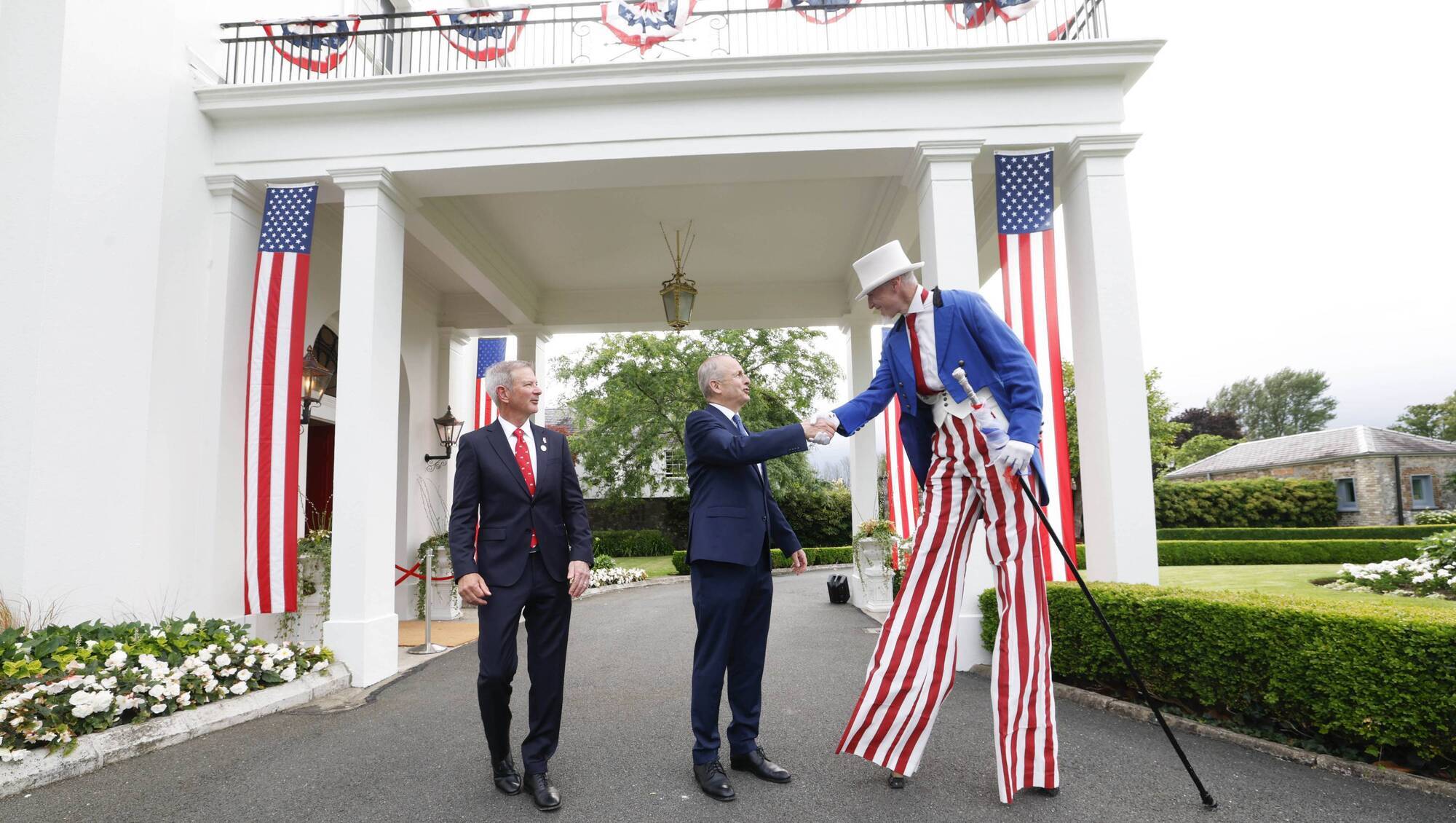
The US ambassador to Ireland Edward S. Walsh (left) hosted a major celebration of America’s 250th Independence Day at Deerfield, the official residence of the US Ambassador in Phoenix Park on July 1 where the Taoiseach Micheál Martin (centre) was greeted by Uncle Sam. Picture: Conor McCabe Photography

Americans are so patriotic. They love to talk, almost as much as we do. Those who flock here on vacation, after years of planning to spend time immersed in all things Irish, make it their business to soak up our charm as much as they can give it back.
They shame me by how much they love our country, reminding me I need to show it more love than I have in recent years. They give the impression when they greet you that they want to be friends, one of their many endearing attributes. It’s chemistry, it’s natural, and it flows.
I’ve swapped contact details with more Yanks than any other nationality because they draw you in and make you feel you’re related to them in some distant way. It’s an organic connection, the Irish and the Americans.
Over years of being befriended by those here to discover the ancestry many of them have spent a lifetime researching, all of them, without exception, have stressed how much they love the United States. Americans are big on home pride. They wear it like a badge of honour.
Read More
Or at least they used to.
I had a long chat with a psychiatrist last Monday. Nothing to do with my mental health, I might add. That said, you never know when you might need one.
Her name is Verna. She’s from Sacramento, visiting Cork for the summer along with her husband Jeff, a retired surgeon. Theirs is not so much a tourist visit or a search for roots as a recce. They are actively looking for a forever home.
They decided to vacate the States for the fourth of July because the notion of celebrating at home right now is risible. I ask them what they both think of Trump. I might as well have asked if they had any embarrassing habits.
Americans are ditching America in droves right now, with 42% dreaming of leaving their home country. It’s estimated that between 210,000 and 405,000 left the States voluntarily in 2025.
It’s the first time in almost 50 years that more people moved out than moved in.
Most of those leaving (89% in a recent survey) are getting out for social and political reasons, including reproductive rights, restrictive immigration policies, cost of living, gun violence, and a general disgust of Donald Trump.
“The country is going backwards,” Verna tells me over coffee alfresco in her cutesy Californian accent. For a moment I think I’m listening to Jane Fonda. They want to settle in West Cork, and who can blame them?
It’s Independence Day weekend in the United States — a time for Americans to celebrate a country that was founded by immigrants. It became the one place that millions from all over the world imagined someday they might live in and make their home.
Now the country appears to have gone into reverse thrust. Verna and Jeff are so desperate to get out they’d happily give up their citizenship if they can just call Ireland their home.
One in five Americans feel the same way. Their country is on the slide and the people at the top don’t even notice.
“Here in Ireland,” Jeff says, “your children don’t have to rehearse how to hide from a school shooter.” That says it all.
In January last year, during his second inaugural address, Donald Trump claimed that “the entire nation is rapidly unifying behind our agenda”. Clearly he’s not getting it.
Here’s a man who raked in more than a billion dollars from his crypto businesses last year, while also running the Oval Office, not to mention his real estate and royalty deals. It’s a far cry from the 30,000 Americans who die annually waiting for a decision on their social welfare disability benefits.
As the country marks its 250th anniversary, barely 36% still believe in the American dream, and the tenet that hard work begets success and upward mobility.
And then there’s his mental health. Barely a week ago, at an event of lawmakers in Washington DC, Trump quipped that he was “very disappointed” he wasn’t mentioned in the Declaration of Independence alongside God.
Jeff cites his years as a surgeon when he says: “If I spoke like Trump does when he goes off on one, they’d never have let me near an operating theatre, I’d be struck off; and here’s the most powerful man in the world behaving like he’s Tony Soprano, and he doesn’t even know he’s doing it.”
Last May, 30 psychiatrists and doctors who specialise in mental health signed a statement declaring Trump mentally unfit to serve, warning that his ability to launch nuclear weapons is a “danger” to the world.
“Severely impaired judgement and impulse control,” and “grandiose and delusional beliefs, including assertions of infallibility, imagery of himself as Pope suggestive of a divine mission” were among the examples cited of his “marked deterioration in cognitive functioning”.
The doctors called for Trump to be immediately removed from office, arguing that he presents a “clear and present danger” to the world. Meanwhile Trump’s supporters coined the term Trump Derangement Syndrome as a rhetorical swipe at his opponents, claiming it is his critics who need their heads examined, not him.
At a speech in Springfield, Illinois in June 1857, Abraham Lincoln, in an almost uncanny prophecy, told his supporters the authors of the declaration “knew the proneness of prosperity to breed tyrants, and they meant when such should re-appear in this fair land and commence their vocation, they should find left for them at least one hard nut to crack".
The hard nut was the declaration.
Lincoln paid the ultimate price for his belief that everyone should have an equal chance in life. He believed that democracy was inseparable from liberty and equality. What would he have made of Trump?
Three major reports out last March have found that Donald Trump has done serious damage to democracy since he began his second term. According to one by Bright Line Watch, which surveyed more than 500 US scholars, the American system right now falls midway between liberal democracy and dictatorship.
Then there’s JD Vance, who Verna calls “the organ grinder’s monkey”. While Trump plays with America as though it’s a roulette wheel, Vance is writing about religion.
His latest memoir, , would make quite an insightful read about a man who finds a god who finally makes sense through his conversion to Catholicism in 2019, if he wasn’t hitched up to Trump’s life-support machine.
No doubt Vance will run for the 2028 presidency, and this screams of a clever plan to endear himself to America’s 50 million Catholics, who account for about 20% of the adult population.
But his — at times — deeply thoughtful views on Christianity, and loving thy neighbour, don’t hold up when you consider that he also defended an operation by ICE agents in Minneapolis last January which resulted in the tragic death of Renee Good.
Over coffee, which lasted two hours, Verna reminds me that Carl Jung believed life was split into two halves. The first half is all about work and success, while the second half is about reclaiming the parts of yourself that got lost along the way.
He called it individuation — how each of us is a unique and distinct individual — something that Trump can’t see.
“It’s why so many Americans are leaving,” Jeff says, “because we deserve to live better lives on our terms, not his. Eventually you get tired of living in the shadow of fear.”
Just as I’m about to head for home, I ask them who they’ll vote for in 2028. Both of them wave off the question. They’re done with all that; their once unflinching patriotism snuffed out like a damp firework.
Abraham Lincoln would be disappointed.
CONNECT WITH US TODAY



Be the first to know the latest news and updates