Terry Prone is an author, columnist and one of Ireland's most well known commentators on communications, politics and public life.
WHEN RYAN Tubridy and his agent Noel Kelly started to trouble RTÉ for documentation about them that they knew the national broadcaster held in its files, the temptation was to do that half-wink which indicates that one is in the know.
Aha, that half-wink suggests: One can see what they’re at.
Except that one can’t. One really can’t. Nobody knows what they’re at.
All we know is that this and several other actions don’t seem to be consistent with Tubridy getting back on air with RTÉ, which he has made no secret of wanting to do.
In that context, demanding documentation from RTÉ amounts to getting up the nose of the only guy — Kevin Bakhurst — whose nasal equipment needs a good leaving alone by Ryan Tubridy.
Potential employers don’t rush to hire folk who have taken up their time and personnel by making semi-legal demands.
Engaging in this document discovery process doesn’t have the distinctive look of a courtship dance designed to endear Tubs to RTÉ.
At the very best, it’s likely to delay the onset of such courtship terpsichore. At worst, it could interdict it for good.
It does, however, have similarities with Tubridy’s approach to the Shane Ross book.
If you’ve been in a bookshop in the last month, you can’t have missed it, its green cover dominated by photographs of Gay Byrne, Marian Finucane, and Ryan Tubridy.
Many people with past association with RTÉ will have sneak-read it in the shop, searching out references to themselves in the index and simultaneously relieved and insulted if no references surfaced.
Tubridy, though, didn’t wait for the book to appear or concentrate on the index. Before it hit the shelves, the proposed cover was enough to irk him into action.
Fionnan Sheehan, in the Irish Independent, has written about legal letters arriving from Tubridy and Kelly to the publishers, demanding — and, it would seem, effecting — changes to the cover of the book, some of those changes predicated on Tubridy being the only living person of the three who figure on it, therefore the only one potentially damaged by association with the title as originally worded.
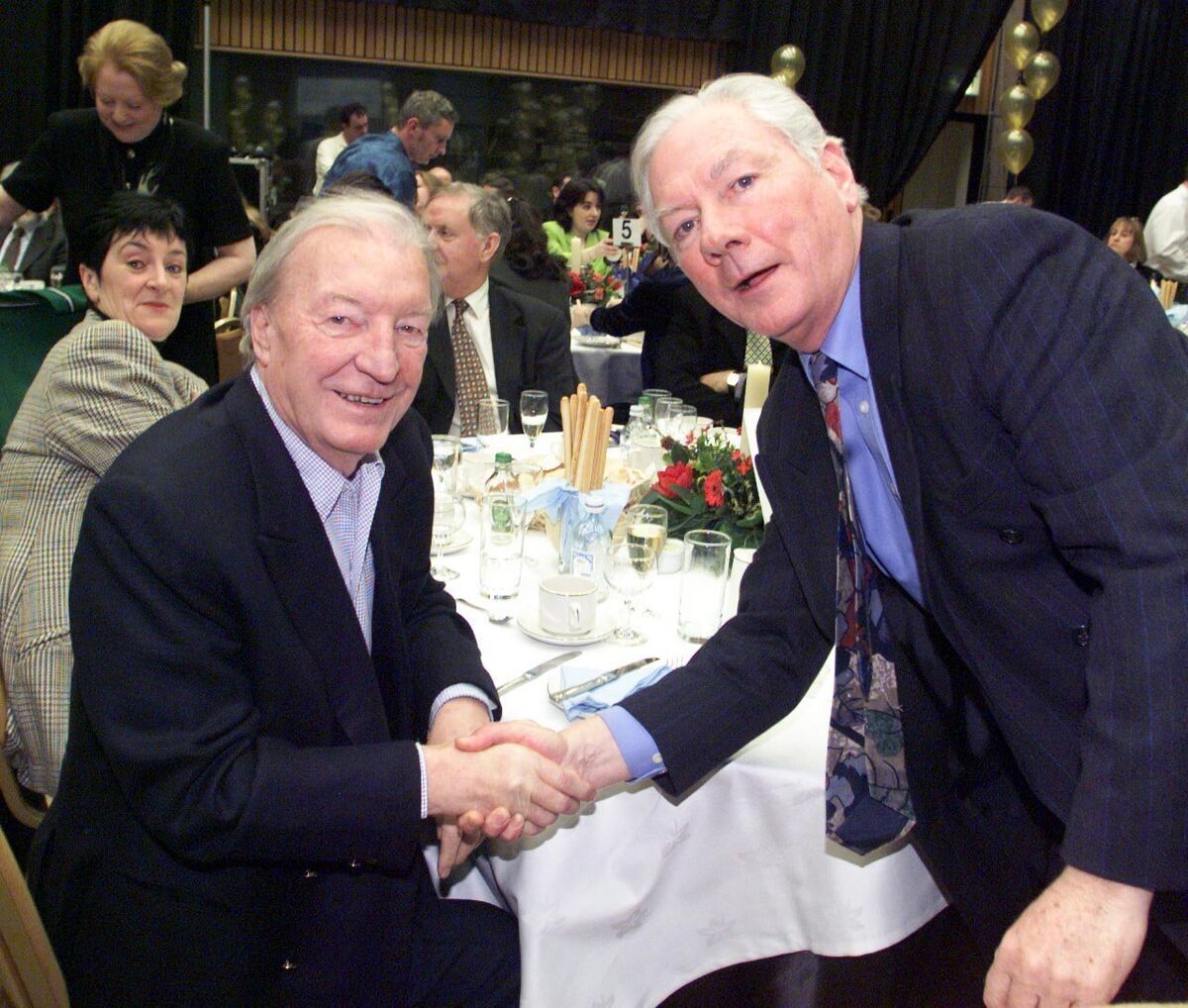
Gay Byrne and Charles Haughey: Shane Ross's book alludes to Gabyo being more of a dyed-in-the-wool Fianna Fail than his reputation suggested. Picture: Billy Higgins
(Ross does produce hitherto unpublished letters from Gay Byrne to Charles Haughey, which tend to support his view of Gaybo as more dyed-in-the-wool Fianna Fáil than had been his reputation.)
Sheehan’s reports, by bringing the changes demanded by Ryan’s lawyers, may not have boosted sales of Saints, Scholar and Scandals, but they certainly created extra interest in Ross’s publication, an instant bestseller, number one in non-fiction in the Irish Times’ ranking, having been published in May.
And — here’s the grim truth of it — anything that drew in more readers for the Ross paperback did Ryan Tubridy no favours.
The reputational impact of the book lies in its structure, evidence, and commentary.
The structure puts Tubridy right up at the beginning and threads him throughout.
The evidence is plentiful, the commentary devastating, leaning, as it does, on a theme of the presenter being limited, self-satisfied, and self-promoting while coping with the advantage of powerful political connections.
It’s logical to figure that Tubridy doing monthly interviews this spring and early summer has to be related to the publication. Those interviews lurch wildly between contradictory statements.
In one, he says he feels he has “hit a nice groove at the moment, so I don’t want to say that I’m missing something. Things are going very well.”
In the same paragraph, he goes on: “In some ways, the biggest insecurity is certainty about the future. I don’t know where it’s going. Workwise, for example, I’m all over the place.”
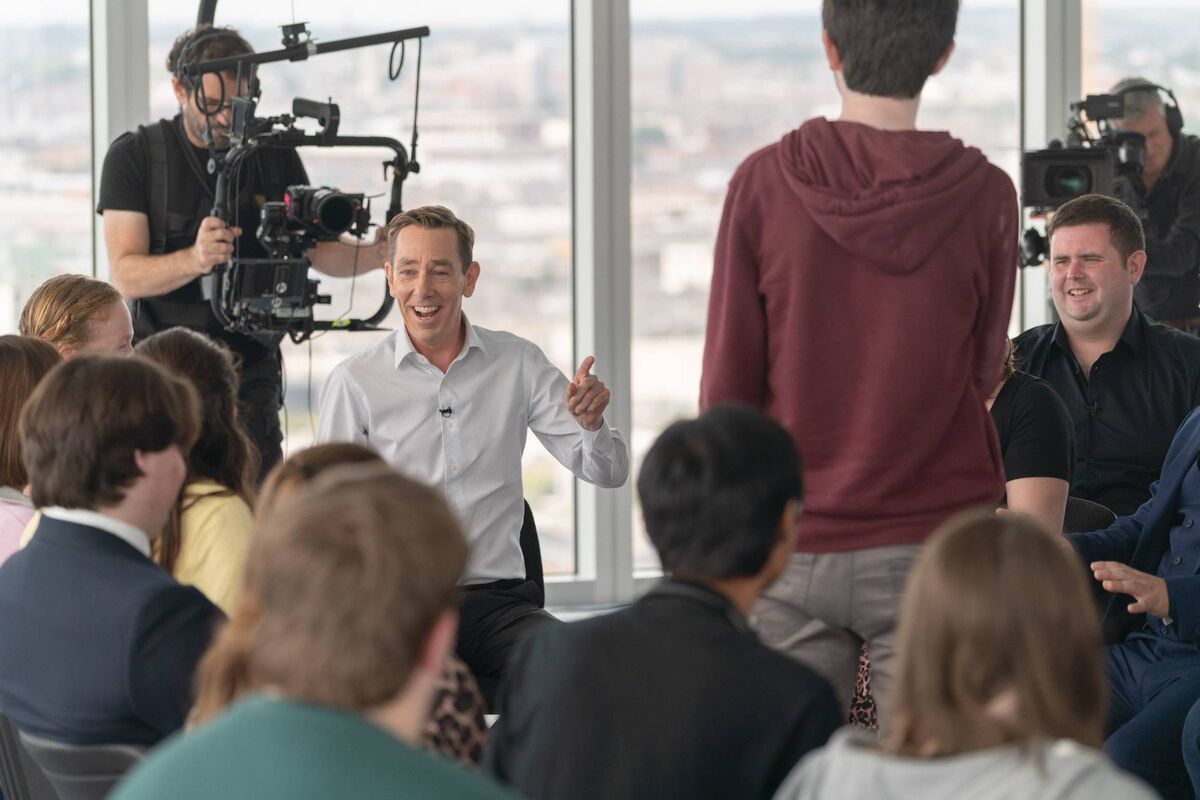
Ryan Tubridy in January recording his episode in Virgin Media Ireland’s series with Muireann O’Connell, ‘The Assembly Ireland’. Picture: Mattia Pelizzari/Kite/VMTV
This is where an external communications adviser would do the halt sign, presenting Tubridy with an upraised flat palm: Hold it, right there.
Such an expert would have to begin by asking questions about the audience and purpose.
Questions that would probe who the broadcaster wanted to reach by participating in the interview, what he wanted them to know about him, and what he hoped they might do as a result.
That’s what public relations is about. It has a purpose. Or should have.
Roll on a month, and another interview with Ryan appears, this one even more untethered from overt purpose.
Unless the purpose was to poke Patrick Kielty in the eye, which, in fairness, is unlikely, given Tubridy’s reputation as a really nice guy.
But the fact is that the big take-away is a portrayal of Kielty as having an easy-peasy job to do compared to the much harder job earlier presenters had.
“It’s a much shorter show, it’s a shorter season,” Tubridy says. “It’s much better for someone to present and it’s a much easier run compared to what it was for Gay, Pat, and myself.”
Essentially, his argument seems to be that if, back in the day, he’d been offered the easier version of the Late, Late Show that Kielty gets to do, he wouldn’t have been so eager to abandon presenting it.
It carries the consequential inference that if Kielty wants out, Tubridy would be happy to return to the show, based on the new contractual context.
To which a number of responses inevitably suggest themselves, the first being to quote Heraclitus that “No man ever steps in the same river twice, for it is not the same river and he is not the same man”.
RTÉ is definitely not the same river, nor Tubridy the same man.
But also, since Tubridy has such faith in his agent, and since that agent carried such heft back in the day within RTÉ, why didn’t his agent negotiate a contract like the one Kielty got?
To portray himself, Gay Byrne, and Pat Kenny as stalwarts presenting a show unchanged until Kielty took over also has to be questioned.
To give just one example, neither Gay nor Pat depended on cue cards to dictate their questioning, as Tubridy did.
The programme was much wider in scope and less predictable with Gay. It would be more accurate to portray the Kielty programme as the inevitable next stop on a road set by Tubridy.
The payments debacle
Ryan Tubridy's unique selling propositions are that he’s a nice guy, he reads books, and he gets along well with famous people.
The problem is that this is simply not enough to sustain several interviews. So he ends up talking about the payments debacle.
Then — as he tells it — he gets reproached by people in the street for doing that, leading to him explaining that he has to answer any question he’s asked.
No, he doesn’t. Not if he’s offering something more compelling than a revisitation of the past. And if he can’t, why do the interview?
The tragedy for Ryan Tubridy is that the controversy may be the most interesting thing about him. The unlearned lesson is that constantly talking in public about it is not serving him well.