Mick Clifford: Pushing fear, inviting anger — How social media outrage outpaced the facts of the Belfast attack
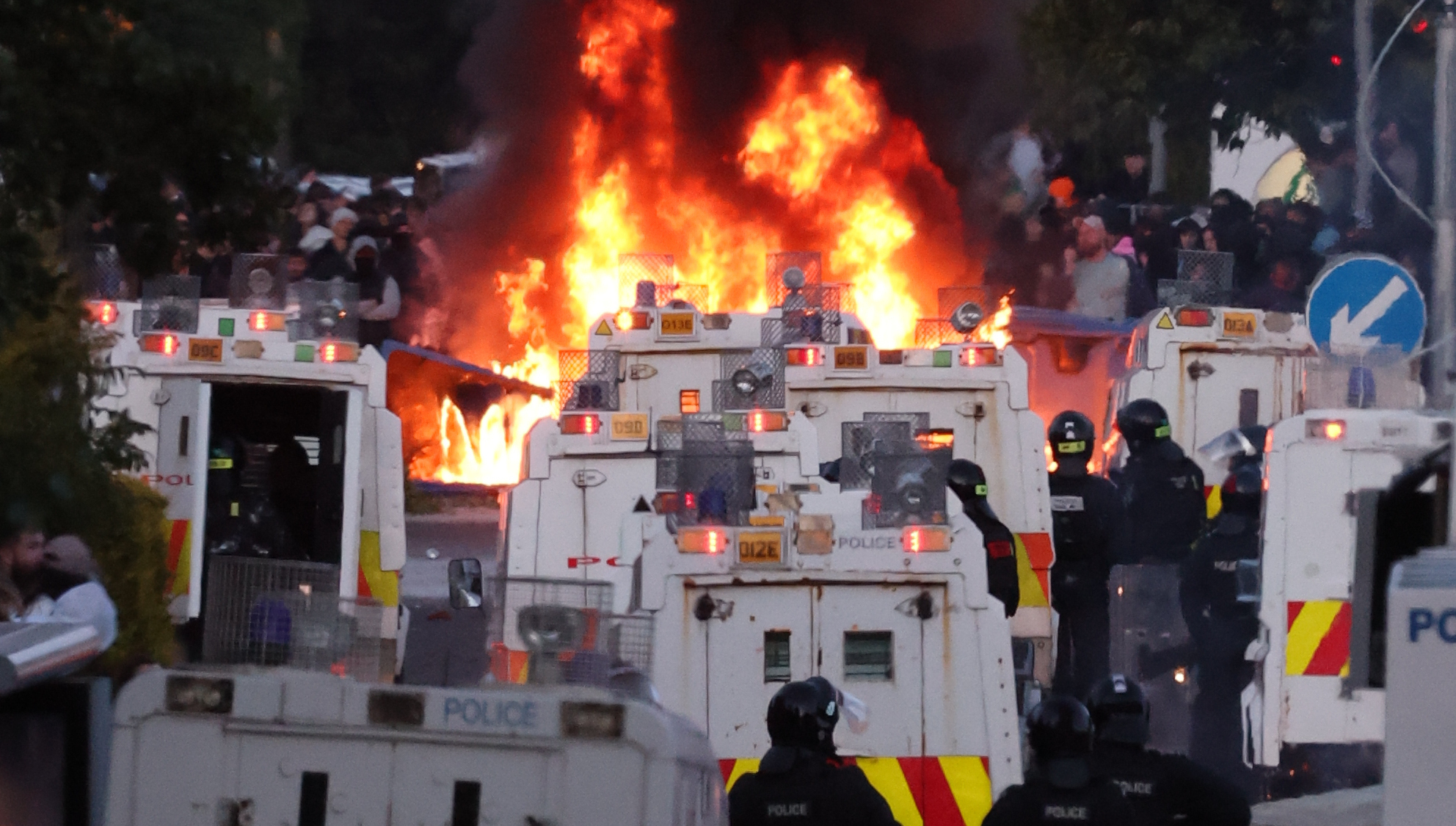
Protesters set fire to a barricade as police block Antrim Road, at the Sandyknowes roundabout in Newtownabbey. Picture: PA

This week a lot of people got highly animated about a violent incident in the North. The reaction, in this jurisdiction and others, largely encouraged people to be angry and suggested, with precious little evidence, that the incident was indicative of this country and the neighbouring jurisdiction both going to hell in a handbasket.
On Monday evening a man was allegedly attacked by a knife-wielding assailant on a street in North Belfast. Some passersby came to his rescue. Others filmed the incident, which appears very often these days to be an instinct that supersedes rushing to help.
The level of alleged violence used appears to have been extreme, even vicious, and the victim was seriously injured. A suspect, who is originally from Sudan, was arrested and later charged with attempted murder.
Read More
On Tuesday, as the news filtered in, some people felt it necessary to give their tuppence worth on this incident. Ken O’Flynn is a TD for Cork North Central. He does not have a long record of interest in affairs north of the border, which might be understandable considering Belfast is 420km from Cork.
This is what he tweeted on Tuesday.
“I am horrified by the attack which took place in Belfast last night. The video footage circulating online appears to show an attempted beheading. If confirmed, this represents an act of barbaric violence that has no place anywhere in Ireland.”
“This is not an isolated concern,” he went on, pointing out that in 2022 “a man was beheaded in Sligo.”
He also referenced recent violence on the streets of Dublin and signed off by noting that his thoughts were with the family of the victim and emergency responders.
Other politicians posted on social media on Monday to ask for calm ahead of what was expected to be a night of violence. Deputy O’Flynn didn’t go down that route — and why would he? — as he is not a public representative in the North. In fact, one might wonder what exactly the purpose of his social media post was and what he hoped to contribute to the prevailing situation by posting at that time.
On the same day, O’Flynn’s party colleague Michael Collins was on his feet in the Dáil to mention the EU migration and asylum pact, which he opposes.
“We need an urgent debate in the Dáil as there is a national outcry against this,” he said. In reality, you’d be hard pressed to find somebody who knows what the specifics of the pact are, not to mind what within is prompting a national outcry. But obviously Deputy Collins is outraged at something to do with immigrants and his party’s social media feed no doubt conveyed that.
Meanwhile, back at the immigrant issue de jour, the vicious attack in Belfast and another to throw his tuppence worth onto X was businessman Declan Ganley.
“I’m hearing things are going to ‘kick off’ in Belfast tonight, not really surprising,” he tweeted. He went on to heavily criticise the political system and policies on immigration.
“Government don’t yet seem to be fully cognisant of how much of a powder keg they have put under their own societies. Very few people voted for this.”
His statement about voting is curious. The last vote in this state on executive power was the 2024 general election. The exit poll in that election found that immigration was an issue for just 6% of voters.
The last full year for figures for immigration into this state, recorded by the CSO, found that there was a fall of 16% of arrivals to 125,600. In terms of asylum seekers, there was an even bigger fall or around 30% to just under 13,000.
If there was concern among 6% of voters about immigration in November 2024, and numbers have shown a steep drop in arrivals since, it might follow that concerns are being eased.
The businessman was, however, entirely correct in his prediction that things would “kick off” in Belfast that night. Families were burnt out of their homes. Men, women and children, including a baby, had to be rescued by the police from the possibility of being assaulted or worse. A bus was set alight and other fires were started in a spate of violence predominantly perpetrated in loyalist bastions of the city.
O’Flynn and Ganley were just two of a whole army of people who felt compelled to give their opinion on what had occurred, what was coming and what it all said about wider society and politics.
Further afield, the incident attracted online comments way out on the far right of the spectrum, from English activist Tommy Robinson — who for some reason doesn’t go by his real name — and Elon Musk. Between it all, a casual peruser of a platform like X might have come away angry and convinced that this violent incident is an exemplar of what is wrong with much of the modern world today.
On British TV channels a preponderance of English men, and the odd English woman, sat around and wondered what was wrong with the Irish, or the Northern Irish as they were referenced.
One topic was the common travel area. The suspect had landed in Dublin and travelled north where he was granted temporary asylum. Was Ireland now a gateway for maurading immigrants to enter the United Kingdom?
In reality, the bulk of evidence suggests that that common travel area is facilitating asylum seekers to come to the Republic through the North.
The whole outpouring of often extreme emotion removed from facts is a vignette of how some want to discuss the issue of immigration these days.
Right now, there are issues around immigration that should be aired. There are concerns, some valid, others induced through the spreading of misinformation, that should be addressed. There is a case to examine fully how this country deals with immigration, particularly as it pertains to work and student visas, the needs of the economy right now and the needs of society as the native population ages.
There are also myths and lines that are spread about the asylum seeker process which should be examined. But in the overall context of immigration this cohort represents a tiny proportion of people entering the country despite the impression conveyed on social media.
Instead of rational debate we get the kind of reaction that was prevalent this week, pushing fear, inviting anger, treating a random incident of violence as exhibit A for the case that the country is gone to pot and the only people who can rescue it are those who are screaming get them out.
This “common sense” brand of politics is much further down the line in the UK and the USA. Has anybody checked of late how they are doing socially and economically?
CONNECT WITH US TODAY



Be the first to know the latest news and updates