Clodagh Finn: The artist who went to the Aran islands on holiday and stayed eight years

Elizabeth Rivers illustrated for Frank O’Connor and the Yeats sisters; worked with her dear friend stained-glass artist Evie Hone; helped found the Graphic Studio Dublin, and championed Aran handcrafts through The Country Shop, Muriel Gahan’s famous outlet in the capital city.

I love a story of a haunting and this one begins with a conversation by the frozen-food section in Spar on the Aran Islands, followed by the delivery of a fish tub full of forgotten papers.
More documents would later be spirited out of their hiding places — a toolshed in Cornwall and a garage in San Francisco — to make their way to Miriam O’Neal, writer and poet laureate of Plymouth, Massachusetts, who drew on them to write a book and inspire the conference on modernist artist Elizabeth Rivers which is taking place on Inis Mór next week.
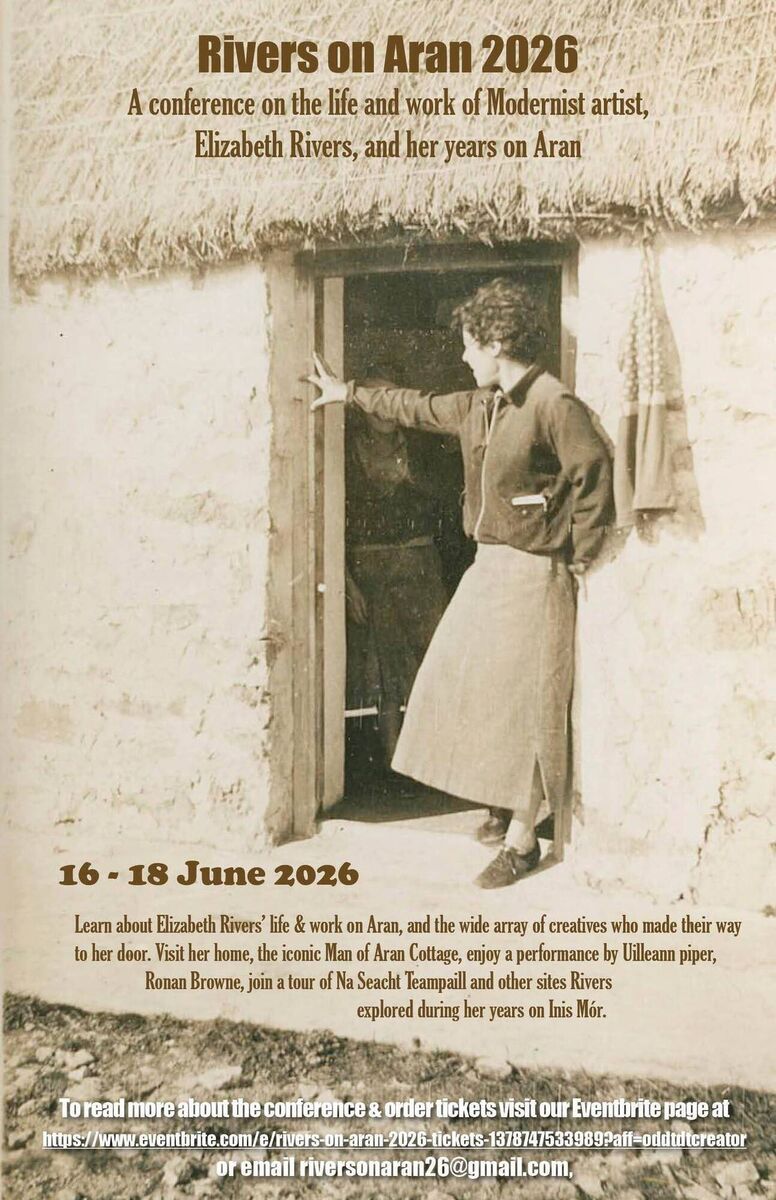
‘Rivers on Aran’ is a three-day celebration of the influence of the islands on Elizabeth Rivers, an artist who, among many other things, illustrated for Frank O’Connor and the Yeats sisters; worked with her dear friend stained-glass artist Evie Hone; helped found the Graphic Studio Dublin, and championed Aran handcrafts through The Country Shop, Muriel Gahan’s famous outlet in the capital city.
Elizabeth ‘Betty’ Joyce Rivers was born in Hertfordshire, in the UK, in 1903 and she might well have pursued her career there, or in Paris where she studied under Cubist painter André Lhote, if she had not seen a film that would change the direction of her life.
In 1934, she saw Robert Flaherty’s 1934 film and was so moved by it that she decided to go to see the island for herself.
When she arrived in 1935, she planned to stay just three months but her holiday turned into an eight-year artistic adventure that resulted in a series of oil paintings, watercolours, wood-engravings and three books, including Stranger in Aran (1946).
She learned Irish, worked on the land and, co-incidentally, lodged in the very cottage built for where she helped fellow artist Amy Elton run a B&B to make some money.
Miriam O’Neal came across Elizabeth Rivers quite by accident in March 2020. The writing workshop she was to give with her cousin Mary Ryan didn’t work out and one day, in the frozen-food aisle, she bumped into a descendant of Pat Mullen, the Aran islander enlisted to be assistant director on .
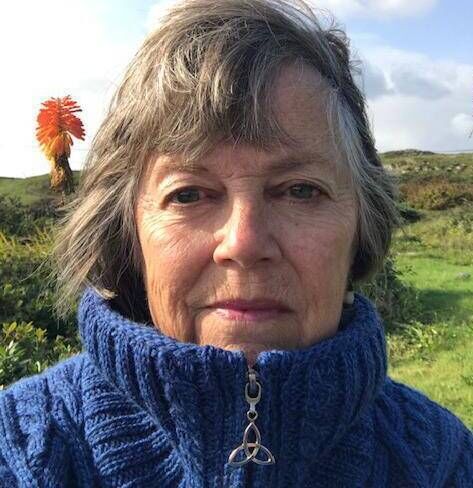
That person later delivered the aforementioned fish tub of documents.
“As I sifted through the papers belonging to another long-time resident of Inis Mór [Mullen], a sketch of an aged, gaunt-faced man with a dark-eyed gaze caught my eye. In the lower right corner, I could make out the signature, ‘E. Rivers’.”
Elizabeth Rivers has lived in Miriam O’Neal’s head ever since. “She has been my personal haunt for almost five years.”
There is a pleasing symmetry about the discovery. Like her subject, O’Neal came to Aran for a short time, never imagining that a woman who had done the same thing but ended up staying for years would draw her back to the island in much the same way.
Next week’s conference from June 16 to 18 is proof of that. It draws together a range of people — poets, artists, musicians, historians and descendants of some of Rivers’ closest friends — who will gather to celebrate the artist.
Two unpublished memoirs gifted to Miriam O’Neal offer new perspectives. They were written by women who stayed with Rivers in her cottage, one by the very person who persuaded her to visit in the first place.
And, thanks to a bit of welcome serendipity, where one memoir ends (September 29, 1936), the second one begins.
If Elizabeth Rivers is not as well-known as she deserves to be today — though that is changing — she attracted considerable attention, and praise, in her lifetime.
In the spring of 1936, her Aran work was exhibited at Daniel Egan’s Gallery in Dublin alongside some of the hand-sculpted dolls representing the people of Aran made by Violet M Powell.
On May 12, 1936, the reviewer noted: “Twelve scenes from the life of the people of Aran were reproduced as models by Miss Powell, the clothes and props being supplied by the islanders and the sets made by Elizabeth Rivers... One of the most pleasant from the point of view of composition was ‘Fireside Gossip’, where colours are happily blended."
The reviewer thought Rivers’ engravings admirable, showing “able craftsmanship”, but dismissed her chalk drawings as “crude and loosely constructed”. The exhibition, though, was a success and it firmly established Elizabeth Rivers in the Irish Modern Art scene.
O’Neal explains: “Her style was modernist, but her subject matter was the spaces and people around her… the islands came alive on paper. There were pencil drawings like and capturing a sense of her neighbours’ daily life.”
Indeed, she captured the essence of daily life so well that her friends said she was turning into an islander herself.
As artist and art historian Mary Stratton-Ryan writes in the current issue of : “According to her visiting friends, Rivers had ‘gone native’ in everything but dress.
"Apparently her habit of wearing trousers and hosting céilithe resulted in chastisement from the local clergyman, who wanted her off the island. She persisted in staying. In time, her persecutor turned his attention to other matters, namely the censorship of unsuitable books.”
Stratton-Ryan also notes that Seán O’Faoláin, whose book was the second of his to be banned in 1936, had stayed with Elizabeth on Aran.
Even before Elizabeth Rivers came to Ireland, she had made connections with other Irish artists. She met Norah McGuinness in London in 1934 when she joined the avant-garde Twenties Group. Like Evie Hone, Rivers had studied in Paris with André Lhote though later, in 1931.
Later again, the two artists became firm friends. She collaborated with Hone for nearly a decade, from 1946 to 1955, working her inch-designs up to full-scale, and later working in stained glass herself.
In the interim, in 1942, Elizabeth went back to London during the Blitz to work as a fire warden. The political events of the world were everyone’s business, she said: “I have no belief that artists are separate people who should sit aside and nourish their souls.”
She returned to Dublin after the war where she continued to paint, drawing inspiration from her time on Aran.
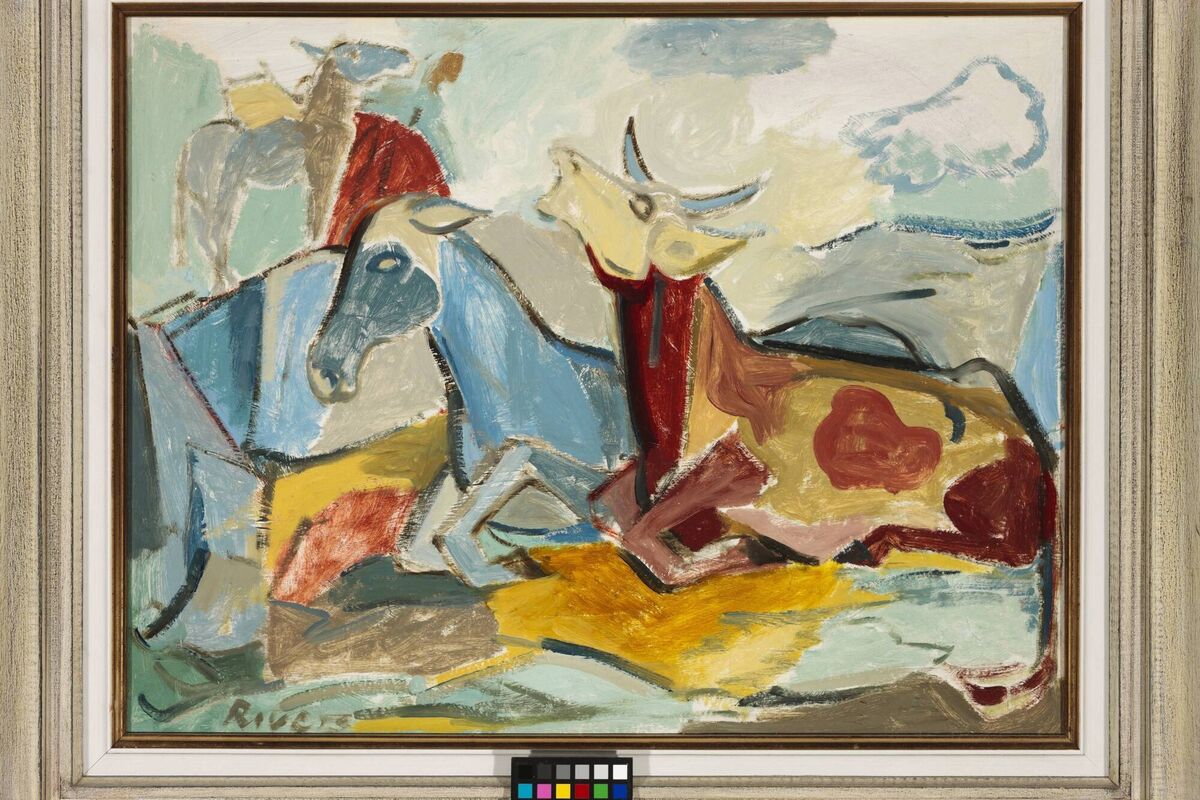
Miriam O’Neal explains: “Years after Elizabeth Rivers had left Aran and settled in Dublin, the colours, lines, and gestures of her Aran work would continue to inflect her work. Her ‘Aran Landscape’ c. 1955 [now in the Irish Museum of Modern Art (IMMA) and kindly reproduced here thanks to the Elizabeth Rivers Estate], is modernist in style, but representational as well.
“Aran’s animal world is caught in action as a cow, bound for market and in full gallop along the strand, passes a startled horse while a woman in traditional Aran dress watches the scene from above beside her panniered donkey.”
Rivers’ work was regularly shown around Dublin. There were six solo exhibitions between 1942 and 1960. Two years after she died, in 1964, the Municipal Gallery of Modern Art (now the Hugh Lane) held a memorial exhibition.
Her archive is in the National Library of Ireland while her work is in IMMA, the Ulster Museum and the British Museum. And now, with next week’s conference, her spirit is back on Aran.
Miriam O’Neal is completing final edits on her manuscript, .
Next year, another exhibition, ‘Elizabeth Rivers in Black and White’, will open at the National Print Museum, Dublin, on January 21, 2027, with a symposium on the artist in Trinity College planned for that afternoon.
CONNECT WITH US TODAY



Be the first to know the latest news and updates