Mick Clifford: Gerry Adams case shows how Sinn Féin still differs from other parties
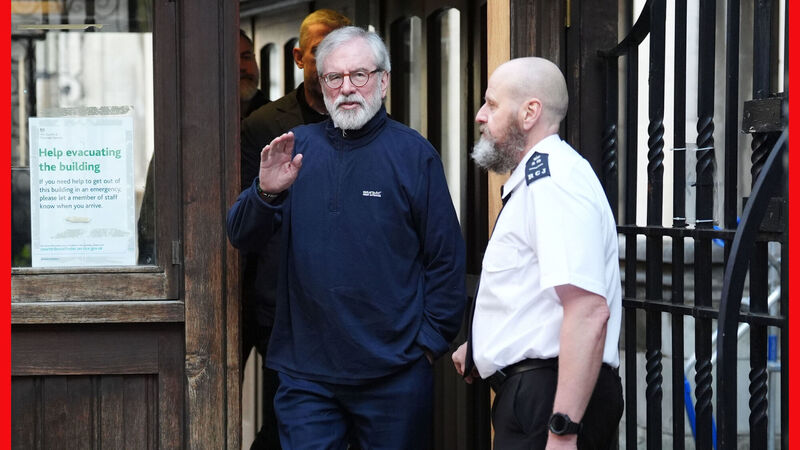
Former Sinn Féin president Gerry Adams (left) outside the Royal Courts of Justice in central London on Thursday. He was as steady as ever in the witness stand. Picture: Jonathan Brady/PA Wire

THE Gerry Adams civil case that collapsed yesterday shone a light on the past and another on the present.
On a number of occasions during the hearing, John Finucane stood outside the Royal Courts of Justice building in London commenting on the plaintiffs’ case. He was one of a clutch of Sinn Féin representatives who did so.
Finucane is an MP for North Belfast. He is also a solicitor. In some respects, he represents the new face of his party: Young, well-educated, and yet rooted in his community, no personal connection to the past when the party was an adjunct to the Provisional IRA.
Finucane had earlier been attending the hearing inside in which three men were pursuing a declaration that Gerry Adams was a senior member of the IRA involved in bombings in Britain.
Adams is 77, a Sinn Féin veteran who retired as leader in 2017.
Read More
Some claim that the party is a form of a cult built around him. He has always denied ever having been a member of the IRA.
The action was brought by John Clark, a victim of the Old Bailey bomb in 1973, and Jonathan Ganesh and Barry Laycock, who were injured in the 1996 attacks in London’s Docklands and at Manchester’s Arndale shopping centre respectively.
Here’s what Finucane said outside the court last Monday: “Once again, the witnesses called today were unable to provide any direct first-hand evidence linking Gerry Adams to the three bomb attacks at the centre of this case. What the court heard instead was a mixture of opinion, rumour, and hearsay.”
Like the three plaintiffs, Finucane is a victim of the conflict in the North.
In 1989, loyalist killers burst into the family home in Belfast and shot dead John’s father, Pat Finucane.
The murder had all the hallmarks of collusion between British security services and loyalists. After years of campaigning, the Finucane family finally achieved their aim of having a public inquiry into the murder. It is due to start this year.
The Finucane family’s pursuit of the truth has been admirable, relentless, and exhaustive. They deserve justice.
But what of the three British people, ordinary working men who had no role in the conflict, who were just in the wrong place at the wrong time as IRA bombs blew up in pursuit of something or other. Are they not as entitled to justice as anyone else?
They believe that Gerry Adams was a central figure in the organisation that planted the bombs. That is not a controversial or fantastical position, notwithstanding Adams’s denials. They are entitled to pursue justice through the legal system.
Yet Finucane, in his role as a Sinn Féin MP, attempted to take charge of the narrative outside the court — or at least the perception of it — because it involves impinging on a version of the past his party wants to maintain.
Is it the approach of Sinn Féin that justice must be attained for those who were victims of the British state but for the mostly innocent victims of the IRA, there can be sympathy, but not justice especially if that impacts the party’s carefully curated version of what went on?
Apart from highlighting once again the selective approach to victims and justice, the case has shone a light on how Sinn Féin today still differs from other political parties.
Why should it matter to a modern political party whether its former president is deemed to have been a member of an organisation he made no bones about supporting?
The issue is hardly one exercising the voters in constituencies such as Finucane’s North Belfast. For instance, he would not have got elected there back in the day when the IRA were attempting to kill their way to a united Ireland.
Prior to 1997, when there was a ceasefire in place, the only MP elected for the party was Gerry Adams in West Belfast. He lost his seat in the 1992 election, after holding it for nearly a decade.
There were four SDLP candidates elected in 1992, the last election before ceasefires kicked in, demonstrating that electorally the vast majority of the nationalist community did not support the violence of the IRA.
So it’s not as if great swathes of the Sinn Féin electorate today are mad anxious that Adams be retrospectively cleared of association with the Provos.
Yet the party went all out over the course of the trial to undermine the case of three innocent victims. The whole approach, including issuing press releases about the evidence, certainly gives ballast to the theory that it behaves as some form of a cult in thrall to Gerry Adams and a few of his kindred spirits.
There is no other explanation as to why it got so caught up in a trial that means next to nothing to the vast majority of its electorate today.
The evidence heard over the course of the trial was entirely circumstantial, reliant on individuals who had knowledge of the conflict and its main players.
ADAMS himself was as steady as ever in the witness stand. His denials, particularly about his former pal Brendan Hughes, will have annoyed some from his generation in Belfast.
On Thursday, Adams met the media outside, noting without a hint of irony that he was restricted about what he could say. This is despite what Sinn Féin MPs had been saying from the same spot over the course of the trial.
“I will limit myself to reminding you that Irish people have long had a bad experience in British courts, Irish republicans especially,” he said.
All neatly done. If the judge ruled against him, he would once more be a victim. If the case went his way, he would have achieved justice despite everything, the cult hero smiting all the dark forces which would attempt to lay him low.
About as selective as it’s possible to get.
As it was to turn out yesterday, British justice did deliver for the former Sinn Féin leader.The case was dropped by the three claimants.
The hero skips free from what was a highly illuminating, if flawed, exercise over the last couple of weeks. A court will not now determine whether Adams was or was not a senior figure in the Provisional IRA.
As for the real victims, the plaintiffs whose lives, along with thousands of others, were simply collateral damage to the pursuit of a cause that could never be achieved?
They, it would appear, are mere footnotes entitled to sympathy but nothing more in their pursuit of justice.
CONNECT WITH US TODAY



Be the first to know the latest news and updates