Fergus Finlay: One thing I've learned is that life is about making the most of what you've got

Mandy Finlay as a child. It’s hard to describe how little support there was for babies with Downs syndrome and their families back then.

I’m writing on what I always refer to as my wife’s wedding anniversary. I learned an invaluable life lesson, which I’m happy to share, on her first anniversary. Because they were all the rage at the time (I thought) I gave her an electric carving knife. If you’ve ever been chased down the street by a woman with an electric carving knife, it will teach you to take romance more seriously.
I survived that, and I must have learned, because now it’s her 53rd anniversary. Yes, ok, I know it’s mine too. But I’ve always felt the lucky one. I know if you were talking to Frieda now, she would — as kindly and gently as possible — refer to me still as a work in progress. I’m a task, a job of improvement that will never end. She’s just one of those people who never gives up.
This is not a column about Frieda. I’ve written them before and I will again. All I’ll say is that she knows that she’s the single most important person in my life and that nothing would have been the same, or nearly as worthwhile, without her.
But 53 years is worth celebrating and reflecting on, surely? Apart from anything else, an awful lot has changed in the world around us in that time (although a couple of things really haven’t). We’ve had friendships that have survived all those years, and newer friends, and we’ve mourned friends that are gone.
We’ve had a wonderful family — four magnificent daughters and seven grandchildren, not to mention the odd son-in-law (they’re all a bit odd, actually), and they’re all still talking to us. We’ve had holidays, travels, adventures and crises. (I said I wouldn’t mention Frieda again but she’s much better in a family crisis than I am.)
In our first year together, we lived in the abject poverty of unemployment and yet in idyllic surroundings, in a stable at the back of a big house in Bray.
When we weren’t having parties on the croquet lawn (yes) we scratched a living producing a children’s crossword for an English syndicate. Each crossword had about 12 simple-ish answers, and the clues were all pictures. Frieda did the pictures and I did the words. She had the harder task — there’s an awful lot of children’s words, like sad or fear or love, that are much more difficult to suggest in a picture.
And then we had a Down syndrome baby — or Mongoloid, as she was called in 1973.
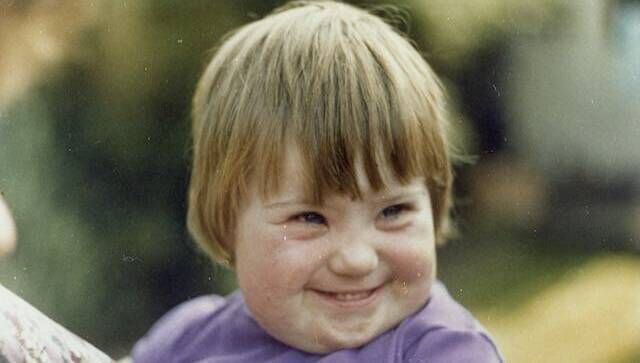
Mandy’s arrival was a turning point. That weekend should have been a big change in more ways than one, because I was supposed to start a new job the following Monday, after months of living on our wits and playing croquet.
I was going to fulfil a life ambition by starting work with the famous Workers Union of Ireland, founded in the years after the Dublin Lock-out by the great Jim Larkin — Big Jim, as he was known. I had been through a very rigorous interview process presided over by Denis Larkin, the son of the great man. And now I needed to postpone the start of my illustrious career.
But when I was taken to Denis Larkin’s office on the Monday morning and explained the situation, he was adamant. “You have to start today,” he growled [Denis growled a lot], “there are members waiting, cases waiting. We’ve finished the recruitment. You owe it to us to start today”.
Again I tried to explain what we’d been through over the weekend and how my wife and I needed some time to come to terms with everything Mandy’s arrival meant. But he was implacable. “I want you started today,” he kept saying. “No excuses.”
I lost my temper. Trembling in rage (and not a little fear) I told him that in those circumstances I was going to have to tell him where to put the job I had wanted since my teens. I put it much more rudely than that. As I got to my feet, he gave a big smile.
“Sit down there, you eejit, and let me write something.” He took something out of his drawer, wrote on it, and handed it to me. It was a cheque. And it was for the equivalent of two week’s pay.
“You’re on salary now,” he said, “and you are under instruction from me to take two week’s paid leave starting immediately. Look after that wife and baby of yours, and if you need more time come back and talk to me.”
As I reached the door, knowing in my heart I would forever walk into the fire for this man, he stopped me. “One more thing,” he said, “good negotiators never need to lose their temper or use four-letter words.”
That was our first year — marriage, baby, job. And disability. It’s hard to describe how little support there was for babies with Down syndrome and their families back then. The medical profession was almost universally dismissive of their potential, the education system wanted nothing to do with them, almost every available service was one that had been started by parents themselves. (Later, many of them were taken over by religious orders and became both rich on public funds, and utterly remote and bureaucratic.)
Later, Frieda was to meet a professional in the field who responded to Frieda’s assertions about Mandy’s potential with “some mothers get notions”.
Experience was the reason we both ultimately became disability advocates and campaigners. And things are a bit better now for people with disabilities — but only relatively. Uniquely, people with disabilities in Ireland are the only Irish citizens with no effective rights whatever. If you want to give me an argument about that, bring it on.
Fifty three anniversaries and 52 birthdays later, Mandy is her own woman, and the credit for that goes to her and her mother. This year, like most years, she’ll celebrate the anniversary with us. Most years, there’s hardly time, because Christmas is upon us and there’s not a child in the house washed.
It probably wasn’t the best idea to get married in Christmas week. But if I’ve discovered one thing over the years, it’s that there may not be a lot of point in trying to plan your life out.
I learned it as a trade union official, in the political world, and from the brilliant people I worked with in Barnardos. It’s not always about how you build a plan. But it is always about how you make the most of what you’ve got.
That’s what we learn from Christmas too, at least in our house. We worry and we fret and there isn’t going to be enough and who have we forgotten? And then it’s here and there’s excitement and laughter and we’re together again. As I really really hope you will be this Christmas too.
CONNECT WITH US TODAY



Be the first to know the latest news and updates