Terry Prone: Average-looking women must work twice as hard to be successful
Kim Kardashian on Wednesday shared photos and video of what appeared to be a backyard graduation ceremony.

Two photographs. One showing the woman holding a legal certificate. The other showing her with a red circle superimposed on her hairline as if made by a Sharpie. The first establishing that she has passed America’s Multistate Professional Responsibility Examination and can move forward to becoming a lawyer like her father was. The second suggesting, without comment from her, that she’s had cosmetic surgery which has left her looking younger.
You can figure that the more popular picture is not the one of Kim Kardashian celebrating her completion of the apprenticeship programme which gives her a legal qualification even though she did not graduate from college. No. It’s the one with the red circle. The exciting possibility of her having “had work done” outweighs mastering the law. Kardashian has never been famous for achieving stuff, enthusiastic and proud as she may be over getting through this programme, which is rare among American states, even if it took her two years longer than planned.
“The journey is real and so is the accomplishment,” she somewhat prissily stated. She may well be right. But why do we know about her apprenticeship at all? We know because she is world famous for her looks. Full stop. Not only is she world famous, she’s filthy rich. Not because of anything she has ever achieved, but because she is beautiful and has monetized her outsized rear end. That’s it. We’re not saying she is not willing to do the intellectual hard yards. That would not be fair to her, although we doubt she gets to be bothered by a column in the .
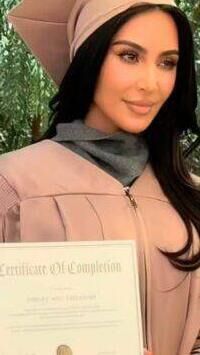
Being fair to her, we acknowledge that she has now proven she can work at something other than being beautiful, coming from a famous family and mating with other famous, if severely weird husbands, to one of whom she was married for around 70 days. But that’s a side issue.
As is the work capacity of thousands of influencers. They’re not regnant because they work hard. Most of them have achieved their influencer niche because they’re good-looking.
That wasn’t what was envisaged when feminism took off in the 1970s. Many of the instructive influencers of the time truly hated what Betty Friedan called , starring the wasp-waisted, perky-boobed little wives of the ads of the 1950s and 1960s, pictured in full-skirted delight at the very prospect of wielding a hoover on whatever dust might have settled overnight in their pristine homes.
The women driving feminism in the latter half of the twentieth century condemned any emphasis on appearance and rejected the idea that you had to be pretty to succeed. But here’s the thing. Rejecting an idea doesn’t mean the idea goes off into a corner where it curls up and dies.
Instead of writing columns (as I did in the 80s) condemning the moral and employment judgements made against overweight or unattractive women, we should, of course, have positioned this as a human rights issue and ensured that auditions and job interviews were “blind,” so that the appearance of the actor or job applicant could not influence the interviewers or producers.
Instead, over time, the looks issue boiled down to eye-rolling when someone compliments a little girl on how pretty they are or tells a colleague or friend that they look gorgeous. It’s a particularly unproductive form of censorship based on reversing the “if you see it, you can be it” theory. The reverse theory is that if you don’t hear it said, it can’t be real. Which, combined with the body positivity movement and MeToo, should mean that women can be successful without reference to their appearance.
Who are we kidding? Women who don’t look good can be successful. Of course they can — as long as they work twice as hard as everybody else and have twice as many brain cells. Bosses maintain that looks never influence their choices at all, at all, but evidence has repeatedly emerged identifying a striking link between career success and being physically attractive. It’s got its own title, and all: The Pretty Privilege.
In January of this year, for example, researchers from the Institute for Operations Research and the Management Sciences in Baltimore, USA, analysed the careers of more than 40,000 graduates who’d done MBAs. They found the Pretty Privilege in play, big-time, at all stages in the careers of the 40,000.
The professor who led the study didn’t put a tooth in it, claiming that, “Appearance shapes not just the start of a career, but its trajectory over decades. These findings reveal a persistent and compounding effect of beauty in professional settings.” In other words, not only were the more attractive job seekers more likely to get the jobs they wanted, they were also paid more than 10% more than colleagues who didn’t compete in the looks department and were more likely to be promoted. Game, set and match to the lookers. Doesn’t look like the enlightened frowning at eejits who tell first holy communicants that they look like princesses is having much effect, does it?
I’m not saying we shouldn’t dial down on the gratuitous complimenting of women, young and old, on their appearance. What I am saying is that we shouldn’t fool ourselves that such well-meaning semi-censorship achieves anything significant. Good-looking people have always been favoured by life, although few so floridly as Kim Kardashian.
One résumé-building firm, StandOut CV, says conventionally attractive employees can earn markedly more than their average-looking peers. This piece of research may not be deep science, but it’s relevant, all the same.
“We asked respondents to rate how conventionally attractive they are and compared this to how successful they are, to find out how far looks (or body confidence) really does impact your career,” researchers from the company say.
“Not only are attractive people treated preferentially, but those deemed less attractive are actively disfavored.”
We cannot be shocked by this when the US President repeatedly makes reference to the appearance of women and employs women who look alike in their slender long-haired pulchritude. We should not behave as if we’re helpless in the face of social media persuading children before their teens that they need moisturiser and to lose weight to fit into the model of what is acceptable.
The fifties model of the acceptable woman was limited and limiting.
But probably not as limited and limiting as the current one.
CONNECT WITH US TODAY



Be the first to know the latest news and updates