Joe Leogue: Over a decade on, ill air corps technicians still await a fair hearing
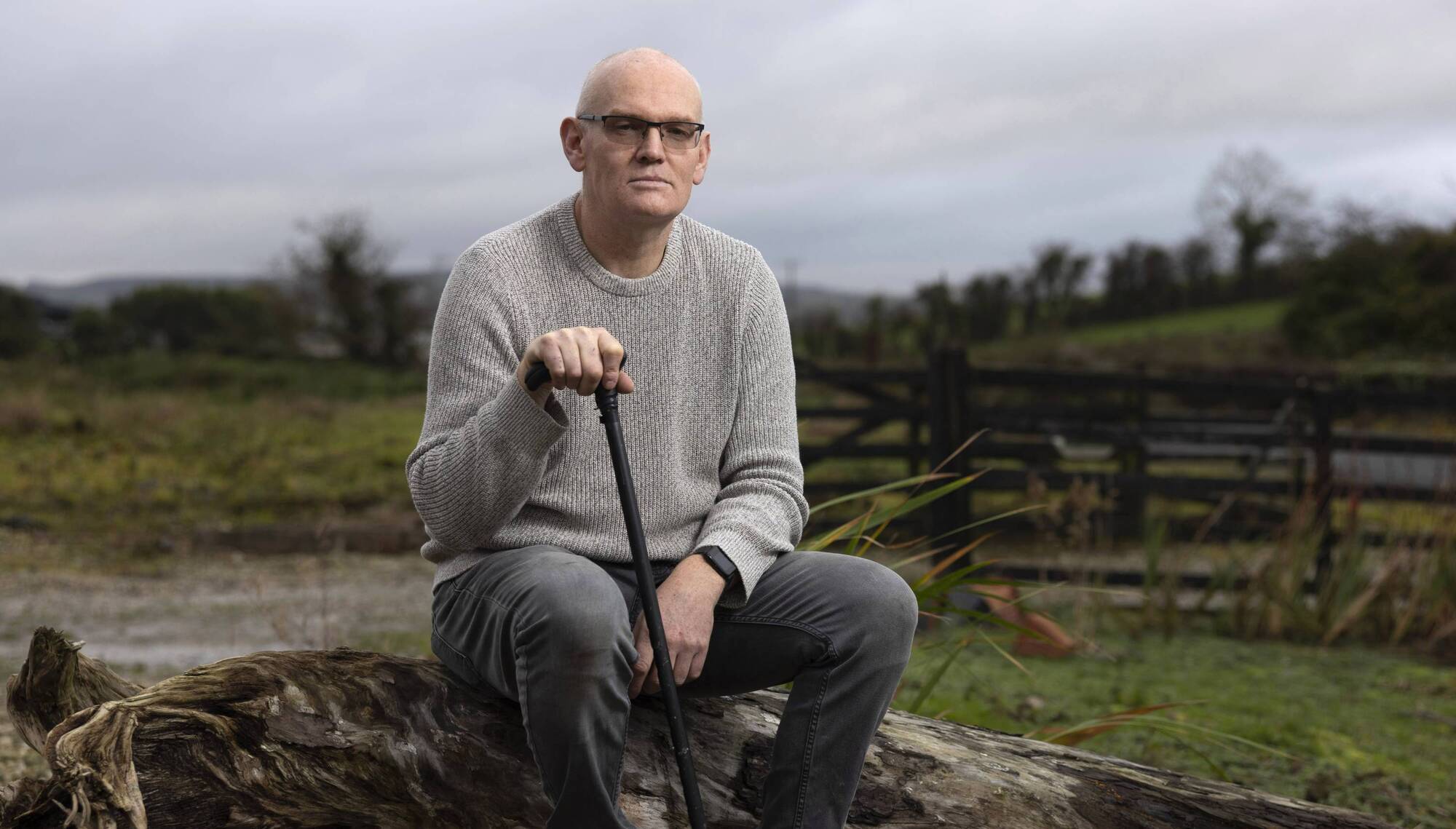
Ex-air corps member Gary Coll from Lifford, Co. Donegal. The State has agreed to pay €2 million to the former air corps technician. Picture: Joe Dunne
A settlement on the steps of a court usually marks the conclusion of a dispute — however, the reported €2m payout to Defence Forces mechanic Gary Coll on Wednesday is but another development in a bitter dispute between the State and former air corps technicians that has raged on for over a decade.
Mr Coll settled his High Court action against the State having alleged he was exposed to various dangerous chemicals while he worked at Casement Aerodrome in Baldonnel, Dublin. The settlement was made without an admission of liability. The State contended it provided a safe workplace at Casement, and did not allow inappropriate work practices there.
The settlement is a milestone in an ongoing saga that is complex, but at its core comes down to two simple, related, questions; did the State fail in its duty to protect scores of Defence Forces staff from the impact of harmful chemicals, and were there attempts to cover this up?
Mr Coll’s case was the first of 10 such legal actions to come to an end, with all 10 cases bearing similar complaints. The first legal claims were lodged with the High Court in 2013, and all litigants worked in repair and service workshops based in Casement Aerodrome.
All 10 say that they suffered chronic conditions including cancer and neurological problems as a direct result of their exposure to the chemicals with which they came into contact as part of their duties when servicing air corps vehicles.
Furthermore, they allege that not only did the Defence Forces fail to fulfill basic health and safety obligations, but that senior officials turned a blind eye to initiation rituals that saw new recruits doused in these dangerous substances in a practice called ‘tubbing’.
There are claims that the implications of this extend beyond the 10 litigants. One of the 10, Gavin Tobin, claims his research has found scores of illnesses and deaths among former air corps staff that could be attributed to chemical exposure, and need to be investigated.
There are international precedents for the links between aircraft maintenance and chronic illnesses. In Australia, for example, the state has paid out tens of millions of dollars in compensation and established healthcare screening programmes to workers who performed maintenance on the Royal Australian Air Force’s F111 bombers.
Here in Ireland, running in parallel to these legal actions, has been a process that began with allegations from three different whistleblowers and now sits with a tribunal of inquiry.
In addition to the claims heard in court, those submitting protected disclosures claim there was an ongoing effort to cover up the air corps’ failure to provide a safe working environment.
The whistleblowers’ submissions began in November 2015. They alleged that staff working with dangerous chemicals were not being provided with Occupational Health Surveillance — something that is required by law and would pick up, at an early stage, whether staff health is being affected by their exposure to these substances during their work.
There were further allegations of a failure to provide staff with basic personal protection equipment (PPE), and one whistleblower claimed he was being targeted within the air corps for raising concerns.
These whistleblowers also complained to the Health and Safety Authority. The HSA investigated, and subsequently issued the air corps with a report outlining 13 recommendations on necessary health and safety measures required at Baldonnel. It further warned that the air corps could face prosecution if it failed to implement these measures.
On top of these conclusions, the published the findings of another report, conducted internally at the air corps from 2014 that raised concerns over its adherence to health and safety measures.
Among its findings were that there was no record of maintenance staff being provided with PPE, no record of adequate training, and that areas such as a tea room, changing room, and meeting area were all unsegregated from and adjacent to a room where Triklone N, a vapour degreaser which is a known carcinogen, was being used.
The author of this report raised concerns of potential contamination of food and clothes, and asked that in terms of health and safety if “the Defence Forces be found not to have done everything reasonably practicable?”
Instead of addressing the concerns of the whistleblowers, however, subsequent investigations only added to their sense of frustration, and a feeling that the State wants to dismiss their claims with minimal fuss.
Another document — “The Chemical Exposure Report (1994-2005)” — produced by the air corps, has not been published, with then Junior Defence Minister Paul Kehoe telling the Dáil in 2017 that it is legally privileged.
Mr Kehoe also refused to commission an investigation into a further whistleblower claim that a named official ordered the destruction of inspection reports dating back to the 1990s that allegedly raised safety concerns.
That these inspections took place is not disputed. Their findings are unknown as they cannot be found. Mr Kehoe told the Dáil that he could only speculate as to their whereabouts, but said it is believed they were ‘misplaced’.
Cynics may wryly observe that it is very unfortunate that a body that is adamant of its fastidiousness should happen to lose the very documents that should support this assertion.
A separate, independent State-sanctioned report investigating the whistleblowers’ claims added little clarity, with its author conceding that he was “not in a position to consider the substances in use or any implications for human health arising from such use as these issues are outside my competence”.
Crucially, however, he found that appropriate records to demonstrate the air corps’ compliance with health and safety standards “are not readily available.”
In 2017, then in opposition, Fianna Fáil leader Micheál Martin was scathing of the report, accusing the government of knowingly appointing a reviewer who, by his own admission, was unable to meet the terms of reference of the investigation.
"It’s farcical. It seems to me there are no records of compliance with health regulations, which is very, very serious because in their absence one has to conclude that the probability is they were not complied with,” he said.
“The government needs to establish a forensic examination into this,” Mr Martin added.
That line has proven particularly prescient eight years later. The settlement of Mr Coll’s case this week means that no evidence was heard. Nothing has yet established what has happened in the past.
This matters to the former air corps mechanics for many reasons. Chief among these is that since 2018 the government rejected opposition calls for a healthcare programme for these workers — similar to the Australian model — on the basis that the courts were the place to establish liability.
However, this week the first of these cases was settled without any admission of liability.
Speaking to this paper this week, Mr Coll said: ”Previous ministers have said they could not comment about cases like mine, because they were before the courts.
If the State continues to settle cases, evidence won’t be heard and liability may never be established. The terms of reference for tribunal of enquiry into the harassment allegations by the Women of Honour group includes provision to probe what is alleged to have happened at Casement.
However, over a decade on, confidence among former air corps mechanics that their voices will get a fair hearing is low.
- Joe Leogue was an journalist who broke the air corps chemical exposure story and covered it from 2017 to 2020.
CONNECT WITH US TODAY



Be the first to know the latest news and updates