Subscriber

Terry Prone: Most powerful tool to owning the outcome is communication
In war, if the objective is to capture the public mind, rather than enemy terrain, communication is the most powerful weapon
Terry Prone: Most powerful tool to owning the outcome is communication

Former US president Donald Trump can thank another former US president Ronald Reagan for weakening the ‘Fairness Doctrine’ — a protective fence around public information.

A number of people around his cabinet table gave out hell to Abraham Lincoln at one point during the American civil war because he continued to employ Ulysses S Grant as a key general, despite Grant being a notorious binge-drinker whenever his wife wasn’t present to influence him towards sobriety. Lincoln, as was his practice, listened attentively to the data being presented about Grant’s worrying drinking bouts, but at the end of the discussion, refused to fire him. Instead, the president said: “I need this man. He fights.”

It was a persuasive point. During the civil war, Lincoln had to put up with a number of generals who, despite all their training at West Point, paradoxically didn’t fight. These commanders never saw a battle they liked the look of and were geniuses at avoidance-behaviour. In fact, his top military man early on was George McClellan, who was adored by his men, perhaps, it might cynically be suggested, because he so rarely committed them to battle. McClellan always needed reinforcements. Twenty thousand men, he insisted one night, changing his mind after a good night’s sleep. Waking up, he doubled that number.

Grant, on the other hand, believed in battle and couldn’t wait for the next opportunity to have a go at the Confederates. He was a fearless inspiration to his armies and that’s what Lincoln liked. But, while Grant’s pugnacity endeared him to the president, he had another, arguably equally important strength. He “quickly grasped how modern methods of communication, particularly the telegraph and the railroads, had endowed the commander with the power to collect information more quickly and the means to disseminate appropriate orders in response”, according to John Keegan in his 1976 book The Face Of Battle.

Grant instinctively understood a reality of war and peace, of democracy and dictatorship, which is that the individual or group who owns the communication owns the outcome. 

Before Grant, the orthodoxy was that wars were won by money, munitions, and manpower. Those watching the current conflicts in Palestine and in Ukraine cannot escape the grim appreciation that those “three Ms” are still paramount. A parallel reality, however, is that if the objective is to capture the public mind, rather than enemy terrain, communication is — and always has been — the most powerful weapon.

The early and medieval Church understood this perfectly. The rose windows in the great cathedrals served as a beautiful precursor to PowerPoint, allowing the local clergymen to make presentations explaining complex concepts and abiding narratives to the illiterate locals. The Church delineated its hierarchy by colour. A cardinal wore a particular colour to which an archbishop could only aspire, while an archbishop wore a colour forbidden to bishops and priests. They pioneered the use of couriers. They understood, as well as any secular ruler, the need for intelligence, and accordingly deployed spies. Signs and signals, words and music — the church owned and used every communications platform available to it.

Inevitably, then, in the 20th century, individual American churchmen — notably a Fr Charles Coughlin, serving in Michigan in the 1920s — spotted the enormous potential of the brand-new medium of radio. He started using local radio in a fairly harmless way: telling bible stories to child listeners. But within a few years, “Coughlin [had] invented a new kind of preaching, one that depended [on] the microphone and transmitter. He ushered in a revolution in American mass media by his dramatic ability to blend religion, politics, and entertainment in a powerful brew whose impact is still being felt decades after his demise as a public figure,” wrote his biographer, Donald Warren. 

This man, of Irish extraction, garnered great wealth through dirty business and accepted money from the Nazis to fund him when he decided to run for the presidency. 

Eventually, in 1940, the Catholic Church silenced Coughlin, but too late to prevent him from creating a template for terror and misinformation that continues to apply today.

Fr Coughlin tends to be glossed over when the early power of radio is addressed, largely because US president Franklin D Roosevelt effectively created, in his “fireside chats”, a franchise allowing him to address ordinary people in a tone that created in each listener the conviction that the president was talking to them and them alone. It was a breathtaking achievement. Roosevelt managed to do, sans AI, what a good algorithm does, today: scratch people where they itch, share their hopes and dreams, direct their rage or energy.

In the past, communications platforms — like, for example, radio and television — had to obey rules about balance. In Ireland, they still do, although the tit-for-tattery interpretation of balance in radio and TV needs work. However, in the US, all was well until along came affable president Ronald Reagan, who, it now appears, was an early version of Donald Trump. He radically weakened what was called the 'Fairness Doctrine', which was a protective fence around public information. But he didn’t do it directly. He took the Trump route of appointing apparatchiks to public bodies who would do it for him. 

So it was that in 1987, the members of the Federal Communications Commission he had appointed tore down the requirement for fairness and balance in broadcasting, leading first to shock-jockery and eventually — through four decades of culture change — to Fox News, the leading exemplar of abandonment of any kind of balance in how it addresses political issues. 

Reagan changed everything in a way that was not fully appreciated at the time.
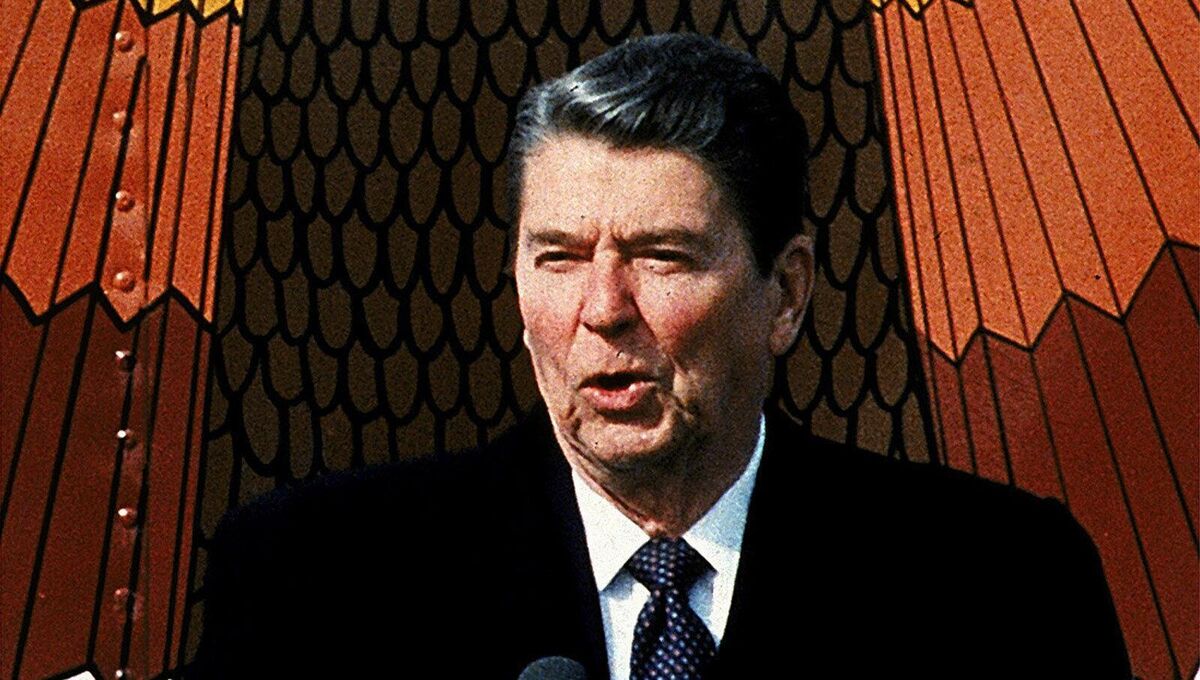
Ronald Reagan changed everything in a way that was not fully appreciated at the time.

Broadcasting history, like medical history, tends to major on the heroic intervention that generated massive change. In medicine, one of those heroic interventions was the introduction of antibiotics. In broadcasting, it was the arrival of a knight in shining armour, like Ed Morrow, who in one broadcast holed the fascist Joe McCarthy below the waterline. Here, although less deified, The Late Late Show served, in a more diffuse way, something of the same function, facing down prejudice and permanently weakening the power of the Church in Ireland.

The problem with the heroic intervention, applied to the 21st century, is that in Morrow’s time, and in the gamechanging years of The Late Late Show, their singular strands of broadcasting dominated public awareness. Nothing comparable exists today. Audiences have choices they did not have during the ’50s and ’60s. One strand alone — the podcast — breeds like guinea pigs do. And the offerings are personalised in a way unimaginable at any stage in the past, with social media (including podcasts) effectively offering crazy to the crazies (alt-right calls, over the weekend, in this country, to burn all buildings planned to house refugees) while providing everybody else with an individual rabbit-hole, intriguing to descend while insulating the individual from other data — and other realities.

Lewis Carroll may have been prescient, portraying Alice, because of her pursuit of the white rabbit, ending up helplessly collusive with the illogical while completely insulated from reality.

More in this section