Terry Prone: Wartime foot soldiers pay the price while top table offenders get off scot-free

Gibson and his Dambusters team killed 1,400 civilians who offered no threat to him or his country. The young Russian sentenced last week killed one civilian he believed offered a threat to him and his companions. The Russian became a convict. The Briton became a national legend.
Terry Prone: Wartime foot soldiers pay the price while top table offenders get off scot-free

A Ukrainian court sentenced 21-year-old Russian soldier, Sgt Vadim Shishimarin, to life in prison for killing a Ukrainian civilian — following the first war crimes trial since Russia’s invasion. Picture: Roman Hrytsyna/AP

HE sat there, silently, the shaved head making him look a bit older than his 21 years. But not much older. He is still a kid. A self-confessed killer but still a kid in a box, his head tilted sideways to hear the translator whispering through a hole in the glass, explaining what was going on in the Ukrainian court.

Much of what was going on came under the heading of “formalities” since the young Russian solder Sgt Vadim Shishimarin, admitted from the outset that he had shot dead a 62-year-old civilian, Oleksandr Shelipov, in the northern region of Sumy in the first days of the war. All that remained for the judge, last week, was to sentence the sergeant to life in prison.

What happened was that the sergeant and another couple of Russian soldiers escaped from a losing battlefield situation by stealing a car. When they reached Sumy and were spotted by the civilian, they convinced themselves that he’d immediately alert Ukrainian troops to their presence. Someone yelled a general instruction to shoot. Even though the person who shouted wasn’t Shishimarin’s boss, he shot the civilian anyway.

This, in due course, led to the judge finding him guilty of pre-meditated murder and of “violating the laws and customs of war”. He has been sentenced to life in prison. An appeal is possible but unlikely to be successful. So he will be incarcerated in Ukraine unless a swap is arranged for a Ukrainian solder captured by the Russians. Which of course leads to the possibility of repatriation to Russia, which may not — for the young man involved — be the best option.

Parking Shishimarin for the moment, let’s look at the case of another young military man thrust into command at roughly the same age. At the beginning of the 1940s, Guy Gibson was 21. The British pilot was handsome, successful, and cordially loathed by his colleagues and subordinates. (His wife went off him quickly, too.) The commander of 617 squadron was variously dubbed The Bumptious Bastard and the Boy Emperor.

However, even those subordinates he never addressed — clearly deeming them to be beneath his attention — even they regarded him as a great squadron commander. His instructions were clear. 

He never asked any man to do what he would not do himself. He had flown close to a hundred sorties over Germany. He was the bravest of the brave.

The Dambusters

All of which led to his selection as the leader of the Dambusters. The Dambusters were 617 Squadron, the pilots, navigators, and gunners chosen to fly to and destroy a key German dam. The British had worked out that a direct hit on the top of this vast dam would achieve nothing. A dam, like an iceberg, has the overwhelming bulk of its structure underwater. What they came up with was the munitions equivalent of flicking a flat stone at the surface of the sea so it bounces several times before sinking.

The “bouncing bomb” was going to hit the water, bounce towards the structure of the dam, sink to the bottom of the structure and explode, delivering structural damage, downstream flooding and the loss of a massive reservoir. (That reservoir was alive with fish, because the Nazis had worked it out that maritime battles might limit their capacity to catch fish at sea, so reservoirs were stocked up as an alternative.)

It was genius, and once a “bouncing” bomb had been created and successfully tested, it was over to 133 airmen led by Guy Gibson to deliver it.

They operated in a changing context. Analysis of photographs taken from and retained in the cockpits of heavy bombers had established that the RAF were incapable of identifying any target smaller than a major city.

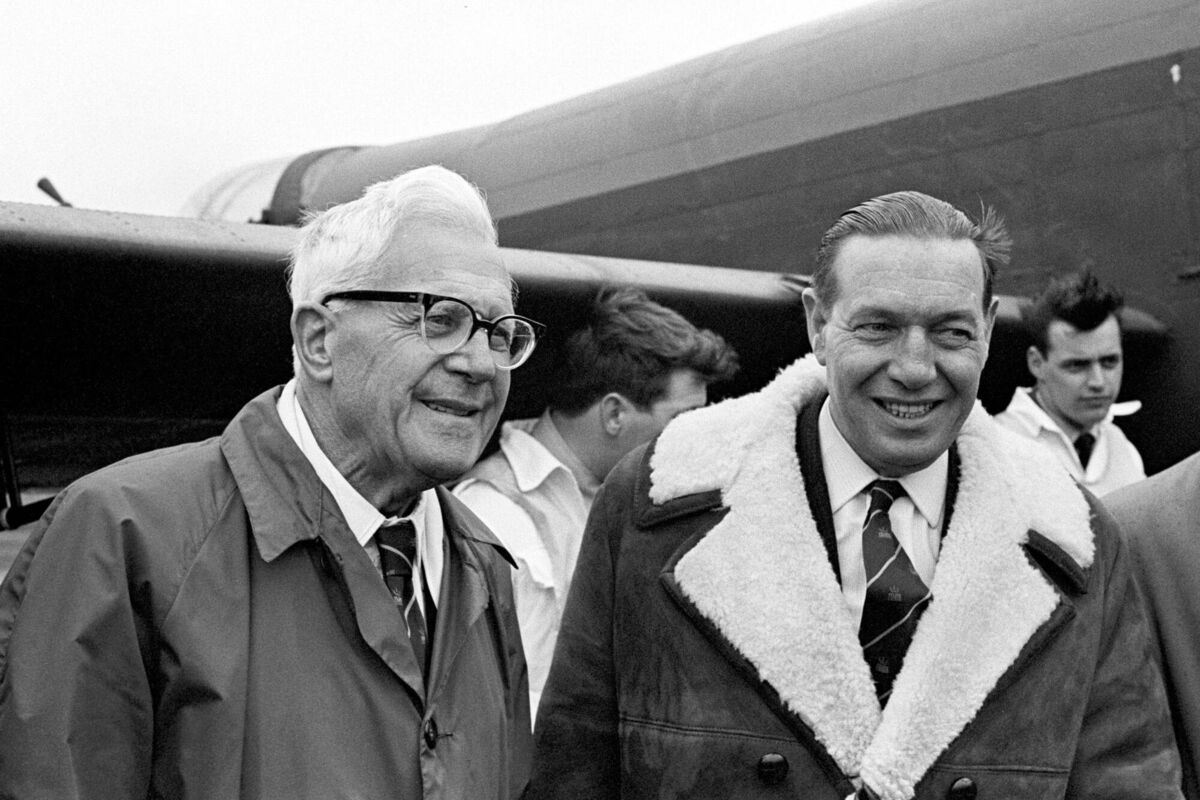
Photo dated 1967 of Dr Barnes Wallis (left), inventor of the 'bouncing bomb', in front of a Lancaster bomber. Picture: PA

In light of this information, Britain effectively abandoned trying to bomb Germany’s military and industrial installations, pivoting instead to an anti-city, anti-civilian attack policy. The new objective was to “de-house” Germans and destroy their morale, despite the abject failure of the same policy on the part of the Luftwaffe directed against England’s civilians and the big cities housing them. 

Ignoring the facts, the RAF changed direction and target and kept quiet about it. When the Dambusters were briefed to destroy the dam, they asked only airmen’s questions.

The 133 of them concentrated on getting to the target location, bombing it, and getting back alive. More than half died in the attempt, and Britain mourned those who died as if they were the only victims.

In fact, though, almost one and a half thousand people drowned following the breaching of the dam. They were overwhelmingly civilians. The majority were women. More than half of them were Ukrainian, Polish, French, and Russian slave labourers. The thundering flood started by the Dambusters caused them to go from exhausted starvation to sudden drowning.

This was ignored by books written soon after the bouncing bomb triumph. The victims were also ignored by the movie about the raid, which is still the most popular British-made war film of all time.

The squadron leader, Guy Gibson wrote a book before he was killed in battle in 1944, in which he claimed that it never occurred to the Dambusters that people might drown as millions of tons of water flooded into the valley below. “No one likes mass slaughter and we did not like being the authors of it,” was how he put it.

Avoidance of being known as a mass slaughterer isn’t hard, when you’re on the winning side, as Gibson and his squadron were.

History written by the victors

In addition, if history is written by the victors, for the most part, war crimes courts are set up by the victors, most notably the Nuremberg Trials.

Nobody at those trials mentioned Dresden, where Allied incendiary bombs created such hellish firestorms that civilians who died there in their thousands left no trace: they were not just incinerated, they were heat-evaporated. Nobody at those trials mentioned the Dambusters, either. Guy Gibson went on to become a knight in shining Lancaster bomber: an idealised British war hero.

Gibson and his team killed 1,400 civilians who offered no threat to him or his country. The young Russian sentenced last week killed one civilian he believed offered a threat to him and his companions. The Russian became a convict. The Briton became a national legend. The Russian was impulsive. The Briton was part of a strategy, so well-planned that it has to have taken into account and disregarded the inevitable loss of civilian life.

Professor Philippe Sands of University College London, this week drew attention in The Washington Post to even more contradictions implicit in sentencing one soldier for killing a civilian in the middle of a war.

“This raises the spectre of a situation where, years down the line, you’ve prosecuted a number of low-grade soldiers or conscripts for dreadful things. But the people at the top table, who are truly responsible, got off scot-free.”

More in this section