'We will not be going backwards': Sinn Féin and DUP clash over Drumcree parade dispute
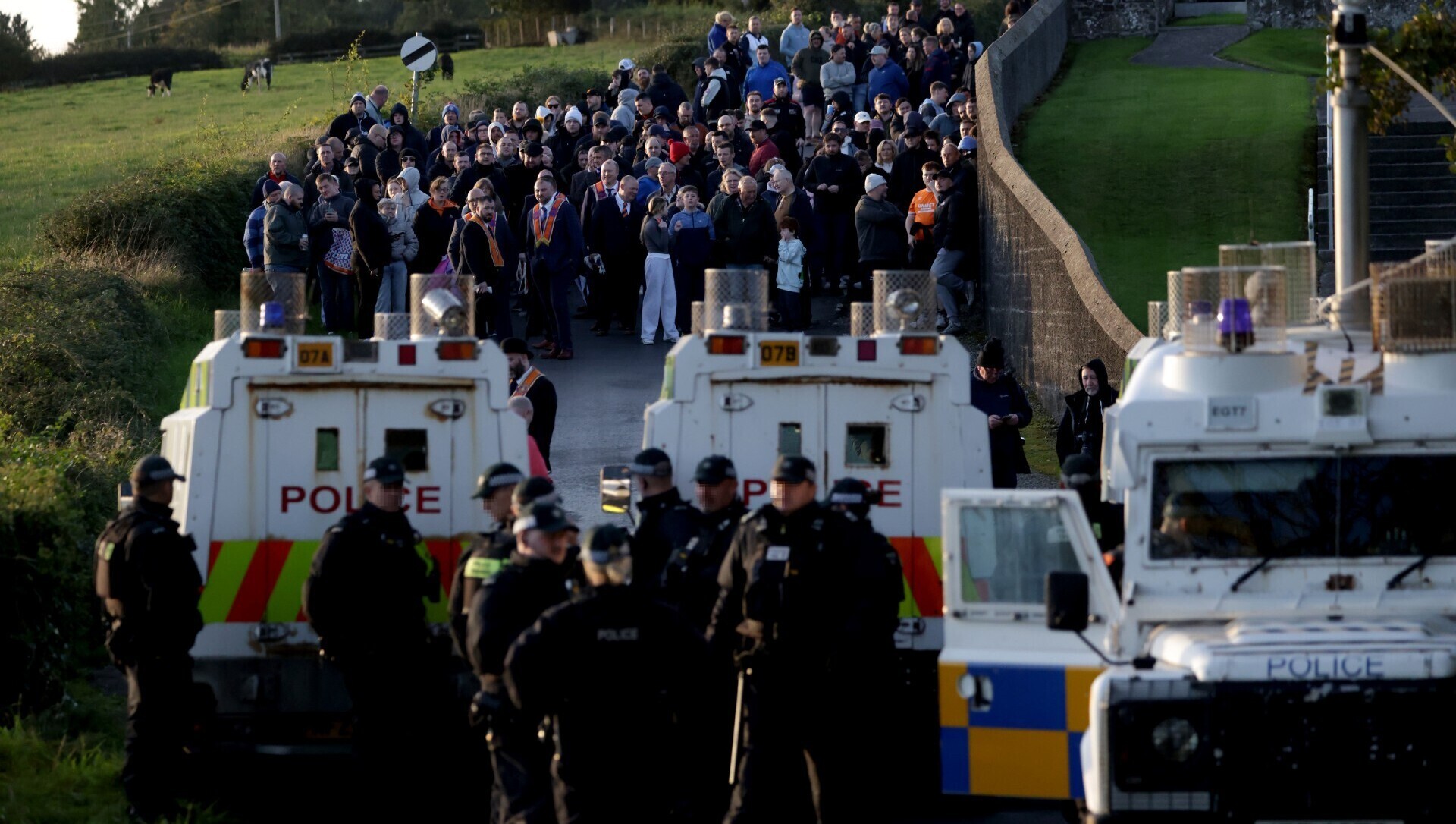
Orange men gather near Drumcree Church as police form a barricade to prevent them entering the Garvaghy Road, where members of the Orange Order were due to take part in the first return parade on the road for almost 30 years. Photo: Peter Morrison/PA Wire
Assembly Members clashed in Stormont on Monday over the Drumcree parade on Garvaghy Road.
Speaker Edwin Poots began proceedings by calling for members not to engage in a way which “inflames tensions”, but on several occasions he had to call the Assembly to order.
Deputy First Minister Emma Little-Pengelly accused First Minister Michelle O’Neill of breaking the law and encouraging others to do so.
Speaking in the Northern Ireland Assembly, the DUP MLA said there was a “total abdication of leadership”.
Read More
She said: “Michelle O’Neill decided to follow the law of the mob and not the law of the land, and that matters.
“Decided, with so many others on the benches across from me, to stand shoulder to shoulder with IRA members, with IRA and dissidents.”
Sinn Féin MLA John O’Dowd said the parade was steeped in a history of “murder, violence, intimidation and supremacy”.
He said: “We stood on the Garvaghy Road over the weekend to ensure that they will never, ever be returned to second-class citizenship in this society, and that no-one will be beating the people off the streets ever again.
“The people of the Garvaghy Road, the people of Portadown, are being used by those people who want to draw this society backwards.”
Garvaghy Road residents are “under siege by toxic Orange triumphalism”, People Before Profit MLA Gerry Carroll said, responding to criticism from the DUP.
He said: “What stopped the march at the weekend wasn’t a determination or a judge.
“It was over thousands of ordinary people linking arms in the rain for hours on end, and there’s an important lesson in that that some should do well to learn.
“[The DUP is] a party up to its eyeballs in scandals that reaches for sectarianism every single time to distract and divide and look the other way.”
Speaking afterwards, First Minister Michelle O’Neill said she was proud to protest with the residents of Garvaghy Road who “have suffered generations of sectarian domination, intimidation and violence”.
The Sinn Féin deputy leader said: “May I invite all those within Unionism into 2026? The days of Unionist supremacy and domination are gone. We will not be going backwards. We are about the future.
“I think those people that wanted to force this march down that road need to give their heads a shake.”
A delegation from the Orange Order has met with Northern Ireland Secretary Chris Bryant to discuss the Drumcree parading dispute.
Speaking after the meeting, which lasted an hour, district master Nigel Dawson said: “We had a very constructive and detailed meeting with the Secretary of State, and we expect to probably hear from him again later on in the day, or from his officials.
“We are now returning back to Drumcree, where we left this morning.”
Asked if the determination for the Drumcree parade was still live, Mr Dawson said: “I spoke to the chief constable [PSNI chief constable Jon Boutcher] this morning shortly after 7 o’clock, and the determination is still a live document.”
Mr Bryant is holding crunch talks with Orangemen and nationalist residents in a bid to resolve an intensifying dispute over the controversial parade in Portadown.
He scheduled meetings with representatives from both the Orange Order and the Garvaghy Road Residents’ Coalition at Hillsborough Castle.
Meanwhile, Northern Ireland Justice Minister Naomi Long made a direct appeal to the Portadown Orangemen as “as fellow Christians” to put reconciliation first in the Drumcree parading dispute.
She pleaded for the group of Orange Order members to “allow it to come to a conclusion”.
“I make a direct appeal to the Orange Order, as fellow Christians, to put reconciliation first,” Ms Long said.
“You have established your rights, but in the greater good for society, you do not need to exercise them.
“Take the moral high ground like the Christian men that you are, and allow this to come to a conclusion.”
The Alliance minister added: “How do we offer hope for those who are feeling utter despair? Where is the leadership to collectively navigate through this?
“Are we willing to do the hard yards of reconciliation? Because if we are not, we are condemning future generations to relive the worst parts of our past, and we offer them nothing.”
Orange Order members remain at Drumcree in Portadown, with efforts set to intensify on Monday to find a political solution to a contentious parade which brought thousands of protesters onto the streets.
The Police Service of Northern Ireland (PSNI) is maintaining a low-key presence near Drumcree Parish Church, where a number of loyal order members stayed overnight in the expectation of completing their march through the Co Armagh town.
On Monday morning, five Orange Order members walked to the police line close to Drumcree Church.
They were told by an officer that they were not permitted to proceed.
But after a member of the public walked along the road, the five members removed their collarettes and walked again to the police line.
After again being stopped, Portadown deputy district master Alastair Power asked the officer to confirm that a member of the public was allowed to walk down the road but his colleagues were not.
A small number of protesters, some with their faces covered, have begun to gather on the Garvaghy Road.
However, at the height of the blockade on Sunday, thousands of people gathered on the road to prevent the parade from the nearby Drumcree Church from passing along the route.
The mass gathering, which was illegal under parading legislation in Northern Ireland, involved senior Sinn Féin politicians, including Stormont’s First Minister Michelle O’Neill.
It was organised after Orangemen managed to overturn a long ban on them parading down the predominantly nationalist road.
The blockade continued through the day and late into the night, as Orangemen assembled at Drumcree Church around a mile from the road waited to commence their parade.
Around midnight, Breandán Mac Cionnaith from the Garvaghy Road Residents’ Coalition told protesters they had secured a “victory”.
He said he would meet Northern Ireland Secretary Chris Bryant and Police Service of Northern Ireland (PSNI) chief constable Jon Boutcher on Monday morning for talks on the Drumcree parade.
Mr Mac Cionnaith said he had received “commitments” that the parade would not be proceeding down the Garvaghy Road overnight.
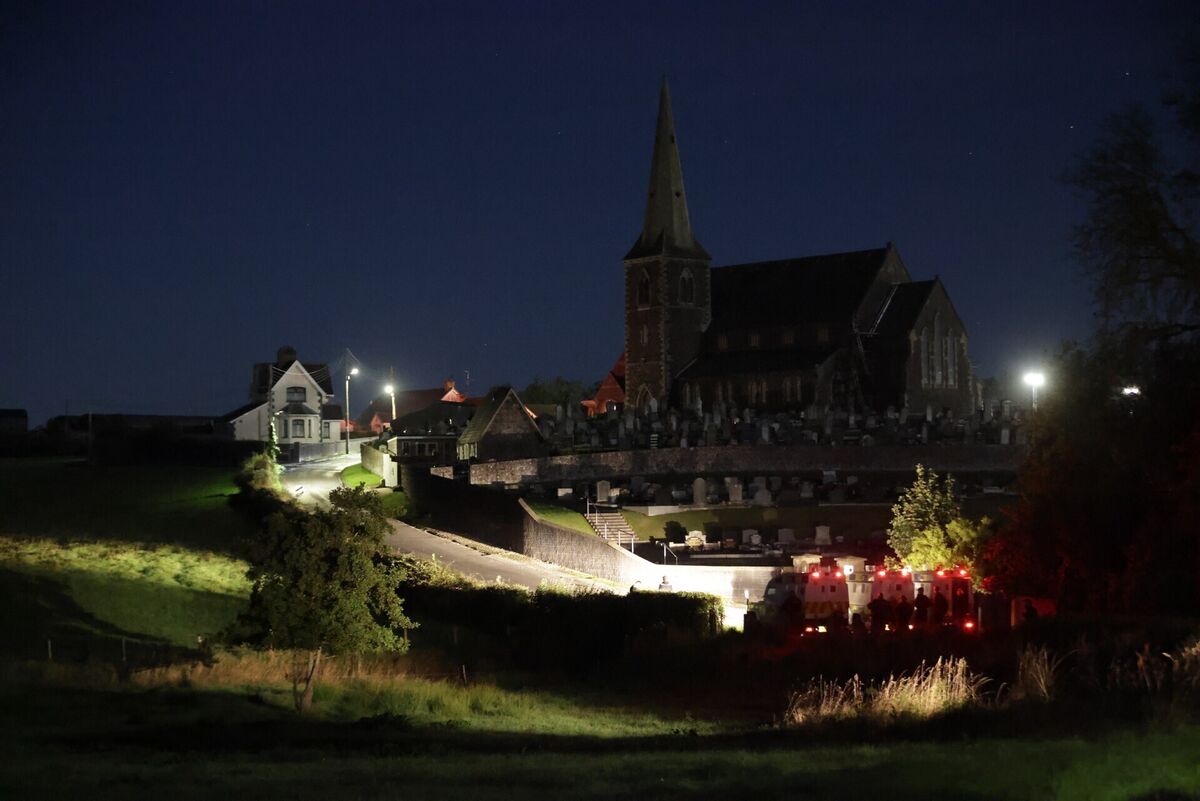
He asked for 20-30 volunteers to remain on the road to ensure those commitments were not broken.
“We’ve stopped them once. The process now is to ensure we stop them permanently,” he said.
On his planned meetings on Monday, he added: “That process starts tomorrow when we go in and meet the chief constable and we’ll meet the secretary of state.
“We’re not going in to do deals with them, or to take half measures with them.
“We said the other day, and we said yesterday, and the day before – we’re not going back, we’re not turning the clock back.
“We’re putting the clock forward.”
Ms O’Neill also said the Garvaghy Road community had won a “victory”.
“This community do not want this, they do not want this march,” she told reporters before leaving the area shortly after midnight on Monday morning.
“And tonight, I believe, is another victory for this community in standing steadfast for the right to live free from sectarian harassment and intimidation.”
Earlier, the Northern Ireland secretary appealed for calm and urged political and community leaders to reach for compromise to resolve the deepening dispute over the Drumcree parade.
He held talks with political leaders on Sunday night, but no resolution emerged.
The presence of Ms O’Neill and other senior Sinn Féin figures at the blockade prompted accusations of law breaking from unionists.
Under parading legislation in the region, protests against parades must be notified and approved by the Parades Commission adjudication body.
The blockade on the Garvaghy Road was an unnotified gathering.
Ms O’Neill and other ministers in the Stormont Executive are bound by a pledge of office that contains a commitment to uphold the law.
On Sunday, police repeatedly notified the protesters through a loudspeaker that they were liable for arrest for blocking the road.
On Sunday evening, Ms O’Neill had encouraged protesters to the “stay the course” as she urged them to remain on the road until at least midnight.
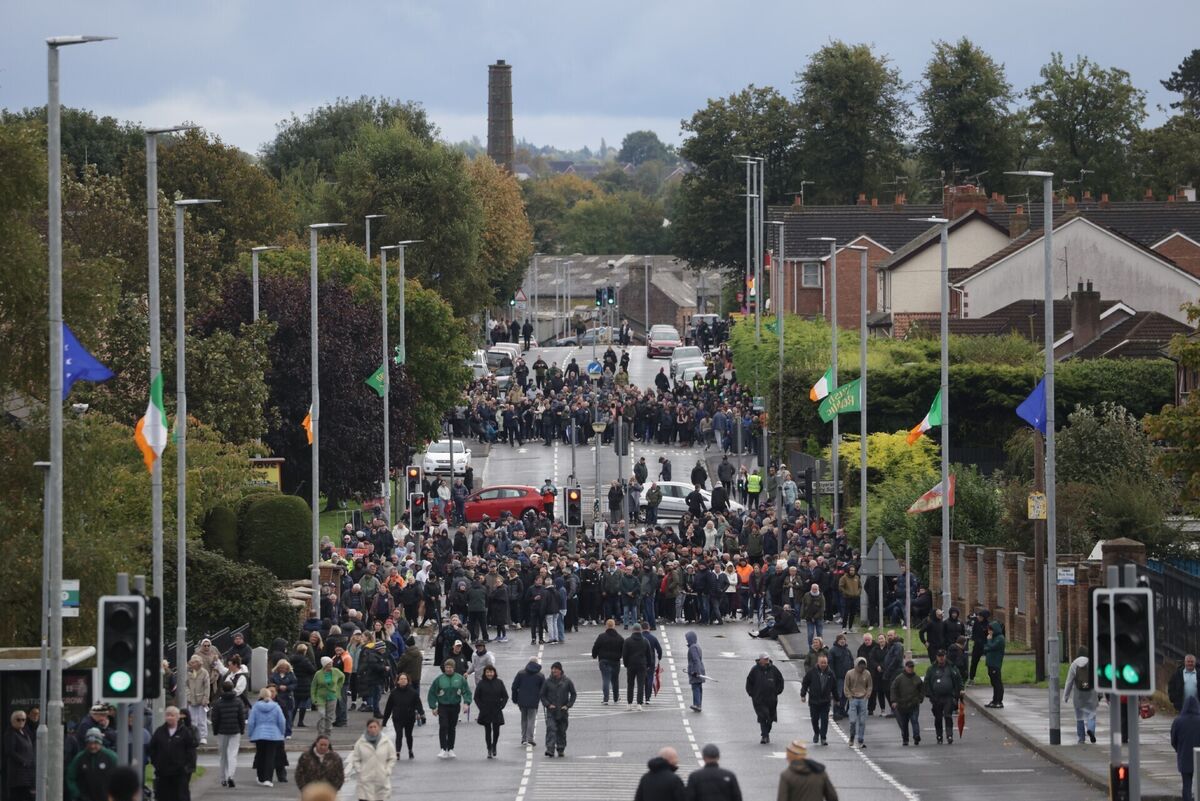
DUP leader Gavin Robinson said Sinn Féin leaders needed to face consequences for their actions.
“We can’t have a situation where people who have the privilege of holding high office in Northern Ireland so flagrantly disregard the pledge of office and statutory underpinnings of their office,” he told media in Belfast on Sunday afternoon.
A ruling by the Parades Commission permitting the Orange Order march from Drumcree Church and along the Garvaghy Road was upheld in an “unprecedented” late-night sitting of the High Court in Belfast in the early hours of Sunday morning.
The Drumcree parade, which was associated with violent clashes during the Troubles, has been banned since 1998.
Protesters, some wearing balaclavas or other face coverings, clustered in large groups in heavy rain along the Garvaghy Road on Sunday morning – a move that delayed the scheduled 8am start of the parade.
The Orangemen waited at the church throughout the day.
Around 6pm, several of them emerged from the church hall and walked down the hill where they were met by police.
A crowd of supporters subsequently gathered with the Orangemen.
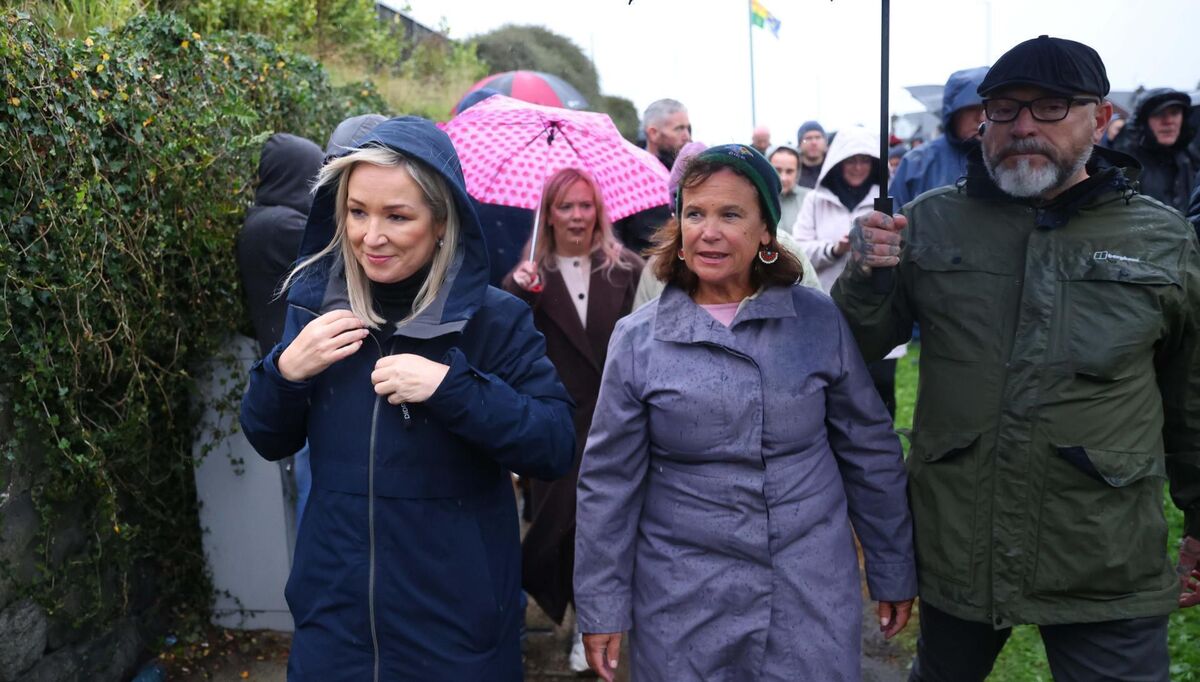
Officers told senior members of the institution that they could not have more than 35 people on the hill – as that was a restriction placed on the parade by the commission.
By 10pm the numbers on the hill beside the church had dwindled to a small presence.
A spokesperson for the Orangemen said they would continue to wait in the church hall, adding “we demand the parade goes ahead”. Their supporters relocated to Portadown town centre.
Loyalist activist Jamie Bryson, who worked closely with the Orangemen on their legal challenge against the long-standing ban, accused the police of failing to act against those participating in the blockade.
“We have spoken directly to the PSNI and called them out for their utterly abominable conduct,” he posted on social media.
“There is no excuse. Not a single step have they taken against the lawbreakers. Not one.”
Two schools in Portadown have announced they will close on Monday due to the parading dispute.
The escalating political row over the parade is set to test the stability of the power sharing institutions in Belfast.
Mr Robinson was asked on Sunday whether he was prepared to continue to work with Sinn Féin.
If either the DUP or Sinn Féin withdrew from the executive, the devolved government would effectively collapse.
“Our party is maintaining the dignity of the Portadown Orangemen as they have shown determination and patience so will we,” replied Mr Robinson.
“I can look at you all in the eye today and say we are being plunged into difficult territory because of the actions of people who are expected to be lawmakers in our country breaking the law.
“The fundamental principle of upholding the rule of law in this society are sacrosanct and cannot be tarnished.”
Earlier, Ms O’Neill told reporters on the Garvaghy Road that the reignition of the Drumcree dispute “brings into question how this whole peace process works”.
Party president Mary Lou McDonald called on the Northern Ireland secretary to intervene to ban the parade.
She said the people of the Garvaghy Road would “not be drawn back to the past”.
“The Secretary of State needs to intervene. The chief constable of the PSNI needs to intervene and put a stop to this,” she said.
Under parading legislation, Mr Bryant has the power to ban the parade.
The Northern Ireland secretary flew into Northern Ireland on Sunday from the Labour Party conference in Liverpool to have discussions with political leaders.
Speaking to reporters in Belfast, Mr Bryant said “nobody wants to go back 28 years”.
“The whole idea of us coming here is to be able to try and be able to talk specifically face to face to some of the political leaders and some of the community leaders to see if we can get to a settled position,” he said.
“The truth is everybody has to double down on compromise – that’s what life’s all about – double down on compromise.” PNSI chief constable Mr Boutcher called for people to come together to try to get past their issues.
He said the police operation thus far had involved evidence-gathering of “whatever has been happening from whatever party”.
“I am hoping we will bring all of today’s events to a sensible and peaceful conclusion,” he said.
On what a successful conclusion may look like, he added: “There has got to be a longer-term conversation which involves politicians and the people involved in what we have seen in the last 24 hours, trying to find a space that they can resolve these issues.”
There had been many “sensible voices” calling for calm which he thought had been “listened to by all parties”.
British prime minister Andy Burnham has appealed for “calm on all sides”, saying there have been “big gains made in Northern Ireland, and we don’t want to see things go backwards”.
Taoiseach Micheál Martin also urged calm as he expressed concern about the situation.
Mr Martin also described the decision by the Parades Commission to allow a parade to go down the Garvaghy Road for the first time in nearly three decades as “incomprehensible and wrong”.
The parade was finally given the go ahead at a court hearing which concluded at 2.15am on Sunday after opposing legal teams outlined their arguments over the parade.
The hearing was one of three separate emergency legal challenges before the courts in Belfast across Saturday and into early Sunday.
The stand-off at Drumcree made headlines in the 1990s, with nationalist residents of the Garvaghy Road opposed to the parade passing through the area, leading to violent clashes for several summers and political tension necessitating major security operations.
The Orange Order has unsuccessfully applied for more than a quarter of a century to complete its 1998 walk along its traditional route.
On Friday, the commission reversed its long-running determination and granted permission for the parade – a decision welcomed by unionist parties and met with outrage from nationalist and republican parties.
Permission was granted for a parade subject to strict restrictions, including a limit of 35 participants and an 8am start time.
CONNECT WITH US TODAY



Be the first to know the latest news and updates