Rents rose a record 4.4% after Government reforms came into force, new report shows

The Daft.ie report suggests that landlords have been delaying putting properties on the market to take advantage of the new system. Picture: iStock
Rents rose at the largest rate on record as the Government’s reforms came into force, with landlords delaying putting properties on the market to take advantage of the new system, a new report suggests.
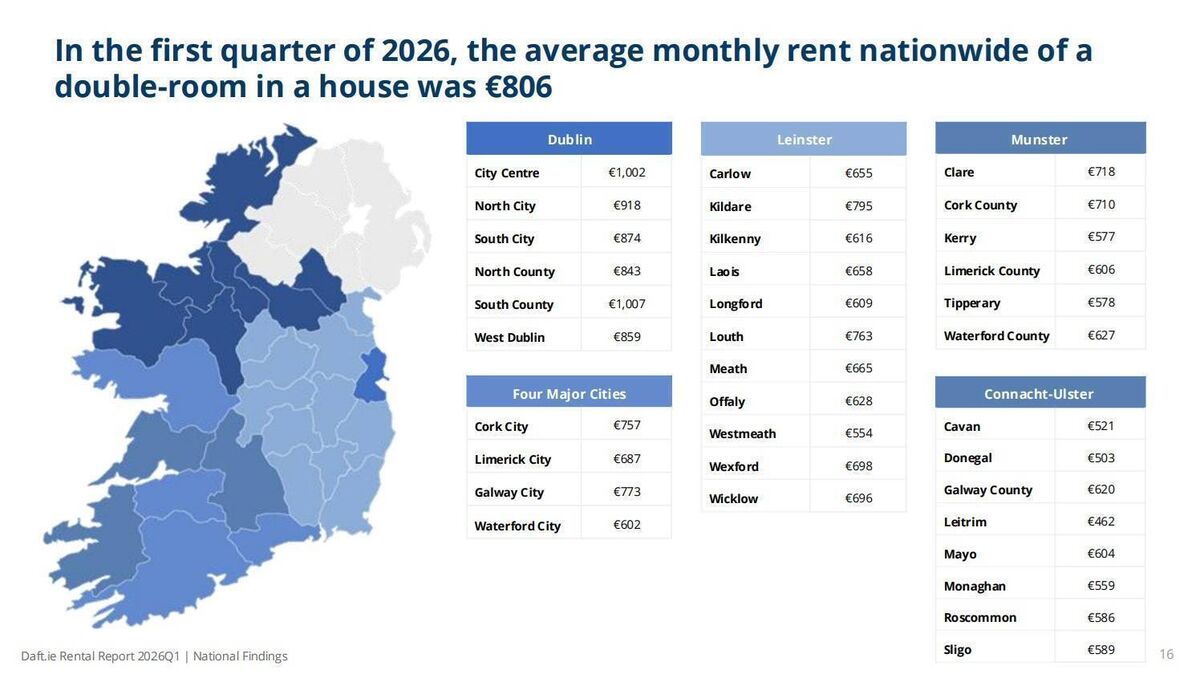
The latest Daft.ie rental price report, for the first quarter of 2026, shows market rents rose sharply by 4.4% between December and March. This is the highest quarterly rise in a series dating back to 2002.
Read More
The rent surge comes after data last week from the Residential Tenancies Board showed evictions in Ireland rose to their highest levels on record, ahead of the introduction of controversial new rental rules in March.
“A key feature of the new rules is the ability to reset rents to market levels when a tenancy ends,” said Ronan Lyons, professor in economics at Trinity College Dublin and author of the Daft.ie report.
“For landlords whose rents had been constrained by earlier rules, this represents an opportunity to re-align rents with prevailing market conditions.
“The scale of the increase in early 2026 suggests that this opportunity has been taken up widely, where tenancies have recently turned over.”
Under the Government’s new rules which took effect in March, landlords can only increase rent by a maximum of 2% a year.
However, they can reset rent back to market rates if a tenant leaves voluntarily, a tenant breaks their obligations, and also after a six-year period has elapsed.
According to Daft.ie, the recent surge means that the average market rent for a two-bedroom apartment in Ireland is now over €2,100 a month.
Rents are substantially higher now compared to pre-covid and almost 80% higher than 10 years ago.
Inflation is particularly high in the major cities outside of Dublin, with rents up 18% year-on-year in Galway, up 13% in Cork, 10% in Limerick, and 8% in Waterford.
A two-bedroom apartment in Dublin now costs an average of €2,609 a month on the open market, while the rate is €2,126 in Cork, €2,290 in Galway, and €2,187 in Limerick.
The report also highlights an increase in supply of homes on the market. Over 10,600 homes were put on the market in February, March, and April — a 13% increase on the same months last year.
Read More
However, this increase should not be seen as pointing to greater supply in the rental market, according to Mr Lyons.
He said: “The delay between announcing, in June 2025, and introducing, in March 2026, the new rent control rules appears to have prompted some landlords to delay listing properties until the new regime came into force. As these come to market, availability has increased, particularly in markets dominated by smaller landlords. Nonetheless, overall supply remains very constrained, and the recent increase is unlikely to represent a sustained improvement in rental availability.”
The Government has faced criticism for the impact of its new rental rules and, in the Dáil on Tuesday, the Taoiseach was accused of having a “Micheál in Wonderland logic” in relation to the controversial changes.
Defending the measures, Micheál Martin said they have added protection for tenants.
He said: “There’s always a churn in terms of tenancies and landlords, and so on. There’s a higher number, over 13,000, who’ve actually entered into the market, so some people exit the market, more enter then the market and it needed to be sorted, it needed to be solidified.”

Labour leader Ivana Bacik said: “What I’ve heard from you just now is Alice in Wonderland logic, Micheál in Wonderland logic. You tell me that you’ve introduced protections for renters, and that these have somehow generated evictions. So, which is it?”
She added that the use of the word “churn” is deeply hurtful to those who are “living in fear” and who are getting notices to quit but have nowhere to go.
Responding, the Taoiseach said that the Government has introduced a range of measures including on cost rental, affordable housing, and social housing.
- Sean Murray, News Reporter
- Elaine Loughlin, Political Editor
Read More
CONNECT WITH US TODAY



Be the first to know the latest news and updates