Eimear Ryan: The Women's World Cup will be Italia '90 for a generation of girls
What we can do next to help that generation grow into the future of the women's sport in Ireland
Pic: iStock
Sat, 15 Jul, 2023 - 12:45
Eimear Ryan
For elder millennials like myself, memories of childhood summers are punctuated by the World Cup.
There were the tense penalty shootouts and billowing tracksuits of Italia 90; Ray Houghton’s head-over-heels celebration at Yankee Stadium; the gut-punch of Saipan and the heroics of Robbie Keane and Damien Duff that followed.
But it’s been more than 20 years since an Irish soccer team reached a World Cup. For my sports-mad nieces, aged 12 and 10, this summer’s Fifa Women’s World Cup will be their Italia 90.
From this juncture, the future of Irish women’s soccer looks bright. But there are still many structural challenges faced by participants in women’s sport — even when there is a professional pathway, as in soccer.
Perhaps these challenges are thrown into even sharper relief because the men’s game — with its huge viewing figures and even bigger salaries —is right there for comparison.
What are the main issues facing elite female soccer players today, what can be done about them, and what are we doing right?
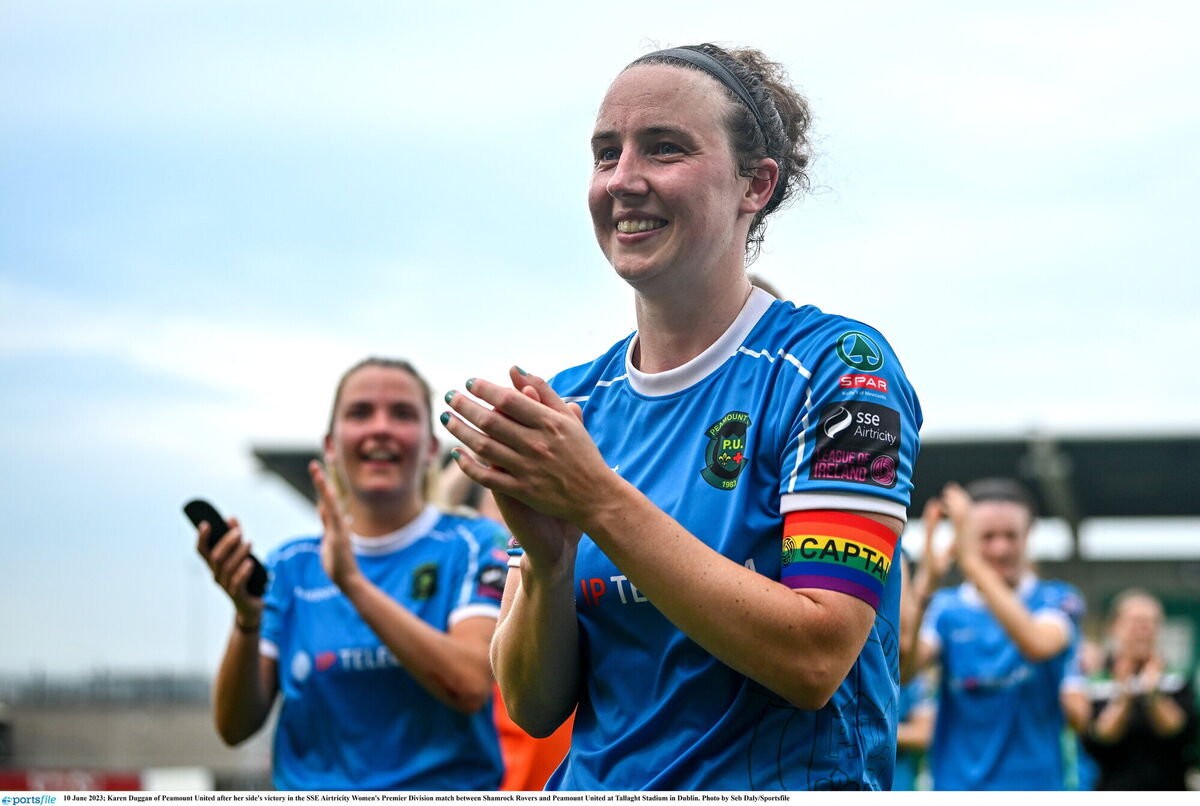
Karen Duggan of Peamount United after her side's victory in the SSE Airtricity Women's Premier Division match between Shamrock Rovers and Peamount United at Tallaght Stadium in Dublin. Pic: Seb Daly/Sportsfile
Careers & development
Let’s start with those salary disparities.
The average wage of a Premier League soccer player is an eye-watering £60,000 a week.
Players in the Women’s Super League, on the other hand, are paid anywhere from £20,000 to £250,000 — per annum, though, not per week.
While it could be argued that the WSL, which has only been in existence since 2010, has a while to go before it catches up to its male equivalent — and while the scale of the men’s salaries is questionable in the first place — if the WSL is to continue to develop as a quality league, its players will need to feel financially secure and supported by their clubs.
This might be true for players on a quarter of a million annually, but players on the lower end of the scale might have to work additional jobs alongside their soccer careers.
In a recent piece for the Irish Times, Peamount United player Karen Duggan, who has 35 caps for Ireland, made the point that the starting salary for a teacher in Ireland is €8,000 more than that of a professional women’s soccer player in Britain.
This makes any decision to move across the water a difficult one, especially if a player is scouted mid-career.
Last year, the Women’s League of Ireland introduced professional contracts, having previously been fully amateur.
However, clubs are not obligated to pay their players, and contracts can be on a part-time or full-time basis.
As Duggan suggests, perhaps a rollout of semi-pro contracts for all players, coupled with scholarships into higher education, would have been fairer and more sustainable.
Another major issue is the lack of career stability. Most WSL contracts are for one year only, so if a player gets injured, their position at the club is immediately in question.
Megan Connolly and Ruesha Littlejohn, both coming back from injury, are among the Irish players who have been released by their clubs ahead of the World Cup.
The fortunes of the team can also have a huge impact on players’ incomes.
Reading, home to Irish players Diane Caldwell and Grace Moloney, was recently relegated from the WSL to the Championship.
The club responded by making all players’ contracts part-time at the stroke of a pen, in a move hardly designed to set the team up for future success.
It’s hard to imagine a relegated men’s team being subjected to the same treatment.
On the international front, things are more equitable. Equal appearance fees for the Irish men’s and women’s national teams have been in place since 2021.
In 2022, after years of lawsuits about equal pay, the US women’s national team won a landmark settlement with the US Soccer Federation, guaranteeing that the women’s team would be paid the same as the men’s team going forward.
Meanwhile, the World Cup prize pot of $110m has almost quadrupled since the last tournament in 2019, and will mean that every participating player will receive at least $30,000, with $270,000 for each player on the winning squad.
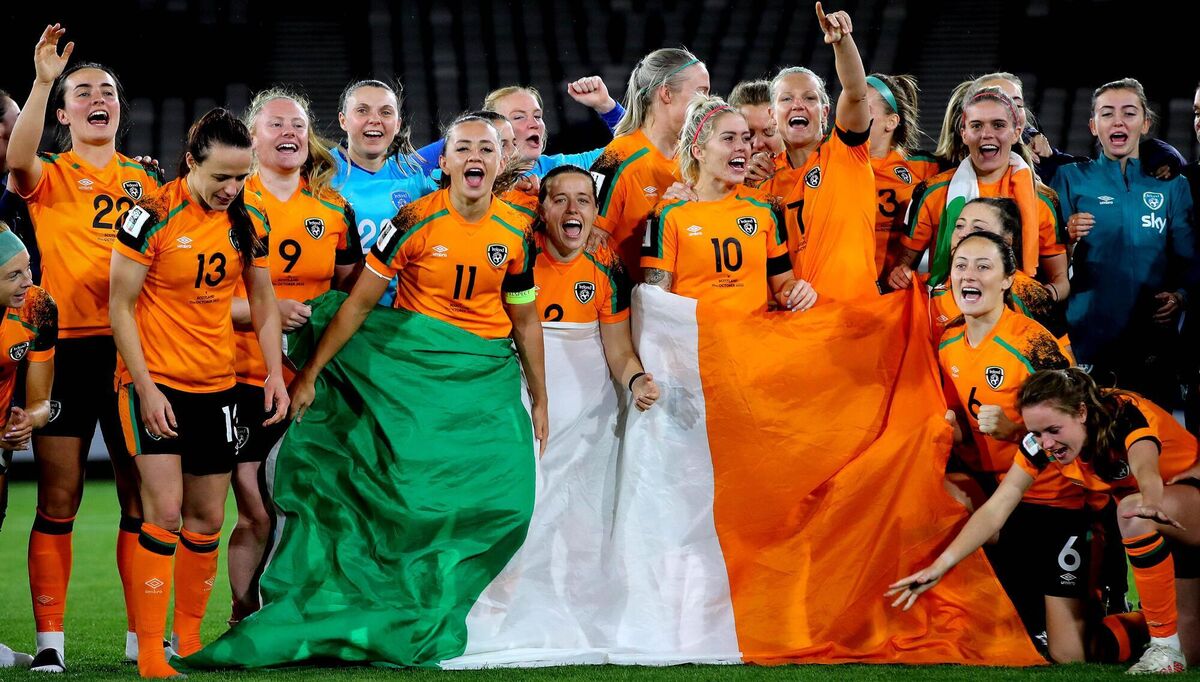
The Republic of Ireland Women's National Team celebrate their entry to the Women's World Cup. Pic: INPHO/Ryan Byrne
Media coverage
For me, the 2019 World Cup represented a tipping point; it was the first time I could remember women’s team sports being chatted about casually in the office.
This time around, with Ireland involved, viewers will be even more glued to the action; 382,000 tuned in to witness Amber Barrett’s perfectly angled toe-poke in the playoff against Scotland in October 2022, meaning that there is now a huge appetite for women’s soccer in Ireland. (It’s not just international soccer that’s experiencing this bump, either: England’s WSL celebrated a record season this year, with attendances up 173 percent on last season.)
RTÉ has pledged to broadcast all 64 games from the World Cup, with over half the games being shown live on RTÉ2, and the rest available on RTÉ Player.
The coverage and analysis will be female-led with anchors Evanne Ní Chuilinn, Marie Crowe, and Clare McNamara, as well as a host of former players such as Stephanie Roche and Clare Shine contributing analysis and commentary.
For a peek into the rival camp, the excellent Disney+ documentary series The Matildas: The World at Our Feet gives a fascinating look behind the scenes of an elite women’s squad.
The Matildas is refreshing because it’s not just a female version of a men’s soccer documentary: it shows many of the features and issues that are unique to women’s sports, from new mothers coming back from pregnancy, to players feeling able to be out in the dressing room, to the numerous ACL injuries that plague women’s team sports.
We are not small men
It has taken years and education, but the notion that sportswomen are ‘not small men’, and have different physiological and training needs to sportsmen, is slowly becoming common knowledge.
Women’s cycles may affect performance, and that is now being taken into account at elite levels with the use of cycle-tracking apps.
Several squads have also changed their shorts to increase players’ comfort while they are on their periods; after winning the 2022 Euros in an all-white kit, the Lionesses switched their shorts from white to blue.
It’s a conundrum that the prime years of a soccer career often coincide with the optimum years for starting a family, although some players manage to square this circle.
US defender Crystal Dunn gave birth to her son Marcel in May 2022, and just over a year later was named on the World Cup squad.
Alongside her is goalscorer extraordinaire Alex Morgan, who gave birth to her daughter Charlie in May 2020.
Meanwhile, US captain Becky Sauerbrunn has been open about her decision to freeze her eggs, preferring to become a mother when she calls time on her soccer career.
Our own Áine O’Gorman and her wife Rachel Neary became parents to James last year and will be bringing him to Australia to soak up the atmosphere.
While US soccer has long had maternity benefits in place, this wasn’t the case internationally; but thankfully, Fifa implemented new rules for maternity leave last year, with players now entitled to a minimum of 14 weeks of maternity cover, and clubs obligated to reintegrate players to the squad once they return.
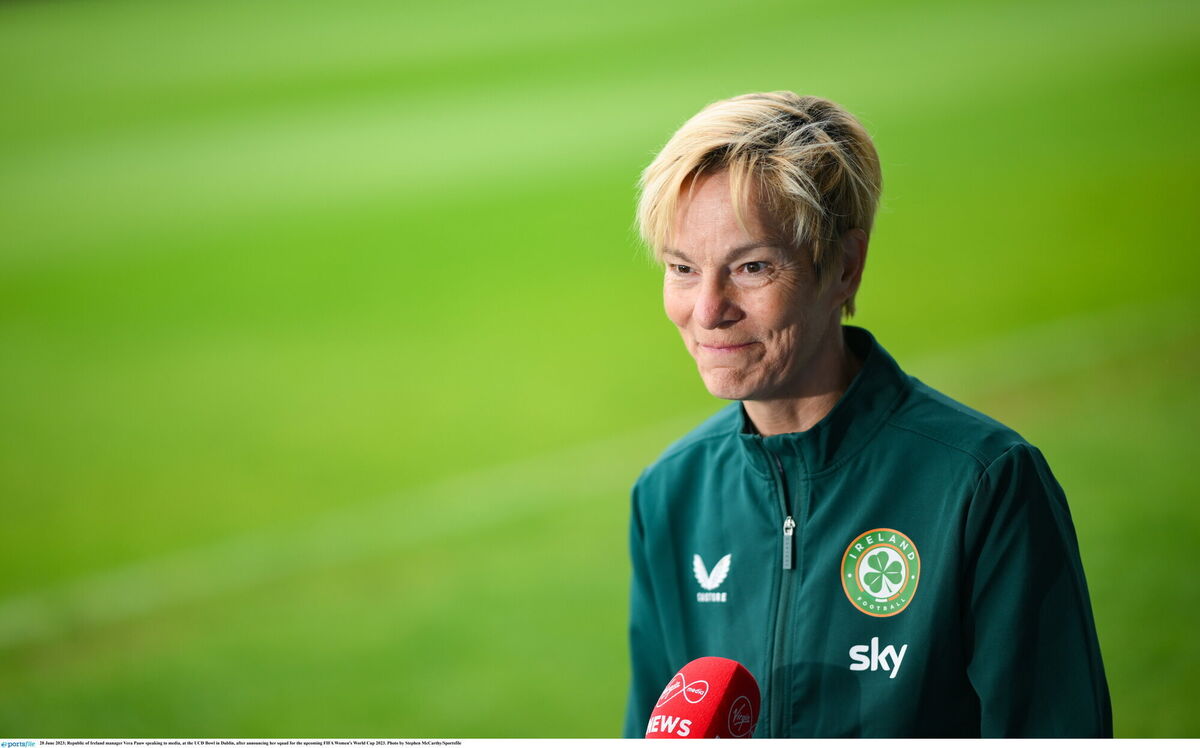
Republic of Ireland manager Vera Pauw speaking to media, at the UCD Bowl in Dublin, after announcing her squad for the upcoming FIFA Women's World Cup 2023. Pic: Stephen McCarthy/Sportsfile
Player retention
Liverpool FC recently released a short video featuring Harvey Elliott, Jordan Henderson, Diogo Jota and Thiago.
Appearing to speak to a journalist after the game, they each in turn revealed why they’re quitting football:
“Just worried that I wouldn’t fit in with my friends. They all think it’s weird that I wanna do this kind of thing.”
“Pressure from my parents. They just don’t see the value in it.”
“On my way home, after a training session or a game, I just feel so vulnerable.”
“I’m worried about my body image, how I look in front of everyone.”
A voiceover then reveals that these are actual reasons given by girls for why they’re quitting sport, and it’s striking to hear these reasons come out of grown men’s mouths.
Girls are twice as likely to quit sport by age 14 as boys are, a phenomenon already well-known to anyone who has coached teenage girls.
This trend was highlighted after England’s Lionesses won the Euros in 2022, and it was subsequently revealed that only 44% of English secondary schools give their female students a chance to play soccer.
Awareness of the problem, however, is half the battle, and programmes such as the FAI’s Cadbury Kick Fit — a fun, social soccer programme aimed at recruiting new players and coaches — should help to reverse these trends.