Alan Healy: There is a battle brewing over Cork's airspace that will be repeated across Ireland
It is refreshing to see a company like Manna, founded by Bobby Healy, being a leader in this field. Too often, Ireland comes at the end of emerging technologies.
Ireland’s cities and towns will shortly be joining the contentious debate as to who can operate in the skies above our heads.
As of this morning, half of the skies over Cork are now off limits to drone users unless they seek permission two days in advance. This restriction will remain in place for three months and is likely to be made permanent.
It means significant parts of the city’s northside, the city centre island, the Docklands, the entirety of Blackrock, Mahon and Douglas will join the existing red-zone areas around Cork Airport and Cork Prison.
Hobbyists and photographers, who would previously send up drones of various sizes to capture local scenes, under the existing restrictions and regulations, will now face a more onerous requirement of having to seek permission two days in advance.
Read More
The decision has naturally led to protest and objection, but it is a sign of things to come and will be repeated across the country as greater regulation is placed on a still-rapidly growing drone technology.
Their emergence over the past two decades has transformed a variety of sectors. Building inspections and surveys previously carried out by erecting scaffolding or bringing in cranes and lifts are now carried out in minutes. Search and rescue teams utilise drones to carry out searches. Hobbyists were among the earliest adopters. Personal drones with high-definition cameras put in the hands of everyday citizens have given us a variety of new and literally bird’s-eye views of our cities, towns and landmarks.
They are also set to transform commerce. Across supply chains, the ‘Final Mile’ has long been recognised as one of the most challenging and expensive parts of getting goods to customers. Efficiencies can be found and erased when delivering shipments and pallets to depots and warehouses, but getting small packages, hot foods or medicines to the myriad of local addresses and destinations remains a major challenge.
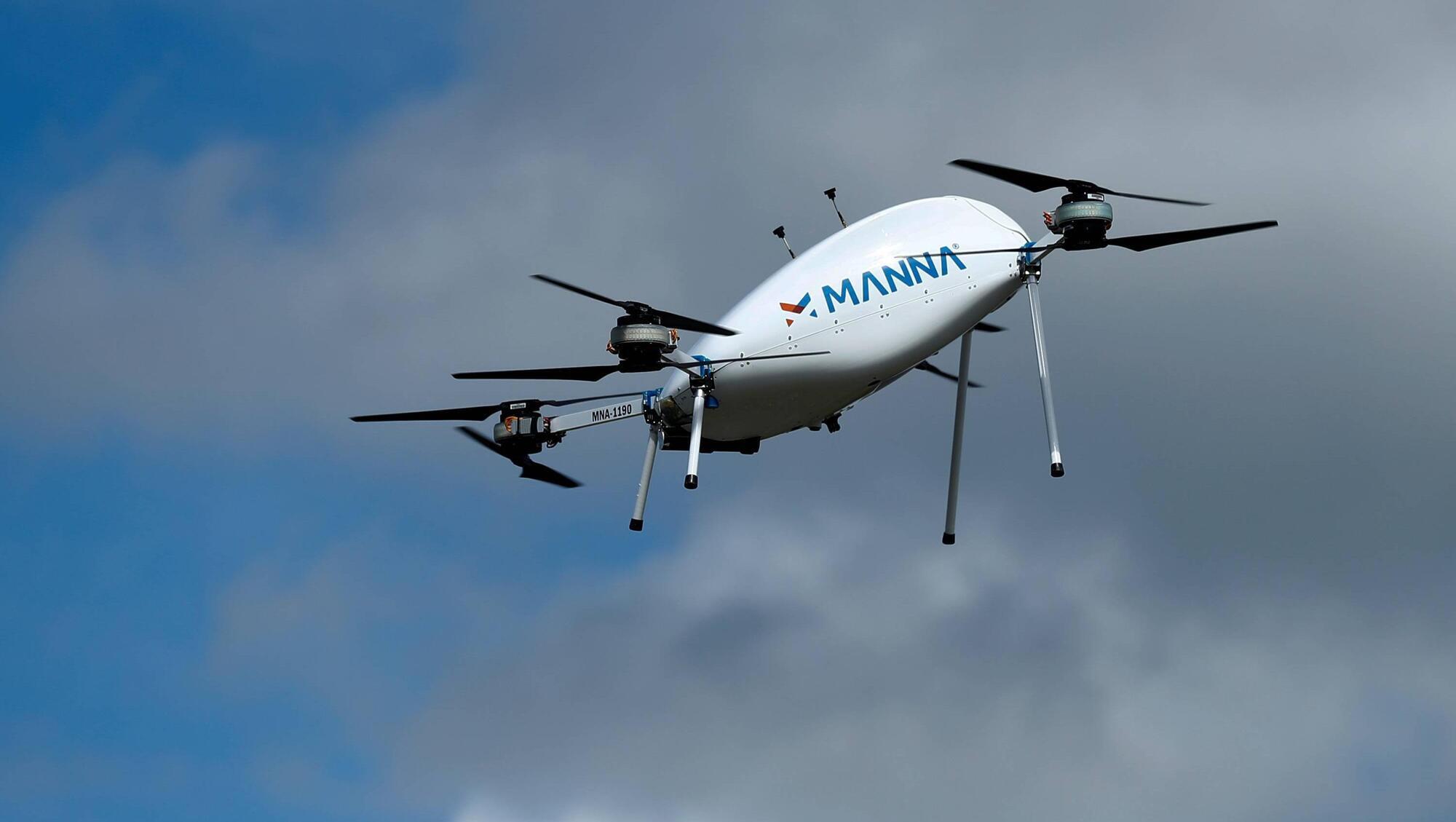
This is one of the reasons for the restrictions in Cork. The Irish Aviation Authority (IAA) has confirmed that drone delivery company Manna is seeking permission to operate in Cork, saying a block or volume of airspace is required to safely allow what is termed as beyond visual line of sight (BVLOS) operations.
Manna is at the forefront of this new business. They have been operating real drone deliveries to parts of Dublin for years. It is refreshing to see a company like Manna, founded by Bobby Healy, being a leader in this field. Too often, Ireland comes at the end of emerging technologies. Both businesses and regulators take a wait-and-see approach and watch how things are done in other jurisdictions. Manna is out there competing with the big boys like Amazon and Google and trialling the technology in real environments.
However, they are not just pioneers in developing the technologies and the operating procedures to safely run a delivery business. They are also pioneers in the interaction between the public, regulators and local authorities when it comes to the usage of our airspace. Manna deliveries have resulted in noise complaints in Dublin from residents, but the company has been clear that it intends to roll out the service to a much wider area across Ireland.
It is also fair to state clearly that the Cork skies are not just being cleared for Manna. Other companies have been trialling drone delivery services in Ireland. BVLOS drone operations can also go beyond home deliveries. Some energy and utility companies use autonomous drones to inspect cables and infrastructure. The technology can also be used in agriculture to monitor crops and forestry management. There are also opportunities for site security and surveillance or environmental monitoring.
The IAA, for its part, has been forward-thinking when it comes to drone technologies. There is a tendency amongst bureaucracies and organisations of any significant size to over-regulate or ban rapidly emerging technologies that evolve quickly.
However, the IAA and other State bodies have embraced an inevitability and put in place structures to avoid a free-for-all. They have established a registration system for all drone users, even though it acknowledged that large numbers of drone users may not be captured.
They have rolled out training schemes and certification, and have largely taken a softly-softly approach to enforcement with drone operators who break regulations.
Drone restrictions around airports, prisons and other facilities have long been in place and for good reasons. A growing number of international airports have seen shutdowns over drone encroachments onto airfields.
Despite this, there is a clear concern amongst the public over the restrictions being put in place. It is not just amateur hobbyists but search and rescue organisations operating in Cork who say they need to be able to use drones without giving two days' notice.
The rapid and ongoing evolution of new technologies and the exponential rise in AI mean other sectors are changing.
Robotaxis are currently being trialled in London and have been rolled out in the US. Irish companies are also investing in new ‘flying taxis’, which are likely to form part of the travel network in the coming years.
It is clear that the debate Cork is getting engaged in over its airspace is just a taste of what is coming down the line, and one that will be repeated across Ireland and globally.
A collection of the latest business articles and business analysis from Cork.
CONNECT WITH US TODAY



Be the first to know the latest news and updates