Alan Healy: Ireland's rapid development is hitting critical energy and infrastructure gaps
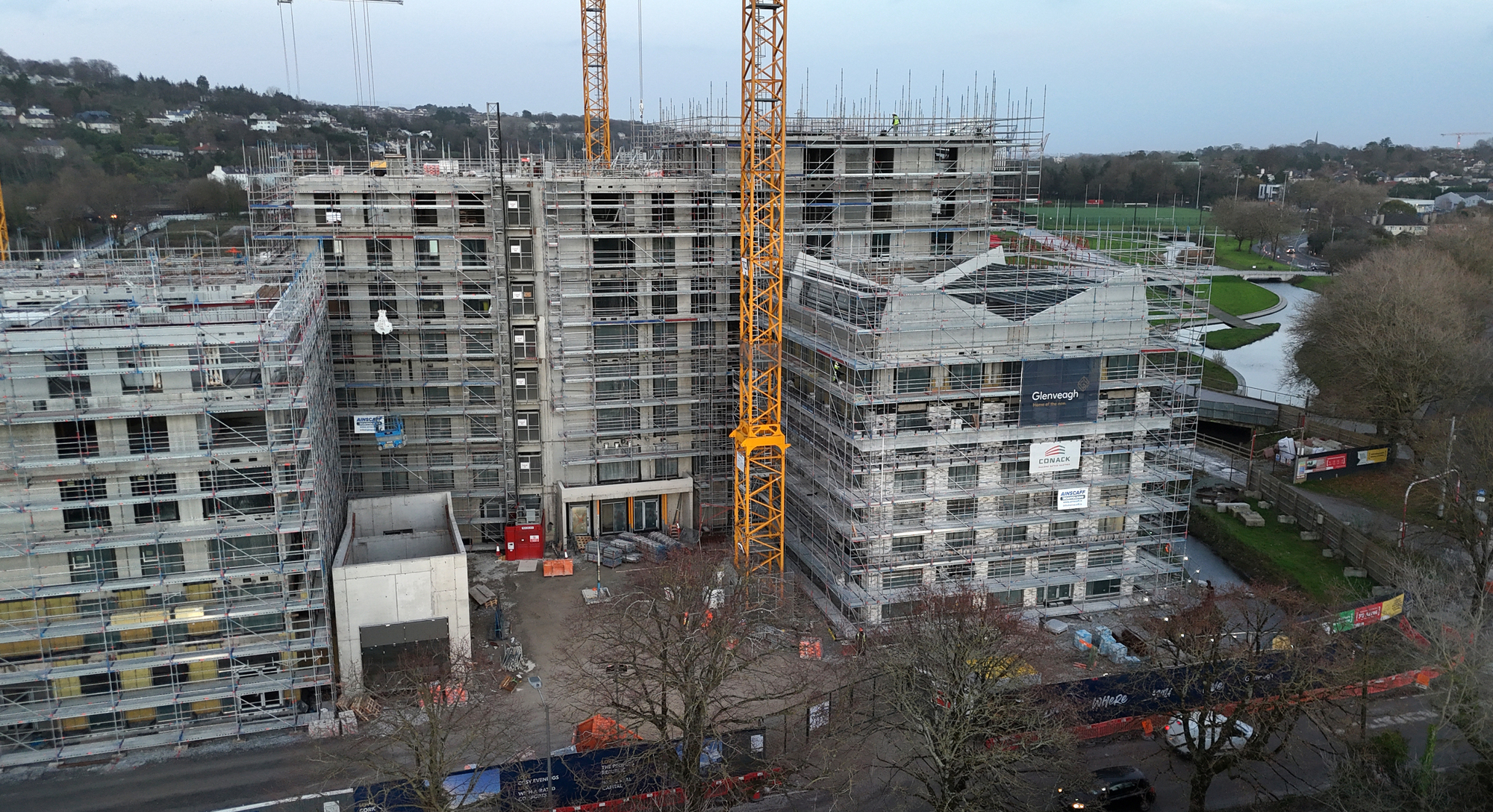
Debates over housing delivery inevitably return to shortages in water and electricity. Picture: Larry Cummins
It’s clear from the scale of construction, expansion and technological change currently taking place in Ireland that we are a country in flux.
The Future Cork series this week aims to capture the level of transformation that is taking place across the city and county, and that is being repeated nationwide.
Across housing, transport, ports, energy and digital infrastructure, the country is building at a pace not seen in decades, even if the pace of housing is nowhere near what is required.
Read More
Yet this level of activity also exposes a recurring theme: our long‑standing infrastructure gaps. Debates over housing delivery inevitably return to shortages in water and electricity. Port expansions require new roads, roads need land; data centres rely on new wind farms; Docklands regeneration needs LUAS lines, and LUAS lines need new bridges. The cart and horse are scattered across every discussion about the country’s future development.
The Government has acknowledged these bottlenecks. This week, it announced plans to simplify and accelerate the complex consenting, permitting and licensing systems that underpin infrastructure delivery in energy, transport and water.
Electricity demand is perhaps the most urgent constraint. A report from the network operator, Eirgid, highlights how our transmission network is already under strain, with consumption continuing to rise. Much attention has focused on data centres, which is understandable: by 2030 they are expected to consume around a third of Ireland’s electricity — making them the single largest demand category in the State.
But other sectors will also add significant pressure. SEAI projections show that Ireland could have up to 768,000 electric vehicles on the road and 675,000 heat pumps installed in homes by 2030. Heat pumps accounted for just 2%–3% of electricity use last year, but this is forecast to rise to 7% of national consumption by 2035, driven by retrofits and new-build homes. Because heat pumps draw heavily in winter, they also place disproportionate pressure on peak demand.
The EV projections are conservative, reflecting slower uptake in recent years. Ireland’s climate targets originally required almost one million EVs by 2030.
This week in Cork, new Irish Rail CEO Mary Considine set out a vision for an electrified future — beginning with the expanded DART network in Dublin, followed by the Cork commuter rail programme linking Mallow to Cobh and Midleton, and eventually the intercity network. Asked about the additional power this would require, she confirmed that Irish Rail is already in discussions with EirGrid and ESB Networks to ensure sufficient grid capacity. She noted that phasing the projects will allow capacity to build over time, but stressed that opening up Ireland’s ports for offshore wind development is essential.
Which brings us to a key question: how will Ireland generate all this power? According to EirGrid’s latest analysis, interconnection will play a crucial role. The Celtic Interconnector, linking France to Cork, is delayed until 2028 but will provide a major new source of supply. The Greenlink connection to Wales was energised last year, and a new North–South Interconnector is due by 2031.
New electricity generation is also coming — particularly wind, solar and battery storage — but EirGrid warns that most of the required capacity will not arrive until 2028. New gas‑fired generation will also be needed as backup. It is this shortfall over the next three years that EirGrid identifies as one of the greatest risks to Ireland’s energy security.
There are other constraints. Along with land, planning and water constraints on housing development, manpower is also having an impact. This week, the Property Industry Ireland (PII) predicted that around 25,000 additional construction workers annually would be needed until 2030 to meet the Government's goals. Right now the industry employs 177,600 construction workers bt almost 300,000 are needed to build at the rate we require.
When speaking at Apple in Hollyhill this month, opening their new offices, Taoiseach Micheál Martin was asked about the State's continued reliance on just three multinational companies paying a third of our corporation tax receipts. He said that, along with putting money away in the Future Ireland Fund for our ageing population, excess tax receipts will also be used on infrastructure that he described as "an investment in the productive capacity of the economy".
There is another constraint on rapid and significant progress and infrastructure development, and that is trust. The belief by the wider population on major development projects is that they take too long to complete and often end up over budget if they are developed at all.
We often compare ourselves unfavourably with other nations. Smaller European cities extend tram networks at a fraction of the cost and time projected for Cork. Larger economies, like China, push ahead with massive infrastructure projects at unrivalled speed.
Ireland's ambitions are not in question, but questions remain over our planning systems, our energy grid, our workforce, oversight and whether they can match the scale of what we wish to achieve.
CONNECT WITH US TODAY



Be the first to know the latest news and updates