Jack Anderson: 10 years after Ali's death, the greatest lives on in memories
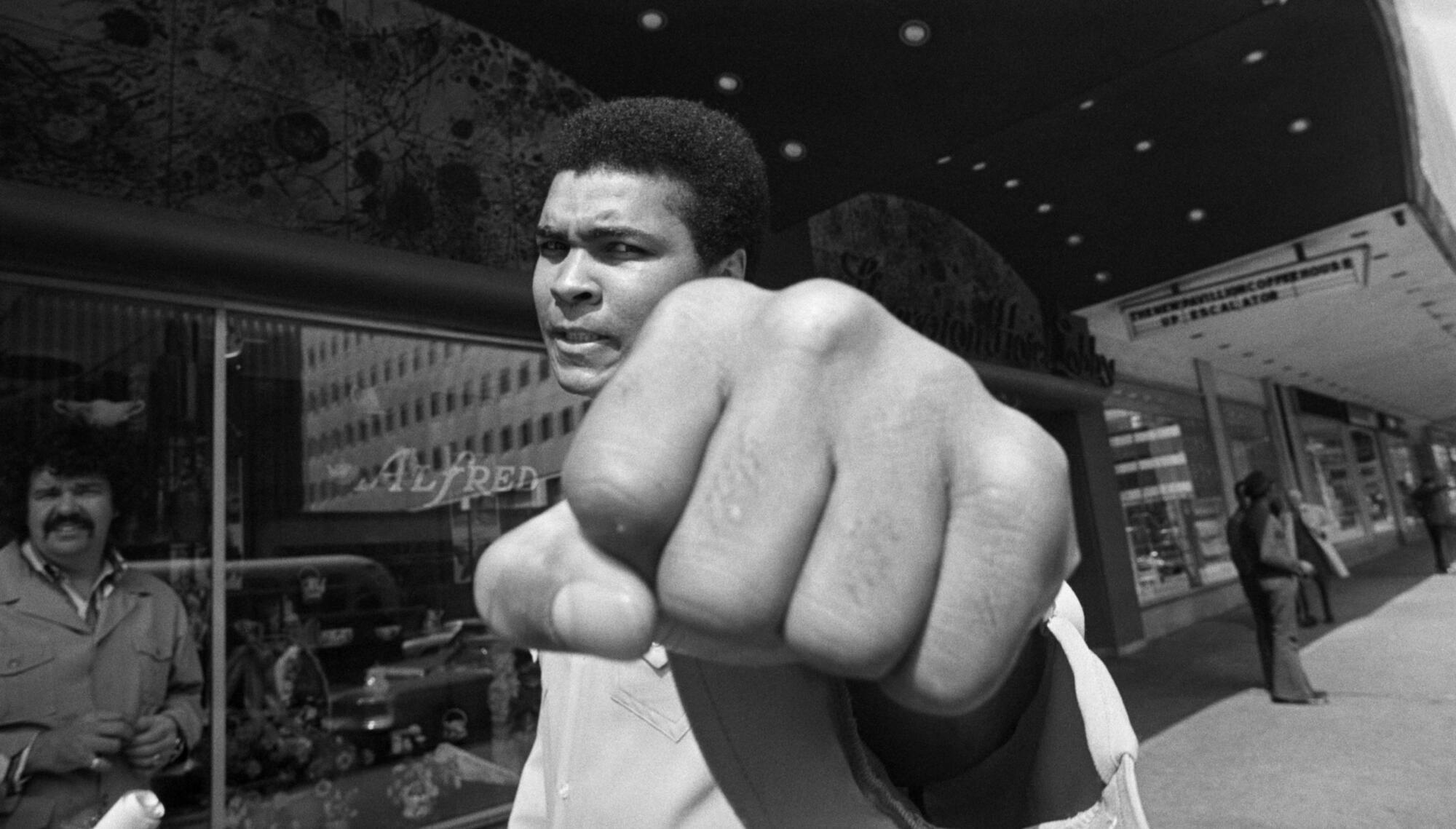
THE GREATEST: Muhammad Ali. Getty
It’s 10 years to the month since Muhammad Ali died. As a boxer, athlete-activist, and self-marketeer, he was ahead of his time. He also died ahead of his time. In boxing we know that repetitive blows to the head can later lead to chronic brain trauma. We’ve known that for a century thanks to a scientific paper published in 1928 by an American pathologist Dr Harrison Martland, who used a well-known boxing colloquialism, but little-evidenced scientific phenomenon, to headline his paper – punch drunk.
One of the few photos that exist of Martland is of him performing an autopsy at Newark City Hospital in the 1920s, a cigarette loosely pursed on his lips; just showing that medicine, even some of its greatest practitioners, can sometimes take a while to realise a danger billowing in front of them.
A century later and the gap in medical evidence on whether cumulative blows to the head in any sport can, later in life, cause neurological disease is now being well and truly filled by buckets of peer-reviewed scientific papers. The next step is to ascertain whether there is, at first instance, something in the genetic make-up of elite athletes that makes them more susceptible to dementia, Parkinson’s and Motor Neuron Disease (MND), which might then be aggravated or trigged by playing at the highest level.
There has been a lot of attention on this recently here in Australia following the passing of AFL great (player and coach) Neale Daniher who had MND. He organised a hugely successful and poignant awareness campaign – mainly by way of selling thousands of blue beanies combined with ice bucket and slide challenges. The campaign was called the “Big Freeze” to symbolise what MND does to the body.
Daniher loved his footy, its sense of community and comradeship, and it loved him back epitomised by the millions of dollars he raised to fund medical research, which may include the links between MND and sport. Daniher was a great man on and off the field. He epitomised one of the best, if slightly forgotten, Muhammad Ali quotes, “Service to others is the rent you pay for the room here on Earth.”
In a sporting sense, Muhammad Ali was of course the self-proclaimed “Greatest”. (Who really is the GOAT of sport is, well, a Messi debate (sorry), let’s leave that for now). For Ali, his battle with Parkinson’s was encapsulated by the lighting of the flame at the Atlanta Olympic Games in 1996. Ali had an ego. He was proud of his body. In his pomp, he could control it, his feet, his hands, like few boxers before or since and yet by 1996 that terrible disease meant he struggled with a torch. Despite it all, through sheer willpower and yes, probably because he adored being centre stage, he lit the flame.
Atlanta was 30 years ago. Thirty years before that in 1966, Ali was lighting another flame. In that year, he became eligible for the Vietnam War draft. He sought conscientious objector status but was refused in his home state of Kentucky. A year later at a scheduled induction into the US Army in Houston, he was called upon three times to step forward and accept induction. So as Rosa Parks stood up for her civil rights on an Alabama bus by sitting down, Ali stood up for his by standing still.
The most recognisable sports person on the planet (then at his athletic and commercial height) would be stripped of his boxing titles, banished into sporting exile and not return for years to the ring until allowed to do so by the US Supreme Court.
On his return, Ali fought too much and for too long. Outside the usual celebrated fights - the Rumble in the Jungle vs Foreman in ’74; the Thrilla in Manila vs Frazier a year later; the first man to win the heavyweight title three time vs Spinks in ’78 – the year 1976 provides a snapshot of his fighting career.
At the time he was the undisputed champion. In the 50 years since, the title has been diced like croutons in the alphabet soup of world boxing sanctioning organisations.
Ali fought four times in 1976. He had done the same in 1975. That’s eight fights in two years. Tyson Fury has fought eight times in the last six years. In February 1976, Ali fought a Belgian, Jean-Pierre Coopman. The so-called Lion of Flanders was a sculptor at heart. He stood still and straight as a piece of rock and Ali easily chiselled him in five. To be fair to Ali, only a few months earlier in October 1975, he fought Frazier in Manilla in one of the most brutal bouts of all.
In May 1976 in Munich, he fought England’s Richard Dunn again winning in five rounds in a bout that marked his last win by knockout. Before and after the Dunn fight Ali fought two excellent fighters, Jimmy Young (in April) and Ken Norton (in September) winning both controversially on points over 15 rounds. It was the third meeting between Ali and Norton. The best fighters then tended to fight each other more often than today, which is one of the (many) reasons why pro-boxing is in decline, overtaken by the UFC.
Speaking of UFC, in June 1976 Ali travelled to Japan to fight professional wrestler Antonio Inoki. They fought under modified rules in a bout that can be seen as a precursor to what would become MMA. Inoki kept kicking Ali in the legs leaving Ali with blood clots. As is so often the case with Ali’s opponents, Inoki (of Brazilian heritage) led an extraordinary life. In 1990 he negotiated with Saddam Hussein to release Japanese hostages during the Iraq war. Ali did the same for 15 US hostages.
That sprinkle of 1970s stardust from Ali; that mix of wrestling, martial arts, and WWE-style razzmatazz, has now crystallised into the professional form of MMA, the UFC.
Trump paved the Rose Garden, and this week used the remaining White House lawns to host a UFC event. The bread and circuses nature of that spectacle aside, the farrago that is professional boxing in the US right now is such that a young Muhammad Ali of today is more likely to start as an MMA fighter with the aim of being interviewed by Joe Rogan at a UFC event.
But that’s a debate for another day; for now, let’s remember Ali, ten years on, with one last story. The New York Knicks have finally reclaimed the NBA championship, their first since 1973. The last time the Knicks went deep into NBA finals was in 1999. As today, the supply of celebrities then seeking courtside tickets at the Garden outstripped demand. Ali, whose first fight against Frazier (the Fight of the Century) was at Madison Square Garden, applied way past the deadline but still got it. The then V-P of Public Relations for the Knicks (of course the Knicks would have a V-P for PR) explained that Ali got in under a special rule: “Exceptions are made if you are the Greatest.” And all sporting hyperbole aside, that was only right and proper, because he was.
CONNECT WITH US TODAY



Be the first to know the latest news and updates