John Fallon: Ferguson and Parrott partnership a puzzle Ireland need to solve
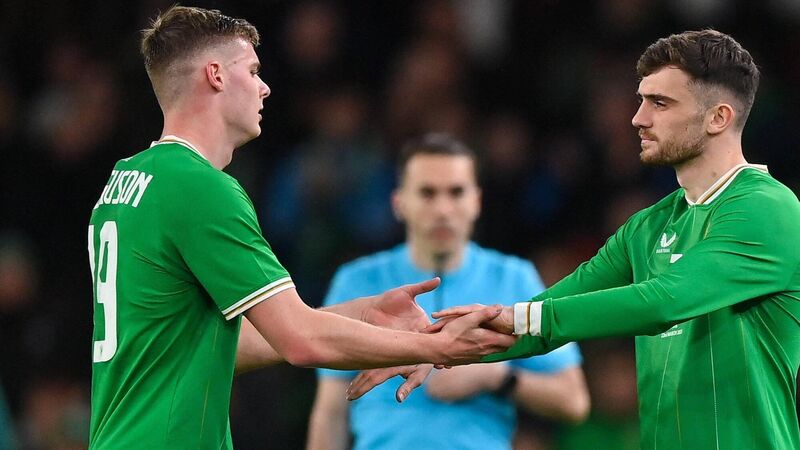
Evan Ferguson and Troy Parrott have only started for Ireland together on four occasions. Pic: Brendan Moran/Sportsfile
“Šín warns the national team about the teammate after whom the Irish named an airport.” So read the headline in a Czechia-based newspaper on Friday.
Matěj Šín was the go-to player for reaction to the draw, given he’s a colleague at AZ Alkmaar of Ireland’s sharpshooter.
He didn’t need to explain the threat of Troy Parrott to his natives ahead of the teams squaring up in the World Cup qualifier on March 26.
Europe and beyond had witnessed the Troy Parrott show dominate the closing window of the qualifiers; his brace against Cristiano Ronaldo’s Portugal followed by an epic hat-trick in Hungary.
Troy Parrott International Airport became a thing, again busting boundaries to a wider audience.
Sporting success, especially the rarity of football, ought to be rejoiced.
Should Parrott repeat his heroics in the Spring, the retitled Dublin Airport gimmick will last more than a week.
Parrott is the national saviour, in the same way Robbie Brady acclaimed that status at Euro 2016. Likewise Robbie Keane in 2002, Ray Houghton in 1988 and 1994.
Everybody adores a goalscorer. A week on from the brilliance of Budapest came the realisation, or reawakening to the fact, that Ireland actually has two.
On the same Sunday Parrott swelled his season’s club haul to 14, Evan Ferguson scored his first. To many, they seemed equal in importance.
Serie A outstrips the Eredivisie for standard and, while both suffered injuries this season, Ferguson’s challenge in securing a Roma starting spot on loan was tougher than where Parrott found himself.
Halcyon days indeed. Ireland’s two frontmen hitting the net on the continent could trigger a dash to the credit union for the masses, until there’s a check on their respective international track records.
Parrott was 17 when making his debut in 2019, Ferguson less than a year older for his bow in 2022.
Be it Frank Stapleton and John Aldridge or Robbie Keane with Niall Quinn, any stellar Ireland team seemed to be anchored by a consistent combination up top.
Ideally, Parrott and Ferguson would be an established partnership by now but the cold truth is they’ve only been in the same starting team on four occasions, three competitively.
Nobody has yet cracked the code on soldering the duo together. There’s only a perception that their skillsets don’t complement, that in their own right each provide a separate threat as a sole striker at the tip of the attack.
Maybe it’s not been tried and tested enough. Club schedules afford scope that international windows don’t, particularly since friendlies were effectively eliminated by the advent of Nations League fixtures that influence seedings for qualification draws.
Heimir Hallgrímsson frequently cites the benefits accrued from the long get-togethers his Iceland and Jamaica teams accrued before tournaments. That will be the case in early summer of 2026 but the next time he assembles his players will be four days ahead of the Czechia showdown in Prague.
Despite the age gap of two-and-a-half years, Parrott is a mere seven caps ahead of Ferguson on 33.
That’s predominantly due to his junior soon attaining the main-man status which eluded him.
Ferguson’s injury-enforced absence from the November window switched that mantle and it’s difficult to comprehend a situation in a one-off semi-final where one of these gems is kept in reserve.
Hallgrímsson has been the most amenable to accommodating them together.
Latvia at home in March 2023 was Ferguson’s first start and goal and he was replaced by Parrott with 17 minutes left.
They were paired by Stephen Kenny for the target practice against Gibraltar three months later while John O’Shea didn’t get the opportunity of experimenting over his four-game caretaker spell due to each incurring injuries in opposite camps.
Hallgrímsson began his tenure with Ferguson as his focal point, swapping them for the final 19 minutes of his first win away to Finland in October 2024.
It was the next assignment, away to Greece, that he opted to fuse them, deploying Parrott in a deeper role behind the ‘No 9’ Ferguson.
Although Ireland lost 2-0 in Athens, the second goal coming in stoppage time, morsels of encouragement were evident.
Parrott assumed precedence for the next outing, the away playoff in Bulgaria, before they were reunited in the starting line-up for the return.
Any euphoria about the Icelander landing on the magic formula was diluted by an underwhelming showing against Luxembourg. Yet some mitigation of it being an end-of-season friendly applies.
Hallgrímsson has since altered to a formation that Parrott’s has revelled in but it doesn’t sound a death knell for the dream duo.
“I can't see why not - I absolutely can't see why not,” he asserted over the weekend.
“You would always like your best players on the pitch but it depends on what the game is and who the opponent is.”
Czechia, four months today, screams a test that necessitates firepower. Maybe the alliance of these twin terrors has yet to take full flight.
News that former FAI director of football Marc Canham has joined CAA Portas shouldn’t be a surprise considering how much his former employers leant on the consultants.
Canham's departure in April ended a three-year spell with the FAI organisation which was ultimately overshadowed by his involvement in senior team management changes.
Vera Pauw insisted he was conflicted in spearheading the review that led to his dismissal within a month of returning from a first women’s World Cup in 2023. His ‘existing contractual commitments’ line from early 2024 came back to bite him when his timeline on Stephen Kenny’s successor fell asunder.
Affording Eileen Gleeson a fallback job within the FAI when promoted to women’s manager in December 2023 caused all sorts of collateral damage, as did his handling of her assistant Colin Healy’s exit when they were both removed.
CAA Portas were first retained by the FAI to assist on their Football Pathways Plan. Back then, they were known as Portas, a forerunner to being taken over by global giant Creative Artists Agency (CAA).
They were also enlisted to conduct an organisation review, the exercise which the FAI have cited for justifying their culling of 60 jobs, including some long-serving underage managers like Tom Mohan and Dave Connell.
Canham is also working with Limerick man Noel Mooney at the Welsh FA, mapping out a long-term strategy. Mooney will be fully aware from his knowledge of the Irish landscape of how the best-laid plans contained in a glossy presentation don’t necessarily come to fruition.
Centenaries across Irish football have been frequent in this decade and last weekend was the turn of the Galway football association to celebrate their 100th birthday.
It was fitting that the week after Ryan Manning helped the Irish men’s team secure their place in the World Cup playoff and a month on from Daryl Horgan leading Dundalk to the First Division title that the country embraces its history.
Over 300 people attended the gala dinner on Saturday, acknowledging the strident work undertaken through the hard times. Having the men’s and women’s senior teams under the same club banner of Galway United after some uncertain times has cemented stability for both.
The venue in which those teams play, Eamonn Deacy Park, is owned by the Galway FA and the stadium manager Noel Connolly was deservedly recognised for maintaining the pitch in tip-top condition amidst the unforgiving weather elements in the west.
It’s fair to characterise the men’s team's current state as transitional. Approaching the November 30 threshold for players’ contracts expiring, mainstays Patrick Hickey and Bobby Burns have led the exodus. Manager John Caulfield has managed to retain Corkman David Hurley but a series of other recruits are envisaged ahead of their third season back in the top-flight.
CONNECT WITH US TODAY



Be the first to know the latest news and updates