Colin Sheridan: A nation’s footballing identity is shaped not by its loudest figures but its truest
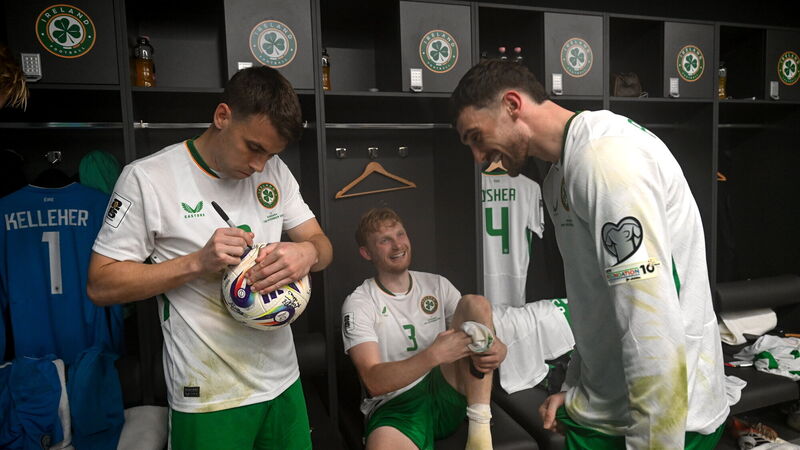
SIGN THERE: Seamus Coleman, Liam Scales and Troy Parrott of Republic of Ireland in the dressing room after the win in Hungary. Pic: Stephen McCarthy/Sportsfile

On his return from a trip to Cairo, the French novelist Gustave Flaubert wrote to a friend; ”I’ve come to the conclusion that things we expect rarely happen.”
That’s how it was last Thursday night at the Aviva, and that’s how it’s always been for Seamus Coleman. From a young lad growing up in Killybegs to one of the most respected footballers in England's first football city. Brutal injuries. Missed opportunities with other clubs. His has been a career of unexpected twists and turns and quiet rebellion. He owned last Thursday night, but, knowing him as we think we do now, you can be certain he will never seek the deeds.
There are men who age loudly, and there are men who age softly. And then, more rarely, there are men who do not age at all, except in the way bog oak ages: darkening, deepening, becoming more itself with every passing year. Seamus Coleman played football as if time had finally conceded defeat and stepped aside for him. Ireland’s sensational win over Portugal was the context, Ronaldo’s red card the theatre. But the performance that will live long after the evening fog has rolled off Lansdowne Road belonged to one man, our reluctant, understated hero from Killybegs.
Coleman, now deep in the winter chapter of his career, should not have been able to do what he did. He should not have been able to marshal, cajole, dominate, and occasionally terrify footballers nearly a generation younger. Yet he did, and he did it with the same blend of ferocity and humility that has characterised his career across more than 400 appearances for Everton and upwards of 70 for his country. Even in the roars and the chaos of the night, his manner remained unchanged: no theatrics, no designed persona, no Instagrammable swagger. Just Coleman being Coleman, which is to say, being the purest version of himself.
There’s a temptation, always, to centre Ronaldo in any narrative he graces or disrupts. His dismissal was operatic, the full martyrdom routine. But focusing on Ronaldo would be to miss the point. His departure was only the shadow that made Coleman’s light burn more brightly. Because while Ronaldo represented everything modern football has become, Coleman represented everything it has forgotten how to value.
And this is where the story deepens. Because Coleman’s greatness did not come easy. His career has been a test of durability, of faith, of the ability to climb out of pits most men would not escape. The horrific leg break he suffered against Wales in 2017- one of those injuries that shushes a stadium - should have ended him. Many believed it would. It was the kind of moment that makes careers buckle and courage evaporate. Yet Coleman climbed back, grim-faced and resolute, as if defying the idea that something as trivial as a shattered leg could deny him what he felt he still owed the game. He returned not diminished, but distilled.
And then there is the matter of loyalty. Football loves to write poetry about fealty while seldom practising it. But Coleman - valued, courted, quietly coveted by far bigger clubs during his pomp - simply chose not to leave Everton. He stayed when others understandably left. He stayed when the club slipped, stumbled, and agonised its way through seasons that would have broken weaker men. He stayed, one has to guess, because he wanted to. And you dare say he does not regret it. Because regret does not live in a man like him. He is built from sturdier stuff.
Ireland has produced many extraordinary athletes, but few whose greatness has been defined not by self-promotion or spectacle, but by the profound absence of both. Coleman’s heroism is the quiet kind, the ordinary kind, the kind that looks you straight in the eye. He is, in that sense, perhaps one of Ireland’s greatest ever sportspeople - not because he has shouted his way into the pantheon, but because he has crept through its doors without making a sound.
On Thursday night, against Portugal, he played like something ancient - the last practitioner of an old craft. His timing in the tackle was archaeological in its precision; his positional sense felt hewn from stone; his leadership radiated that soft-spoken command we once expected from Irish captains as a matter of national character.
And this - - is the point Irish football must understand. If the sport in this country is going to evolve, truly evolve, it must anchor itself in something real. It must root itself not in flickers of fleeting talent, not in tactical fashions, not in imported philosophies, but in the values embodied by Coleman: humility without meekness, intensity without ego, courage without performance. This “Seamus-ness” is not a skill set; it is a worldview.
A nation’s footballing identity is shaped not by its loudest figures but its truest. And for more than a decade, Coleman has been the quiet custodian of Irish football’s conscience. His presence has been a moral compass pointing north whether anyone bothered to check it or not. We always knew it, but never centred it the way we should.
Someday in the not-too-distant future, we will face the first Ireland squad without him. We have before. We thought he was done, and it didn’t serve us well. But when that day does finally come, we will feel the small national sorrow of losing not just a player, but a standard. Thursday night, then, was more than a victory; it was a reminder - of what we are capable of when led by a man who has devoted his career not to acclaim but to service.
Ireland beat Portugal. Ronaldo, the pantomime villain with the 12-year-old's haircut, exited one way, Coleman another. Ancient but ageless, he showed us the way forward by doing what he has always done: carrying us, quietly, steadily, without ever once asking to be carried himself.
If Irish football is to build anything worthwhile in the years ahead, let it be built upon that.
The “no-progress” rule in snooker allows the referee to stop a frame, re-rack, and begin again if they feel neither player can nor will attempt to pot a ball. A version of the same rule should be introduced to international rugby, without the option of starting again.
That is all Ireland’s victory over Australia on Saturday night really taught us. While balls were potted, so to speak, it only happened after they were kicked, dropped, kicked and dropped again. And again. And again. Australia’s inability to execute the most basic rugby skills made the game an appalling spectacle and an even worse advertisement. For long periods, as the ball was launched skyward with such regularity you could time your runs to the fridge, it seemed to be that this was the first time either team had played in the rain. Doesn’t it rain in Melbourne? Certainly, Mack Hansen can’t go from his car to Dunnes Stores in Galway without getting drenched, so, in that respect, Ireland - though slightly less prone to error - were equally as guilty. Missed kicks, backways kicks, an attack that had all the imagination of early AI, one would’ve been relieved to hear both teams went on the piss at the Portugal match the other night, as it would’ve accounted for the slop that was served up.
If your main offensive strategy is to kick the ball to your opponent and hope they drop it, then the team and the sport itself is culpable. “Stop watching,” I hear you say, and that’s fair enough. But, even to this old cynic, rugby when played right can dish up some memorable magic. You can’t blame the rain (in Ireland, in November) for Saturday night, only the players who kicked and dropped and kicked again and the coaches who told them to.
Steph Curry and Under Armour have finally gone their separate ways, ending a partnership that always felt like a defiant little miracle in the shadow of LeBron and Nike. For more than a decade, Curry and UA complemented each other perfectly: the overlooked superstar and the underdog brand, rising together through craft, character and an almost stubborn refusal to chase cool for its own sake. Curry didn’t need the swoosh; Under Armour didn’t need a cultural empire. What they built instead was something quieter, purer, and ultimately more resonant - a reminder that greatness can grow outside the expected corridors. Their split marks the close of an era, but the legacy of their unlikely alignment will endure.
On Saturday night, the Palestine men’s football team played a friendly against a Basque XI - a match rich with symbolism, solidarity and loud defiance. Encounters like this matter because, for Palestine, simply stepping onto a pitch is an act of global visibility. But it should not fall to individual teams or associations to offer that stage. The Basque Federation, like Bohemians FC with their women’s side in May, stepped up where football’s governing bodies have stayed suspiciously low. UEFA and FIFA, who endlessly preach “the global game,” should be the ones ensuring that Palestine are embraced, supported, and given the fixtures and recognition every national team deserves. Until they act, others will continue filling the moral vacuum they leave behind.
CONNECT WITH US TODAY



Be the first to know the latest news and updates