Clayton McMillan warns Munster must change or risk remaining also-rans
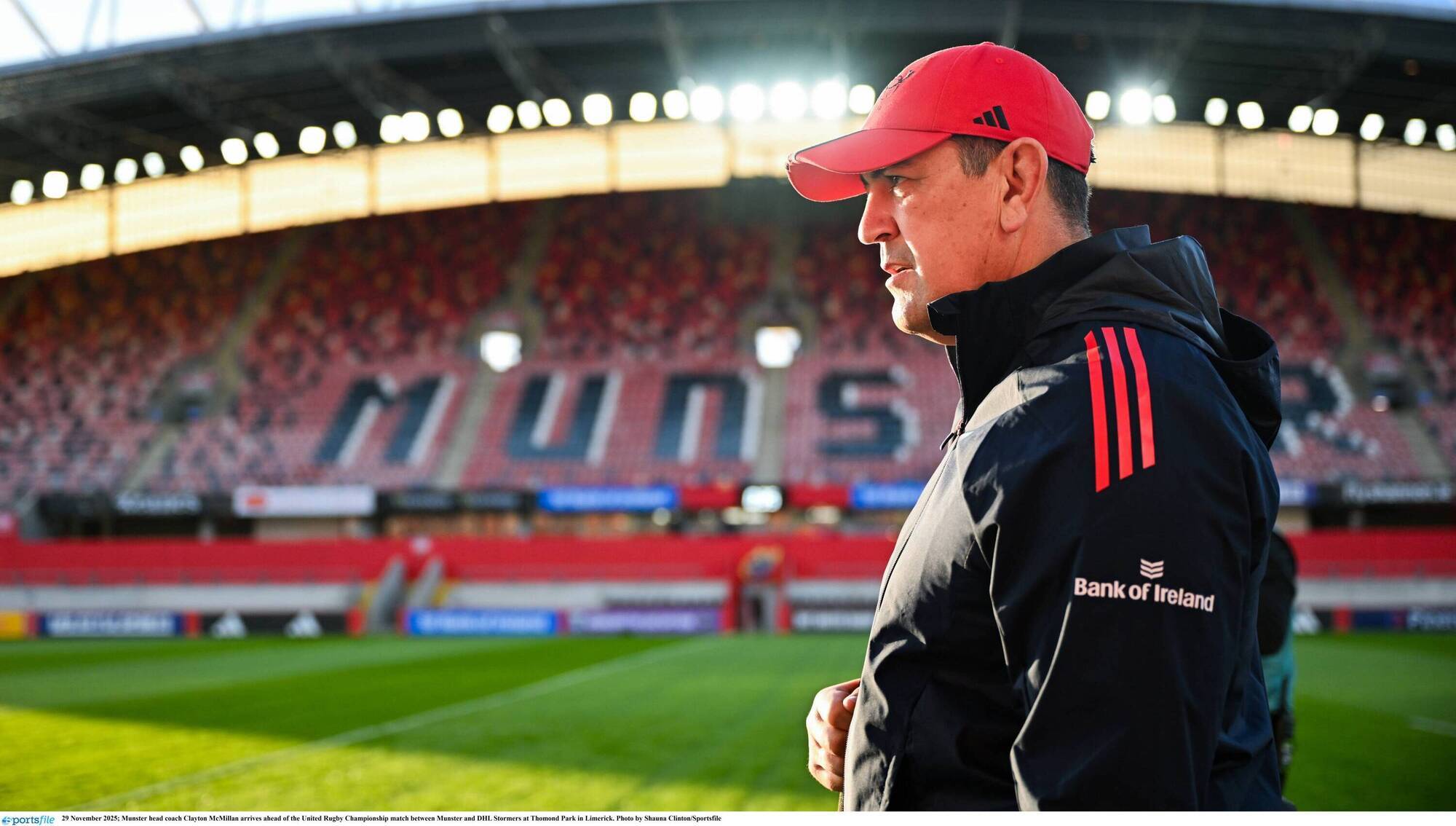
Clayton McMillan: “It's been a challenging year for so many reasons which we won't delve into, but it's been incredibly rewarding and certainly there are experiences that I'll get significant growth from." Pic: Shauna Clinton/Sportsfile
Clayton McMillan did not leave New Zealand for an easy life, and he certainly hasn’t had one coaching Munster Rugby this season.
Yet for all the trials and tribulations of an often fraught first year as head coach in Ireland, the former Chiefs boss reckons he and his players will be better for their experiences, as long as others inside the organisation are willing to row in the same direction as his high-performance unit.
With the Munster squad having disbanded for the summer on Wednesday, 10 days before the 2025-26 season concludes with a URC Grand Final up the road in Dublin, McMillan’s message was crystal clear: change needs to come or the province will continue to be also-rans.
The 51-year-old Kiwi presided over a campaign which was distinctly erratic on the pitch, a maiden season riddled with inconsistency from his team, a strong start, including a big victory over Leinster at Croke Park, undone by a litany of shockers from the end of October onwards.
Read More
Failure to exit their Champions Cup pool after a Thomond Park loss to Castres in the final round led to a meek Challenge Cup exit in Exeter and the push for a URC play-off berth was hit by a spate of late-season injuries as Munster scrambled into fifth place on the last day of the league campaign, resulting in a heavy quarter-final defeat at altitude to the Bulls in Pretoria.
Yet it was the off-field issues that surfaced along parallel lines which also undermined Munster’s efforts. A request for voluntary redundancies within the wider organisation, intentions to depart announced by assistant coaches Mike Prendergast and Alex Codling, and an ill-judged and poorly handled hiring of McMillan’s former assistant Roger Randle as his new attack coach for 2026-27 had the first-season head coach publicly pondering his future at the province just a third of the way into his three-year contract.
An Independent Governance and Organisational Review has been commissioned by the Munster Rugby Board as a result of the Randle affair. On Thursday, McMillan chose not go into detail on the specifics of the aborted move for his former colleague, derailed not only by a public outcry over historical rape allegations, strenuously denied, by Randle, but also the process by which he was appointed, which led to the resignations of three members, all ex-players, of Munster’s Professional Games Committee.
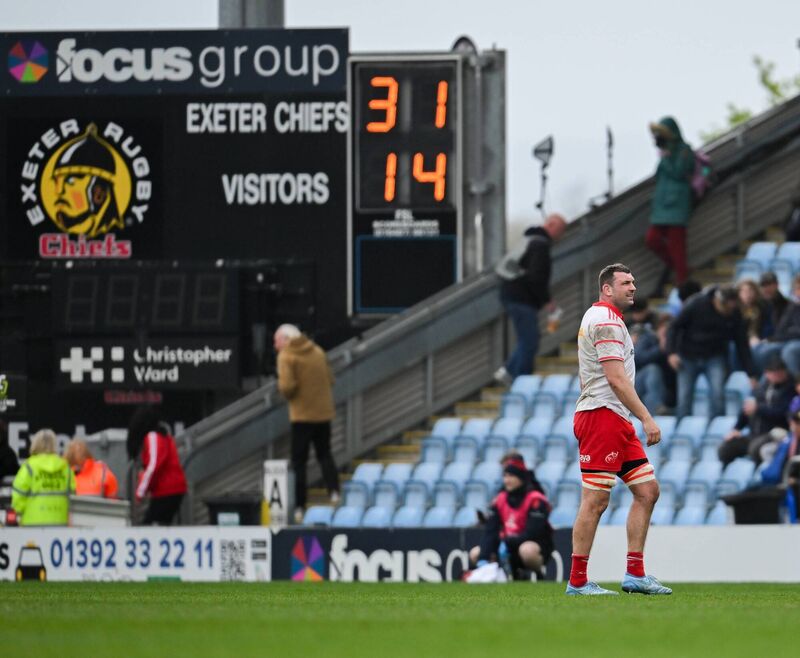
“It's been a challenging year for so many reasons which we won't delve into, but it's been incredibly rewarding and certainly there are experiences that I'll get significant growth from,” McMillan said. “And that's why I'm here.
“I could have stayed at the Chiefs in New Zealand Rugby and been pretty comfortable and not had to cause any disruption to my family, but I can say categorically that I wouldn't have had the growth through the experiences that I've had, both good and bad, this year that I would have had if I'd stayed in New Zealand.
“So, there's been challenges but also highly rewarding and as in anything in life, when you get growth, you get better at your craft and will need to be for the benefit of the team and the club.”
McMillan accepted his first season coaching away from New Zealand had been an eye-opener on so many levels.
“It's probably just a greater awareness around all sorts of things that maybe other people just wouldn't put value on. So, the size of the squads, integrated models around academy players and senior players, how AIL and club rugby filters into the professional arm of the game; the length of the season, the travel components, the different referees, the different styles, the weather, playing through Christmas, coming to work in the dark, going home in the dark.
“They're all experiences that you just don't necessarily get in other parts of the world.”
He said he was “still grateful for the lessons,” and convinced both he and an “extremely youthful side” would be better for him having learned from them, adding: “I'm convinced it will pay dividends for us.
“I think we would have awareness as a coaching group that there's definitely things that we can be better at and own around ‘are we delivering a game? Have we got absolute clarity and alignment around how we want to do that and is that what the players see and feel and then able to go out and execute?’
“I think it's fair to say that we haven't always found that rhythm, but I think through all of the challenges it's made it clearer around where we need our game to go.”
McMillan said he was excited by the appointments of widely travelled new assistants Jimmy Duffy (forwards) and Jared Payne (attack and backs), the latter who will share his portfolio with promoted skills coach Mossy Lawler. Yet McMillan also acknowledged his coaching ticket’s main aim was to find that consistency of performance which proved so elusive in his first term.
Was fifth place in the URC and a European top-tier pool exit a fair reflection of Munster’s current standing or a source of frustration at potential unfulfilled?
“It's a good question, it's a little bit of both actually. I guess the way that I look at this is it's one thing that we never want to disappear from this environment is the aspiration and the expectation that comes with being involved with Munster.
“The moment we start setting the bar lower is when things can go really pear-shaped. So I welcome that, I welcome everything that comes with the expectations that come with being involved with Munster. Our challenge is to live up to that, or not even live up to it, but to create and add to the legacy through playing well, winning silverware and promoting people to the next level.
“In terms of our results, it depends on what lens you look at it through. So there would have been teams, let's use Ulster for example, who I think played a really exciting brand of rugby and for the stuff that I did read would have been praised for the rugby that they did play, but still ended up where they ended up.
“And we probably had some exceptional days at the office, Croke Park comes to mind, and then a lot where we just kind of bumbled our way and got across the line. We are where we are.
“I don't think we were lucky to get into the finals. I think we were still good enough to be there, finishing fifth place. A win against the Stormers at home, which we were well in control of (leading 21-6 at half-time but losing 27-21), a couple of bonus points here and there, and then all of a sudden you're potentially looking at a home quarter-final, not having to travel to Africa, and things could look different.
“The same could be said for Europe. We lost the game at Toulon that we probably feel like we should have won. Lost by two points, lost (to Castres) by two points. Small margins, but they have big consequences.
“And so we've just got to be better, because that's the game. And I've talked about it all year around raising the floor and the difference between our best days and our worst days, and I still think there's a significant gap that we need to narrow significantly.
“But the optimism comes from knowing the lads, knowing how hard they work, how open they are to learning.
“If we as a coaching staff, as a club, if we could all start rowing our boat in the same direction, give the players the clarity, then I'm really confident we can do that. You can't be outstanding one week and not so good the other week. The fact that you have, say, the Croke Park days is evidence that you have it in you.
“It's not a fluke. It's there, just being able to keep close to there more regularly. That's what I think you see from the best teams in the competition. It's not a case of capacity or capability, it's consistency.
“I think good teams have the ability to be consistent. I'd be a big believer that what you see on the weekend is a reflection of how you operate daily, around your habits. And that's not to say that guys don't do that here.
"People will run through a brick wall here if you ask them to do it. But that's around driving a little more self-reliance, owning your own ship and driving it. Us as coaches and staff have to be better at assisting them or holding them to account to find that consistency and drive their own ship.

“I don't want to pre-empt anything on that. We've got a new coaching group coming in. We've got new ideas. And I think it would be remiss of me to not allow these people (Duffy and Payne) to come in and add their own flavour around what we think we can improve on, where we need to.
“The ideas we have, bring them to fruition. I wouldn't want to pre-empt that. But I would think the players that we've talked about and the discussions we've had as coaches, I think there would be a lot of excitement around the direction we want to go.
“My view would be that, and I'm not just talking about the rugby team, I'm talking about us in the High Performance building and us as a team, as an organisation. We need to make some change. And even if we make that change, there's no guarantee that it's going to bring you silverware. But if we don't make the change, it'll guarantee we don't.”
McMillan is confident that change will come, and added: “A new day, a new season, represents new opportunity.
“For a lot of different reasons, as I said, I'm grateful for the journey we've been on but it's been tough, not just on the players and the club, personally, for everyone.
“I'm not happy about that, but it happened. And as with anything in life, you live and learn, and you grow from those experiences and it helps shape to make you better. I think it's actually given us, it will give the club and it will give the team a lot more clarity around what truly needs to be fixed.
“And it's not all insurmountable, but there's also a lot of low-hanging fruit that I think we can pluck off and get better. That's our aspiration every year, is to come back and be better. I always believe that, every year, no matter what team you're with. But the proof will be in the pudding.”
CONNECT WITH US TODAY



Be the first to know the latest news and updates