Mick Cleary: Five reasons why the All Blacks fixture is still rugby’s draw card
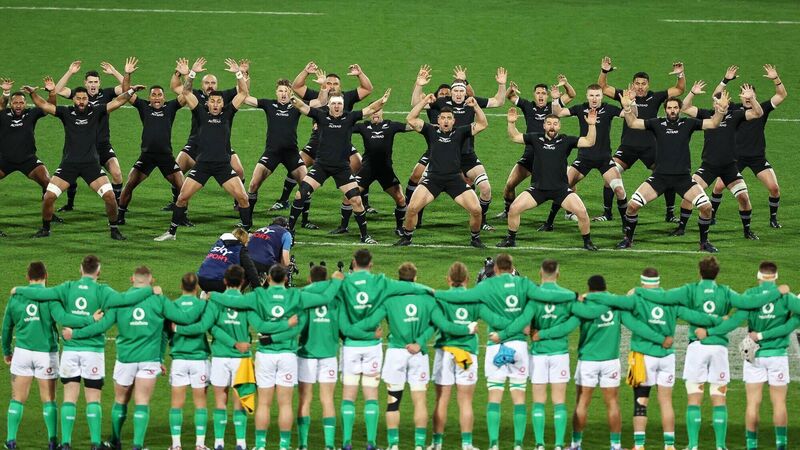
FIVE REASONS: The All Blacks may have shown vulnerability of late but come kick-off time at Soldier Field on Saturday there will be a frisson once again among those clamouring to watch. It is a special moment when the All Blacks are in town. Picture: ©INPHO/Photosport/Grant Down
You can box and cox it however you like, and, yes, you can bang on about the current status of the Springboks (worthy back-to-back world champions and in a class of their own at the moment) but there is still something mystical and magical about the sight of those black-shirted warriors trotting down the tunnel and heading to the centre circle to get ready for the haka. It’s not logical and it’s no longer statistically correct given that Ireland have won five of the last ten encounters after breaking their duck in Chicago nine years ago, but the All Blacks still represent the ultimate challenge in rugby.
Sport reduced to data – carries and metres and dominant tackles (whatever one of those is) - has never had much appeal. The All Blacks transcend all that. They may have shown vulnerability of late but come kick-off time at Soldier Field on Saturday there will be a frisson once again among those clamouring to watch. It is a special moment when the All Blacks are in town, even if it’s in Midwest America.
Read More
It may be a new found thing but it’s real and present nonetheless. It took a New Zealander, Joe Schmidt, to haul Ireland up by the boot straps and make them believe in themselves and show to their All Black opposition that they had absorbed from their Kiwi mentor all the traits that make for a number one ranked side. Chief among them is belief, the sense of never giving up, of always staying in the fight until the final whistle as every single All Black side has done down the ages, somehow winning when all seemed lost. 2013 anyone? Ireland in the clear, 30 seconds left, New Zealand deep in their half when they get a penalty. We all know what happens next. Multi-phase All Black attack, try in the corner, conversion from the touchline. The Great Escape. Again. No amount of twiddling on the rosary beads was to deny the All Blacks. But the tide turned in Chicago in 2016, the spirit of ‘Axel’ Foley inspiring Ireland to summon up great things. The ‘return’ fixture in Dublin a fortnight later was a bar room brawl, New Zealand reaching deep within to regain their honour. And so it has continued. Soldier Field The Sequel to come.
The All Blacks in Chicago is the first in a trilogy of games against the southern hemisphere in this autumn window that will tell us so much about Andy Farrell and his Irish team in the post-Lions era. It will set the tone and sketch the future. With Australia and South Africa also to come in this bloc (along with Japan who, despite the Eddie Jones connection, have little chance of repeating their 2015 World Cup heroics) this New Zealand match will lay down a marker for what is to come. Put a dent in the All Blacks and the ever-increasing whispers of Ireland being over-the-hill will fade away on the Chicago night air. Andy Farrell will get some breathing space as he looks to find a way to transition through this period and regenerate the side in time for the 2027 World Cup in Australia. Lose, and the questions get louder as to whether Bundee and his well-travelled pals who have done such fine service for Ireland might not make it to the start line in Australia. Farrell will have to use all his powers of street oratory to rouse his troops for Soldier Field. It’s time for Hurt Arena II.
It still does it for me even though there are many who find that the pre-match ritual has become overblown and unnecessary. Ignore them. They are just making a song and dance about a song and dance. Of course, it is a modern invention, a contrivance even. It was only sprung upon rugby audiences in the 80s through the efforts of that great Maori warrior, former All Black captain, Buck Shelford, who recognised it for what it was, a deeply symbolic gesture for New Zealanders and a means of getting his men in the mood. It’s theatrical and memorable, at no time more so than when Willie Anderson gave the Kiwis some back, snarling and shouting and meeting the challenge head-on. There have been many such dramatic moments. Who can forget ‘Caveman’ Chabal and the French insurrection at the 2007 World Cup? Yes, it has become over-the-top but it is all part of the afternoon’s entertainment, a tingling prequel of what is to come.
Colin Meads, Ian Kirkpatrick, Brian Lochore, Frank Bunce, Jonah Lomu, Buck Shelford, Michael Jones, Sean Fitzpatrick, Zinzan Brooke, Christian Cullen, Jeff Wilson, John Kirwan, Richie McCaw, Dan Carter, Ma’a Nonu, Beauden Barrett, Ardie Savea, Will Jordan…. And on it goes, the All Black conveyor belt.
CONNECT WITH US TODAY



Be the first to know the latest news and updates