Maurice Brosnan on football: Cork needed a method to make it a famous day
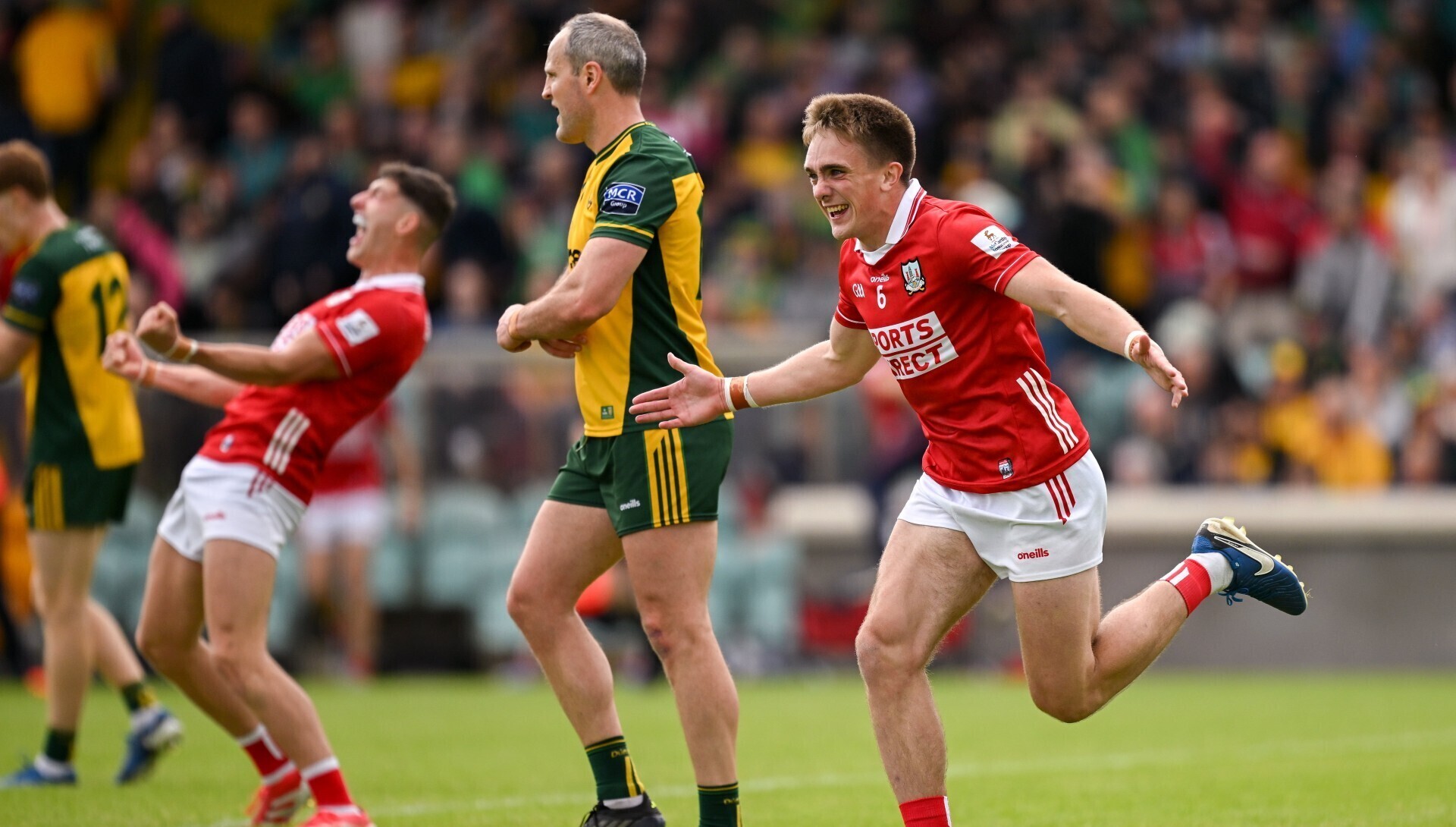
JOY UNMATCHED: Tommy Walsh of Cork celebrates. Pic: Ramsey Cardy/Sportsfile

When the Football Review Committee sledgehammered the sluice gates, the pent-up river of the new game burst in a torrent: more scores, more phases, more speed, more events. Rush forward, don’t look back.
Naturally, after the initial surge, there would be a period of examination and adjustment.
Nobody knew what the successful template looked like but everyone wanted a breakneck game. It was going to take time for a team to do something different.
Back to that old adage, the hardest thing for many athletes is not learning to go faster, it's learning when to slow down.
To truly grasp why they would want to slow the current you must first remember the old rules and the philosophy that underpinned how so many teams played in the end.

In the pre-revolutionary era, an end-to-end shootout with a touch of orchestrated chaos was a way for the strongest, most skilful outfits to thrive.
Owing to the safety of possession once gained and the clinical ease of control once teams secured the ball, defending was absurdly difficult.
The odds were stacked against the defender: A vague and not robust enough tackle, a loose application of steps, the advanced mark, all conspired to make one-on-one defending a vanishing art form.
So teams opted to clog up the scoring zone and sit in. Attack evolved to be patient, to stretch that rigid defensive structure and work the score. This was a cynical, suffocating template that became the default setting.
Then the safety of possession soon saw teams opt to be conservative in possession. Certain underdogs deliberately turned down the flow, even when they weren’t faced with a blanket defence, much like Louth in the 2024 Leinster final against Dublin. A basic idea: they can’t hurt us if we have the ball for long, dull spells.
They wanted to stay in the game, to keep phases low; fundamentally, it was easier to be defensive with the ball than without it. Rather than trading blows toe-to-toe, in a frantic end-to-end "you go, I go" exchange, you throttle it down and naturally the game shrinks, becoming tighter.
For a certain cohort, this was a beguiling, if tedious, way to compete.
There was a legitimate fear around the FRC’s enhancements that the new kickout rule and two-pointer would widen the gulf between the top tier and the rest. So far, when it comes to scoring margin and shock results, that has not been the case.
The impulse for some teams is still the same: dictate their own terms. Coaches crave absolute control. Observers detest it.
This conflict is at the centre of every single sport, the ongoing friction between analytics and the gut, between a cold desire to win and the romantic wish to be entertained.
As it all advanced, teams began to evolve their set attack, learning how to navigate the 11v11. A stock manoeuvre was to overload close to goal and create space for the shooters on the outside. It was repeatable maths.
There was always a nagging question about what would happen if a team settled for that on the majority of their attacks, though. Last weekend, three underdogs went for such an approach: Cork, Louth and Monaghan. It paid off.
What that means for the future of the sport will be fascinating.
Here are eight observations from the Gaelic football championship.
Armagh 40 phases, Louth 41.
Armagh split their offence evenly between fast and slow. Louth opted for 27 slow attacks to score 2-13.
Effectively, Gavin Devlin elected to make it a four-versus-four or five-versus-five for the majority of the afternoon. They isolated their sharpshooters like Craig Lennon, Ciaran Downey and Sam Mulroy on the arc while stretching Armagh’s defence with exaggerated depth.
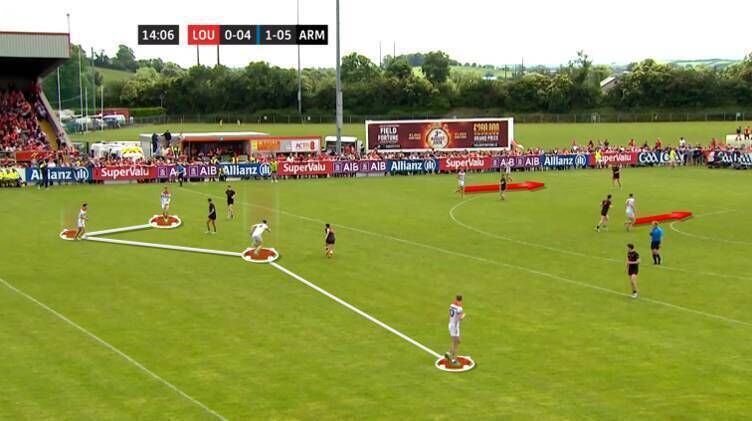
Some of their attacking interplay was sensational. Ciaran Downey scored 0-4 and assisted 0-3. Craig Lennon scored 0-3 and assisted 1-2. Sam Mulroy finished with 1-4 (1-2 from play), and assisted 0-4.
The undeniable virtue of such an approach is that it will almost always put a team in contention. Yet, they still needed some divine breaks on top of that. Dara McDonnell’s goal was born of a fumbled ball, before Lennon was able to get his toe to it and direct it towards the number six. Of their last eight shots, six were inaccurate. Even the dramatic goal was the result of a short shot and a glaring goalkeeping error.
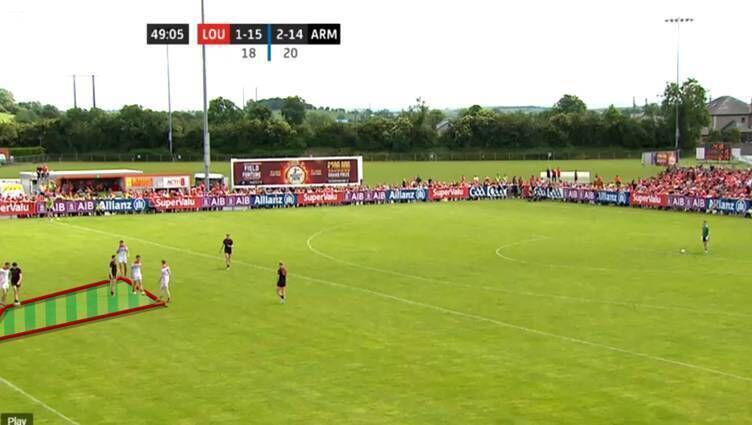
There were three foundational pillars to Louth’s gameplan. Niall McDonnell, who is a leading contender for an All-Star alongside Rory Beggan, retained 64% of his kickouts with their highly effective bunch-and-break routine.
***
Their attack adhered to that standard set approach while they defended deep, secure in the knowledge that Armagh are not natural, prolific two-pointer shooters. From five attempts, the Ulster champions converted just two, only one coming from play.
That was Jarly Óg Burns, who was immense once again. He scored 0-3 and assisted 1-3. Armagh had 15 turnovers, with every single one of them inside their own half. They turned the ball over ten times inside the opposition’s arc.
It makes for a fascinating tactical element of next Saturday’s blockbuster game. Kerry have been outstanding with their deep-lying defence. Armagh know they have to give them a reason to press out early.
In the 2025 championship and the 2026 league, there were approximately 83 team possessions per game. On Saturday in Ballybofey, there were just 63.
Consider Cork’s first three possessions: a two-minute attack resulting in a Dara Sheedy score; a one-minute attack ending in a turnover; a lengthy three-minute attack, another turnover; then a 90-second attack capped by a Stephen Sherlock two-pointer.
In an intense arm-wrestle with the All-Ireland favourites, John Cleary’s side made the logical deduction that a devastating attack can’t hurt them when they don’t have the ball. Their shrewd coaches made sure to stress to their players the importance of attacking in this glacial way.
After the final whistle, the Donegal players were swept away and loaded straight onto the bus while Jim McGuinness completed his media duties. He was in a rush himself, with his son involved in a minor B All-Ireland final that evening.
Meanwhile, Cleary was asked if it takes some convincing to make players realise the value of a controlled attack in the new game and how sheer speed might not always be their friend.
“It does,” he said.
“Yeah and I suppose, the Kerry game we got big criticism because we were too passive. We were slow. We have been working on one or two things. We knew Donegal would do the same, they hold the ball for two or three minutes over and back to tire out our defence. I thought our defence was heroic with the switches.”
There remains a nagging doubt whether such an approach would work in the wide-open spaces of Croke Park, but last Saturday Cork didn’t need it to.
They just needed a method to make it a famous day.
Look, Jim McGuinness is an extraordinary manager. There is no denying that. The All-Ireland winner is a masterful coach and a visionary contributor to the game.
Which is why we asked him afterwards about their defensive approach. In the league final, Donegal showed how they had learned the lessons of the All-Ireland decider with two brilliant, transformative shifts: a more aggressive set defence and an adapted kickout press, moving Michael Murphy out around the middle and keeping their fast runners in a four along the arc.
Come Saturday, they did neither. Murphy was back contesting kickouts at corner forward. Shaun Patton made his first start since the 2025 All-Ireland final and did not venture out as a sweeper.
It should be said, McGuinness can rightly point out that Donegal’s goal came from a short kickout to Daniel O’Mahony and a Murphy turnover. At the same time, eight of the kickouts Cork won were short or mid-range.
“We were,” he replied when we asked about trying to stop Cork going slow.
“We were tagging men inside, you can’t leave men free on the inside line either. We were trying to get extra bodies out to the front line to get heat on them. When you have seven, eight, nine inside, it is very difficult to do that. You will be caught with a ball in the corner or a high ball the square. We were pushing as hard as we could I felt under the circumstances. It was just the extreme nature of the depth, if you like.” This brings us to our pivotal point. This attacking template is now ubiquitous across club and county. What Cork did was remarkable in its diligence and execution, but it was not new. The next innovation will be what teams do defensively in such a tactical landscape.
Should Donegal have been better at shooting out and forcing Cork to speed up their attack? Is there another way to apply genuine heat on the ball?
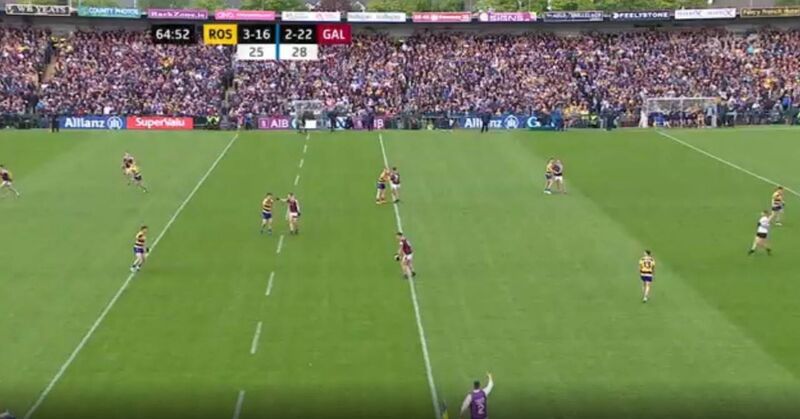
The Connacht final. Galway win a free in their own half. The opposition squeeze up. No option presents itself in front of John Daly. He boots it long, Roscommon regain possession and work a two-pointer for Daire Cregg on their way to the title.
Last Sunday. Galway win a free in their own half. The opposition squeeze up. A host of options retreat behind the free. That ensures there is an ocean of space in front of Paul Conroy.
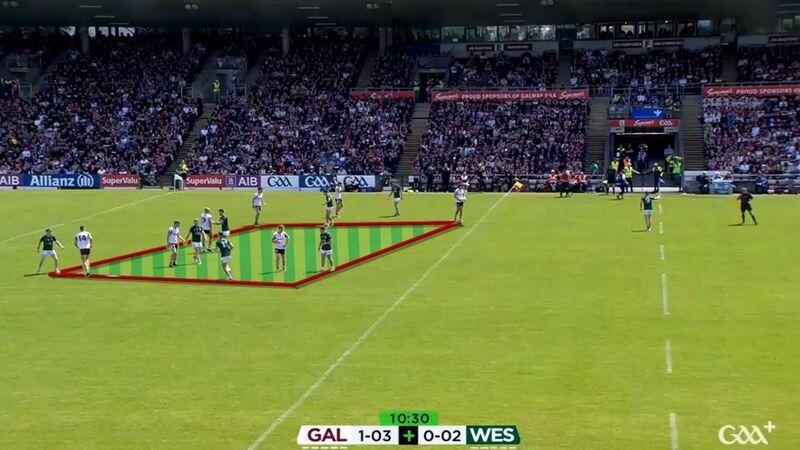
He gets a kick away to Cein D’Arcy, gets it back, and Cian Hernon sprints away from John Heslin. He torches his marker and rolls a shot into the bottom corner.
As Mayo’s Sam Callinan bore down on goal, there was exactly 32:04 gone in the second half. The game was tied 0-20 to 1-17.
His decision to punch over was met with mixed reviews from his teammates. Tommy Conroy at the back post had his hands aloft, pleading for the pass. Ryan O’Donoghue spun with his hands on his head at the near post. It proved costly as Niall Morgan slotted a clutch two-point free.
Speaking to RTÉ post-match, Morgan praised Michael Rafferty for his run in Callinan’s eyeline, ensuring the pass was not obvious.
However, to impose a ban on fisted points over such incidents is to spectacularly miss the point. In the end, Callinan and Mayo suffered over that decision. The game itself is the ultimate educator. A sport should not require a law to compel players to make smart decisions. The best teams do that regardless.
As well as that, the fisted point can often be the right option. In the second half of Dublin’s victory over Cavan, Con O’Callaghan gathered possession in the square with two Cavan defenders in front of him and an advancing goalkeeper. There was no obvious way of working a goal. At a fundamental level, the goal is to play what is in front of you.
From the next attack, Dublin forced a turnover in midfield. Niall Scully, a leading contender for an All-Star currently, looked up and saw it was two-versus-two in space. Colm Basquel gathered the ball, went for goal, and earned a penalty.
If ever Roscommon were going to spark, it was with 15 minutes left after debutant Jack Duggan came on and clipped a fine score. That made it a four-point game.
From the next kickout, Monaghan immediately ran a set-play.
“So much of the Monaghan players are just hanging back here out beyond the 65-metre line in front of the stand,” said GAA+ co-commentator Michael Meehan. “Nothing is going to happen here fast. They are going to try to take the sting out of this again. See if they can set up one of their set plays, create a bit of space for a hard runner to take someone on one-on-one.”
First, Monaghan elected to stack bodies on the left sideline, creating space for Stephen O’Hanlon to drive at Ronan Daly one-on-one.
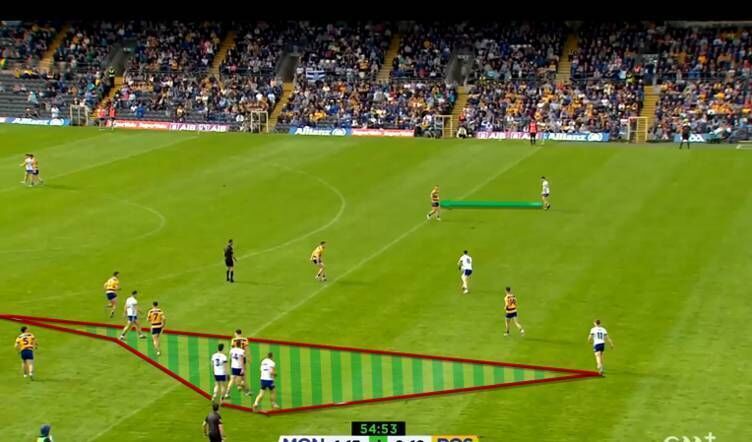
Daly defended it impressively, so they worked the ball back out to the halfway line with Michael Bannigan dropping back to free up Ryan Wylie. That meant they could attack the other wing with Dessie Ward curling over his third of the game.
Ten minutes: John Heslin drops a two-attempt short. Galway counter and Paul Conroy taps over.
Fourteen minutes: Kevin O’Sullivan drops a shot short. From that play, Darcy into open ground to score.
Thirty-four minutes: Sam McCartan drops a shot short after Westmeath try to ice the clock before half-time. From that, Galway counter with two superb kicks and a devastating goal.
“That is a killer,” said McHugh post-match.
“We know how dangerous dropped shots are. We have talked about it. I know the breeze was tricky, but we still should put them dead. At least you can press a kickout. It is disappointing. It is disappointing knowing that we have spoken about it, but the game takes a mind of itself out there. These are top level players. Decision-making in the height of the moment can be difficult.”
A gloriously open and unpredictable championship. Just as there is difficulty in identifying a winner, the fact that every team has lost at least once means the same cloud of uncertainty applies to players.
There is an understandable frustration with how weighted the All-Stars are towards the knockout stages, so it is worth taking stock of the form so far.
A thought experiment: Who is the current Footballer of the Year? What about the leading All-Star contenders, aside from Beggan, McDonnell, Scully, and Jarly Óg Burns, who we have already dealt with, who is currently in the race?
RTÉ/GAA+.
CONNECT WITH US TODAY



Be the first to know the latest news and updates