Talking Point: The things that change hit us harder on All-Ireland final day
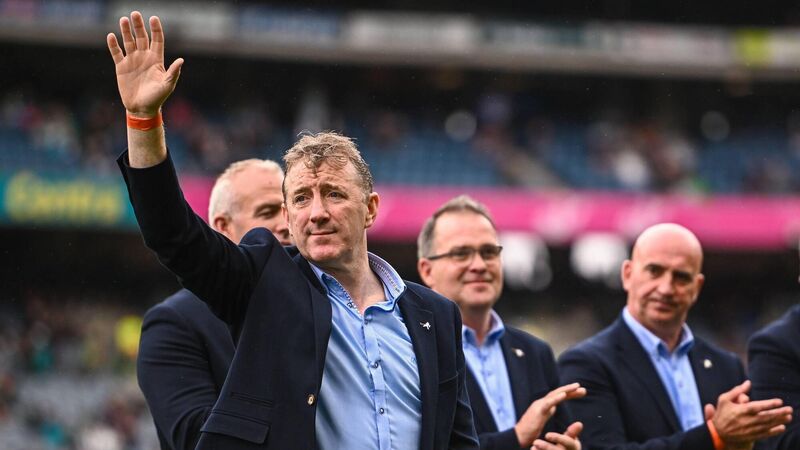
SHOWSTOPPERS: Offaly legend Brian Whelahan with the 1998 All-Ireland winning Jubilee team at last year's decider between Kilkenny and Limerick at Croke Park. Pic: Ramsey Cardy/Sportsfile
As soon as the train carrying the Limerick squad and management arrived into Colbert station on the night of last year’s All-Ireland final, there was a Garda car waiting to pick up John Kiely and Cian Lynch.
The car instantly sped off because Kiely and Lynch were on the clock, heading straight for the Woodlands House hotel in Adare, where the RTÉ cameras were set up in the bar area.
As Kiely and Lynch were in the car, Marty Morrissey was on the train platform, interviewing Darragh O’Donovan and Gearóid Hegarty. Minutes later, Jacqui Hurley in the TV studio went to Joanne Cantwell in an eerily quiet Woodlands bar.
“It’s a slightly quieter celebration – at the moment,” said Cantwell, just before she interviewed Kiely and Lynch. “But it’s not going to stay quiet for very long.”
It didn’t. When the live feed returned to the Woodlands around 15 minutes later, the players, management and their families were in the room, Cantwell having to speak louder to have her voice heard above the cheering and shouting.
It wasn’t your usual post-match All-Ireland winning celebration. Lynch did his interview in shorts, a Limerick training top and a white baseball cap. When Peter Casey was presented with his man-of-the-match award, he also accepted the crystal from then GAA President Larry McCarthy in shorts and a T-shirt.
Limerick had decided to do everything differently beforehand. The genesis of their thinking stemmed from Caroline Currid, their performance coach, who told the group that everything should be about the players and what they wanted to do, as opposed to what everyone else thought they should do.
The players decided to wear their own clothes, as opposed to donning suits at the post-match banquet, and more casual gear at the official homecoming. They didn’t want to waste any more energy getting fitted for suits the week before the All-Ireland. They had enough of them. They only wanted to zone in on the match. And when it was all over, the group only focussed on enjoying every single moment of the celebrations - on their terms.
Limerick enjoyed it all so much that they privately admitted afterwards that this group could never see themselves staying in Dublin again after an All-Ireland final.
It was hard to blame them. The squad and their families had their own space in the Woodlands House hotel on the Monday morning. They spent most of that afternoon relaxing in the People’s Park in Pery square before the official homecoming parade that evening.
It wasn’t just Limerick though, that made that decision to come home as Kilkenny also decided not to stay in Dublin for the post-match banquet last year.
Hotel availability and the cost of rooms was a contributory factor but it wasn’t the main reason Kilkenny returned to Langtons for a meal before staying in the nearby Riverscourt Hotel – Kilkenny had also returned home after the 2022 final.
It’s just the way things are now but it was another sign of how so much has changed in the GAA, and not just because of the split season. All-Ireland final day is a classic example. Supporters who stay in Dublin – those that can afford to anyway – don’t have any post-match banquet to try and crash.
There is no minor match anymore. That is understandable – to a point – but there is a clear void now in the build-up to the main event.
There is no incentive to go in early because there is far more of an atmosphere and buzz outside the ground. The pre-match entertainment for last year’s hurling final (The Mary Wallopers) and football final (The Stunning) started their set nearly two hours before throw-in, to a near-empty stadium.
In recent seasons, the Jubilee team was introduced to the crowd over an hour before the game and, again, to a half-empty stadium. It was such a let-down that Offaly requested that their 1998 winning side be presented to the crowd at half-time last July so that the stadium would be full. A compromise of 2.45pm was eventually agreed with Croke Park.
On Sunday, Cork’s Jubilee team from 1999 will be introduced to the crowd at 2.35, which is earlier than last year, but later than in previous years. With Cork involved, those players will have more of an audience than usual. More Cork people will aim to be in the ground by then to acknowledge that squad. But the place will still probably be half empty.
Dónal Óg Cusack will be the second player to wave to the crowd. On ‘The Sunday Game’ on the night of last year’s final, Cusack described the presentation of the Offaly Jubilee team as demonstrating “a certain amount of tokenism”, while also claiming that their unveiling was proof that “the GAA does not respect its players.”
That’s a whole other debate. Customs and practises invariably change and evolve like everything else in life. There is no longer any pitch invasion after the All-Ireland final, where some players were carried shoulder-high to the Hogan Stand. All-Ireland minor winning captains are no longer permitted to make speeches after lifting the trophy.
Some of the new protocols have been in place for years now, but some of the more recent changes within the split season model have been seismic because they’ve had to be to cater for the new GAA World Order.
Practicality and the distance the counties involved are situated from Dublin is a factor but Clare and Cork are staying in Dublin on Sunday night. Clare’s post-match banquet is on in the InterContinental hotel in Ballsbridge, while Cork are in the Burlington just down the road.
And – as long as there isn’t a replay – the recipient of the man-of-the-match award is unlikely to accept the award in shorts and a T-shirt.
CONNECT WITH US TODAY



Be the first to know the latest news and updates