Donal Lenihan: RG Snyman and the Springbok pack pose the biggest Dublin threat
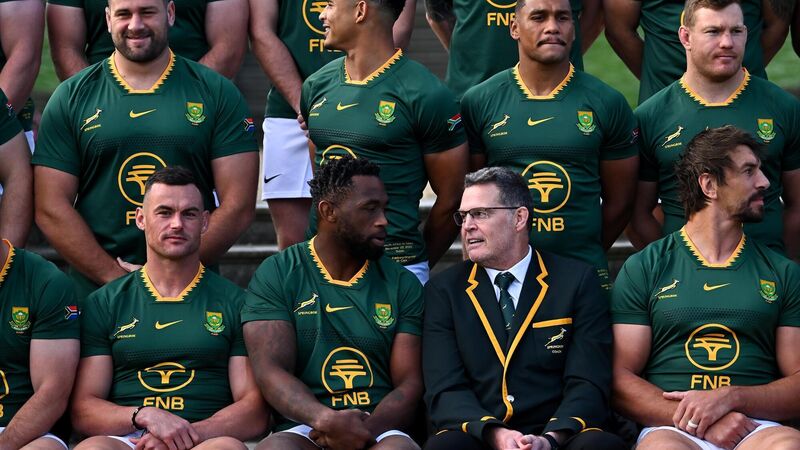
NO JACKET REQUIRED: Head coach Rassie Erasmus speaking with Siya Kolisi before the taking of a squad photograph at Radisson Blu St Helen's Hote. Pic: Piaras Ó Mídheach/Sportsfile
Even without starting, second row RG Snyman is a key man in South Africa’s preparations for this clash in Dublin today. After all, he could have slept in his own bed in Dublin last night and still be in time to meet his teammates for breakfast.
A fully-fit Snyman offers a point of difference to any pack. His athletic physique means he so often draws two or three defenders towards him leaving space for attackers to exploit elsewhere.
This is where his amazing offloading skills come into play, as he invariably manages to maintain continuity with his freakish ability to keep the ball alive in traffic. Yet, more often than not, Rassie Erasmus chooses to hold him in reserve on the bench.
I presume the thought process around this is that Snyman’s offloading skills are used to maximum advantage when the opposition begin to flag and space opens up. Every other international side would crave having Snyman in their starting side but, such is the depth in quality locks available to Erasmus, he can afford to hold Snyman back as a key attacking weapon after the break.
Is it any wonder South Africa invariably dominate the final quarter of games. Snyman’s value to Erasmus ratcheted up even further this week given he trains and plays alongside seven of Ireland’s starting pack today along with three more on the bench.
The Springbok forwards will be looking for nuggets from RG all week, especially starting second rows Eben Etzebeth and Ruan Nortje, around any visible triggers that may help them counter Ireland’s line out.
With Ireland’s starting front row and two of the replacements also club colleagues of Snyman at Leinster, their Springbok counterparts will also be mining any valuable insights into the key strengths and potential vulnerabilities of Ireland’s scrum.
This Springbok pack love nothing more than smashing the opposition up front, especially at scrum time. They not only see it as an invaluable tool for generating penalties, enabling them to control field position from the subsequent kicks to touch, they view it as a means of breaking the mental resolve of opponents.
Once a referee has decided the Springboks have established superiority in this key sector, they invariably reward them with a penalty, even in the vital 50-50 scrum calls that arise when opposing front rows hit the deck simultaneously. The visitors' pack excel in creating doubts in your head. Ireland need to find a way of dealing with that.
For that to happen, Ireland’s key leaders need to step forward, control the narrative, and impose their will on the game from the off.
Much has changed in the fortunes of both teams over the last year. If you were to select a combined side from the starting teams today, Ireland would have far fewer contending than at any stage since the last World Cup.
Even outstanding hooker Dan Sheehan, a guaranteed starter in that scenario, failed to get a nomination for world player of the year, losing out to his opposite number today in Malcolm Marx.
Marx is one of three Springbok forwards along with Ox Nche, the first ever prop to be nominated for the award, and former winner Pieter-Steph du Toit to make the four-man shortlist. Outstanding French winger Louis Bielle-Biarrey is the only non Springbok to make the cut.
Despite Sheehan’s omission from that quartet he would make the cut in my combined team, along with Tadhg Beirne and Caelan Doris up front, ahead of Ruan Nortje and Jasper Wiese respectively.
With the world class Nche absent today due to injury, a strong case could be made for Andrew Porter to start in this combined team ahead of Edinburgh’s Buan Venter who received the shepherd's hook from Erasmus after only 30 minutes against France.
Former Munster tight head Thomas du Toit is playing superb rugby at present thus edging out Tadhg Furlong while, at his best Josh van der Flier has the capacity to pip Siya Kolisi.
Behind the scrum, with Bundee Aki’s form and a lack of recent game time for Garry Ringrose, the only Irish player certain of making the cut behind the scrum is Jamison Gibson-Park.
More than anything, that fictional exercise says everything about how the attacking prowess of the Springbok backline has progressed in recent times, with the increased threat imposed by new out half sensation Sacha Feinberg-Mngomezulu adding a whole new dimension in attack. He is worth the controversial ticket prices alone.
That was not the case when the sides met at the 2023 World Cup or during the two test series in South Africa the following summer, highlighting the direction both sides have travelled since. The Springboks are no longer a one-trick pony with an over reliance on what happens up front.
Last weekend's convincing 46-19 over Australia offered a timely confidence boost, but Ireland need to find another level to compete on equal terms today. For that to happen the key players up front in Sheehan, Furlong, Beirne and Doris need to lead from the front in with actions rather than words.
In addition, Ireland’s experienced midfield combination of Aki and Ringrose must deliver peak performances with and without the ball.
Regardless of what happens today, South Africa will remain the game's number one ranked side heading into the World Cup pool draw next month. Ireland secured their top seeding for that on the back of last week's win and the failure of Scotland to beat New Zealand.
With that pressure out of the way, Ireland need to deliver a standout performance in keeping with the remarkable level of success against the Springboks. Recent history must convince them they are capable of that.
To win today, Ireland not only need to draw from recent experience, they must produce a level of physicality beyond anything seen this year to date. They must find a level of manic commitment bordering on acceptable limits, coupled with a staunch discipline that doesn’t always go hand in hand with what’s required to beat South Africa. Fire in the belly, ice in the brain and all that stuff.
It’s not easy to satisfy both criteria in the heat of battle. Just look at the visitors. Two red cards and a yellow in their three Quilter Nations Series games this month alone.
The difference between South Africa and the chasing pack however is their capacity to absorb setbacks and remain on course regardless. If anything, they thrive on adversity.
In addition, Ireland need to play smart inventive rugby which probably accounts for the inclusion of Sam Prendergast from the outset in this one. His superb kicking and passing game proved pivotal in pulling the Wallabies backfield apart last weekend.
While lingering doubts surround his ability to defend, an aspect South Africa will no doubt look to expose, better to explore now what Prendergast is capable of creating against the game's leading side while testing the extent of his defensive vulnerability now rather than down the line.
Outside of Prendergast, the Springboks will test Ireland’s defensive mettle from close quarters, which was worryingly suspect against Australia with three tries scored from pick and drives within 10 metres of the Irish line.
From close range, South Africa are a juggernaut compared to the Wallabies. Ireland survived last time out by securing 70% of possession in the second half. That’s simply not going to happen against today’s opponents.
This South African team is chasing a cause, given that not one of them has ever managed to beat Ireland in Dublin. The last time the Springboks managed that was a 12-16 triumph in 2012.
As reigning world champions and with back-to-back Rugby Championship success already achieved this season, this represents the last frontier for a proud South African squad. Everything points to that box being ticked today.