Ireland Inc needs an injection of global capital for new homes
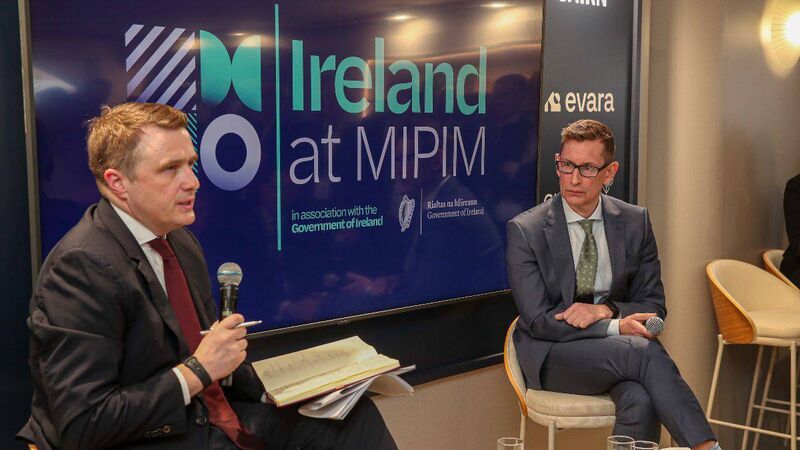
Minister for Housing, James Browne, TD, with Martin Whelan, CEO of The Housing Agency, at the recent Ireland Pavilion, MIPIM in Cannes, France.
Despite all the reports of cash and corporation tax windfalls swilling about the Irish economy, as well as moves by the Government to propose special tax advantageous infrastructure for Irish citizens and savers (we have 38% of our wealth in banks earning close to 0% interest), we still have to look overseas for the billions needed for infrastructure, renewable energy delivery, and for housing.
Ireland needs more than €120bn alone in capital for housing provision across all tenure types by 2030 if we are to hit the high targets aimed for (up to 60,000 units a year by 2030).
We’re not going to find sums like this loose in State coffers, behind the sofa, under the mattress, nor in the banks.
Already, non-bank lenders account for more than a quarter of Irish credit, and the expectation is that more varied lending sources will be needed into future years of this nation’s investment – the derided institutional investors, as well as evolving ‘specialist lenders’.
Hence, for example, the Irish Government backing and presence at the recent, a first-ever Irish pavilion at the world’s biggest real estate MIPIM conference in sunny Cannes, attended by 25,000 professionals from 90 countries.
Back in the 2000s, Irish participation at MIPIM was mostly private developers seeking lenders for projects such as shopping centre developments and offices.
Now, it includes investment for public capital projects, services and housing, from global providers who have straining purse strings.
Unsurprisingly, the MIPIM event attracted predictable enough and political jibes of ‘junketeering’. But, it may well pay dividends as Ireland Inc seeks sums north of €120bn for housing, as public capital expenditure alone in 2026 is likely to approach €20bn, the highest sum ever in the State’s 100-year history, and as water and waste water services run at a €15bn deficit.
Housing Minister James Browne headed the Irish presence in Cannes, supported by State agencies and local authorities including the Department of Finance, the Department of Housing, the LDA, The Housing Agency and others, as well as plc and other major developers from the likes of Glenveagh, Cairn Homes and Quintain/evara.
After three years slump in new apartment construction, changes in VAT, planning reform and changes to apartment standards to reduce delivery costs and return viability, for example, apartment construction is back on the upward trajectory, driving much of the rise in overall housing output, much of it funded by overseas funds.
“International capital is critical for delivering housing at scale as it fills the gap left by limited public funding," said Michael Hynes of Dublin-based evara (previously Quintain). “International investors we have engaged with here at MIPIM are very positive that Ireland is again investible.”
Others, like Michael Stanley of Cairn Homes, said bringing more certainty was a driver, with investors “keenly aware of the significance of various policy changes which have been introduced in the past 18 months. It is changing their sentiment towards investment opportunities in Ireland.”
And, one of the key current deliverers of Cork city’s south docks apartment, Stephen Garvey, CEO of Glenveagh, added that financiers he spoke to at MIPIM “have said that Ireland is now a more competitive investment location for property projects than other countries in Europe”.
Given the need for the broadest possible capital funding bases, policy behind Ireland necessary development ambitions are playing catch-up with changes in so-called buzz concepts like ‘funding architecture,’ or ‘funding ecosphere’, as specialist lending becomes increasingly core.
Chiming with good timing is an April 22 Dublin lending seminar entitled ‘Irish Real Estate – Funding the Future Forum’. This is hosted by real estate financer Stephen Hillis of Hilco, who says: “Specialist lending is central to how Irish real estate is funded. The capital structure has matured. The professional and policy conversation needs to reflect that.”
Bring on the next Dáil debate….
CONNECT WITH US TODAY



Be the first to know the latest news and updates