Alan Healy: Can Ireland foster a dynamic domestic economy?
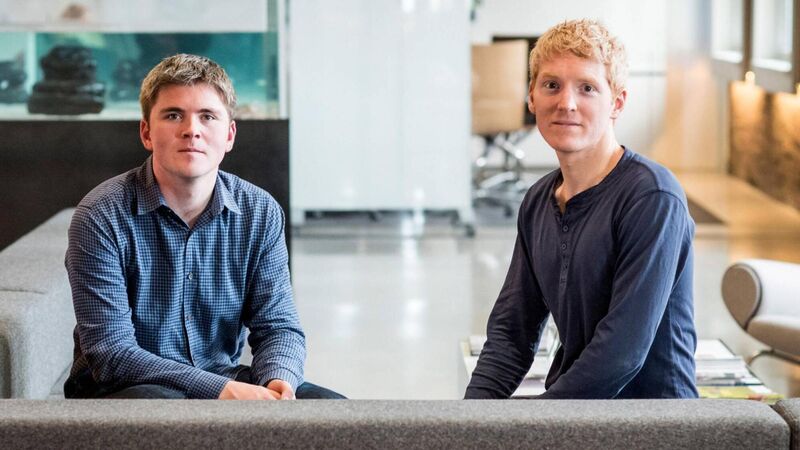
Stripe founders John and Patrick Collison have first-hand knowledge of scaling a company outside Ireland.
Ireland's ongoing efforts to rebalance an economy heavily reliant on multinationals is facing a difficult question: do we have the dynamism, the financing and leadership talent to generate the kind of technological progress that can underpin growth for the next 20 years?
The country is still bearing the scars of an economic crash caused by a construction bubble and is attempting to resolve the growing chorus of warning signs related to an overreliance on foreign firms for the bulk of our tax receipts and income taxes.
A new report this week by economist Professor Alan Ahearne of the University of Galway examines the country's long-term prospects in developing a high-growth, domestic economy. The document was commissioned by Stripe founders John and Patrick Collison. The entrepreneurs have first-hand knowledge in creating a startup but scaling the company in the US and have been vocal on the strengths and limitations of Ireland's business ecosystem.
Ireland has been well served by multinationals. The pharma and tech giants, in particular, have expanded the knowledge and skills base in this country. In many of these multinationals, an inversion has taken place with the local leadership teams evolving over time into global leaders within their respective fields. Many of these companies now have headquarters for entire divisions in Ireland, given the breadth of knowledge and talent developed here. Many Irish workers in multinational firms are world experts in a variety of fields, including medical devices, supply chains and biopharma manufacturing. It has grown into a symbiotic relationship which has benefited the Irish economy and the foreign firms.
However, the issue for Ireland is that these companies remain foreign-owned, often headquartered in the US.
Indigenous companies in Ireland have enjoyed huge success in the past. Traditional and mature sectors such as food production and aviation have seen Irish-founded firms turn into world leaders, but gaps still remain. Compared to other jurisdictions, Ireland has moved at a slower pace when it comes to truly scaling. As Ahearne notes, a mix of global rankings and league tables paints a consistent picture. Ireland routinely ranks as a strong place to start a company, but we are not a world leader in forging high‑growth firms capable of scaling rapidly into international players.
It is not a concern unique to Ireland. The landmark Draghi report on EU competitiveness warned that Europe’s weakness is not a lack of startups but a shortage of scaling companies capable of driving frontier innovation. Europe, in Draghi’s stark assessment, is falling behind in the technologies that will shape the future—from AI to advanced manufacturing—and is doing so because too few new firms reach meaningful scale. Ireland sits inside that wider European problem.
Investors here are also aware of the issue. In December, VoxPro founder Dan Kiely told the Irish Examiner that "Ireland doesn’t have a startup problem. We have a scale-up problem. We’re brilliant at getting companies to 10 people, but we’re terrible at getting them from 10 to 100 people. We just don’t think that way here."
A range of persistent barriers explains that gap. The first is mentorship. Figures like Kiely, founders who have built, scaled and exited companies and can guide the next generation, are invaluable. But compared with the US, the UK, the Nordics or Israel, Ireland has far fewer of them. The ecosystem lacks a dense network of experienced operators who can help founders avoid the common pitfalls of scaling.
Finance is another barrier. Seed funding in Ireland is now healthier than at any point in the past decade, but once companies outgrow the early stage, the capital landscape becomes much thinner. Scaling capital largely comes from London, New York or Silicon Valley and can lead to founders relocating and control moving abroad.
The other barrier is talent. Human capital is long-recognised as the key to high-growth, and the rush to attract the best and brightest continues in earnest, but Ireland may be late to the game. Other countries like Portugal, Spain, and Israel have long operated tax incentives to attract top talent.
However, Ireland has the potential to really drive domestic innovation and growth. The country already exists as a fertile playground for high-value tech and pharma growth. Cutting-edge healthcare, fintech, advanced manufacturing and agricultural innovation already take place here. Domestic companies in these fields have the potential to expand rapidly to become international market leaders.
To achieve this, the report suggests a bold move on tax and immigration policy geared toward attracting people who can mentor, lead, invest and build. On financing, it notes that the money is here. Ireland runs a current‑account surplus, but ways to channel it into ambitious domestic firms remain underdeveloped.
Ireland’s half‑century economic boom, powered by foreign knowledge and global capital, has served the country well. But the next phase of prosperity will depend far more on what happens inside our borders, on our ability to produce, retain and scale our own high‑growth companies. The question now is whether Ireland can build the ecosystem needed to unlock that potential, or whether the next generation of Collisons will need to leave to fulfil it.
CONNECT WITH US TODAY



Be the first to know the latest news and updates