

Munster Rugby in 2020: Five experts analyse the province’s potential for a return to the top
Those in the know, Tom Savage, Simon Lewis, Donal Lenihan, Duncan Casey, and Owen Harrison, give their verdicts on where Munster stand at the end of 2020, where expectations should be set for the year ahead, and how near or far Munster are from consistently challenging Europe’s elite again.
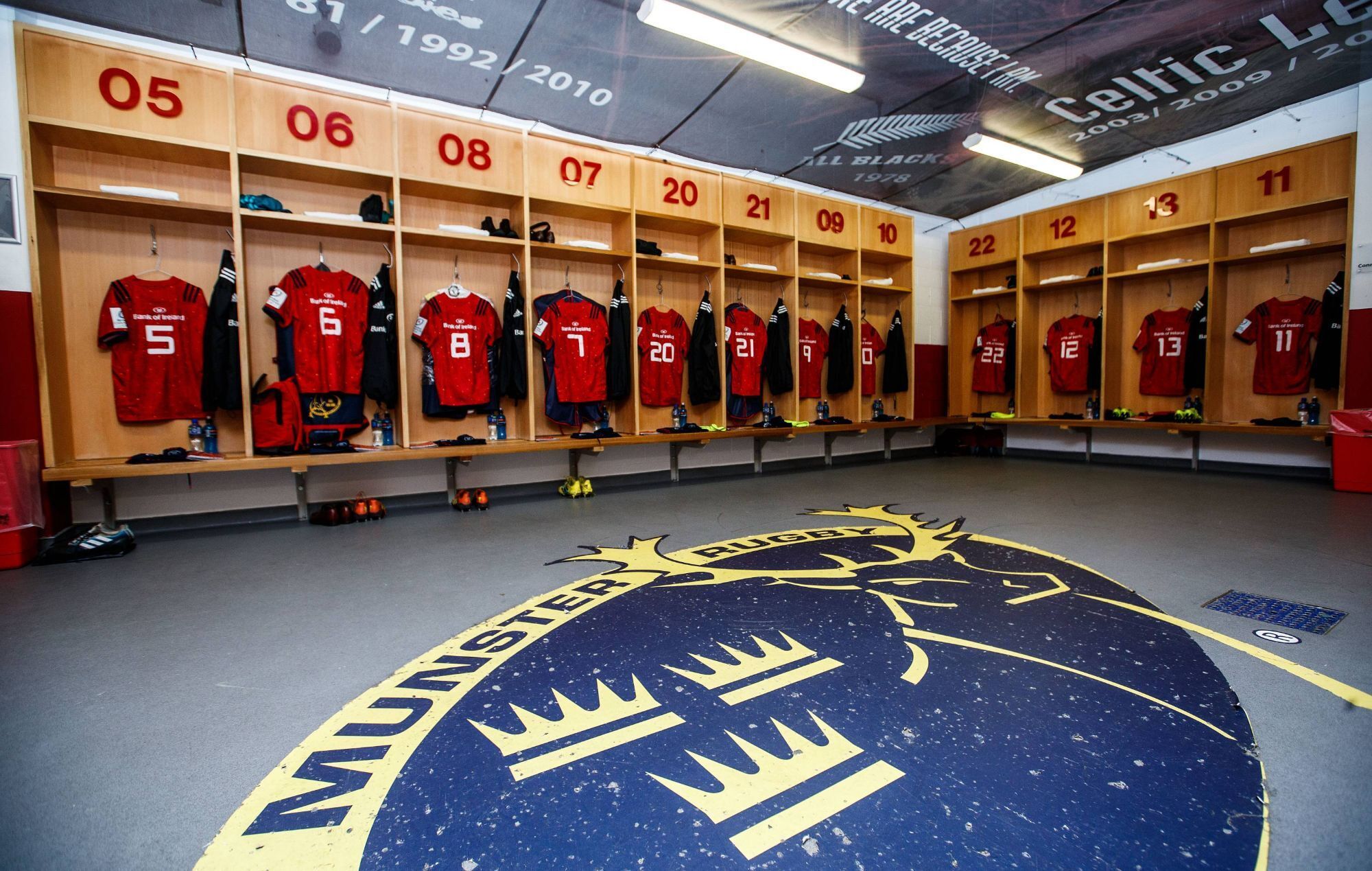
COVER IMAGE : The Munster dressing room. Picture: INPHO/Tommy Dickson
TOM SAVAGE
Still a Few Forwards Away From Elite
TOM SAVAGE, Editor of Three Red Kings website
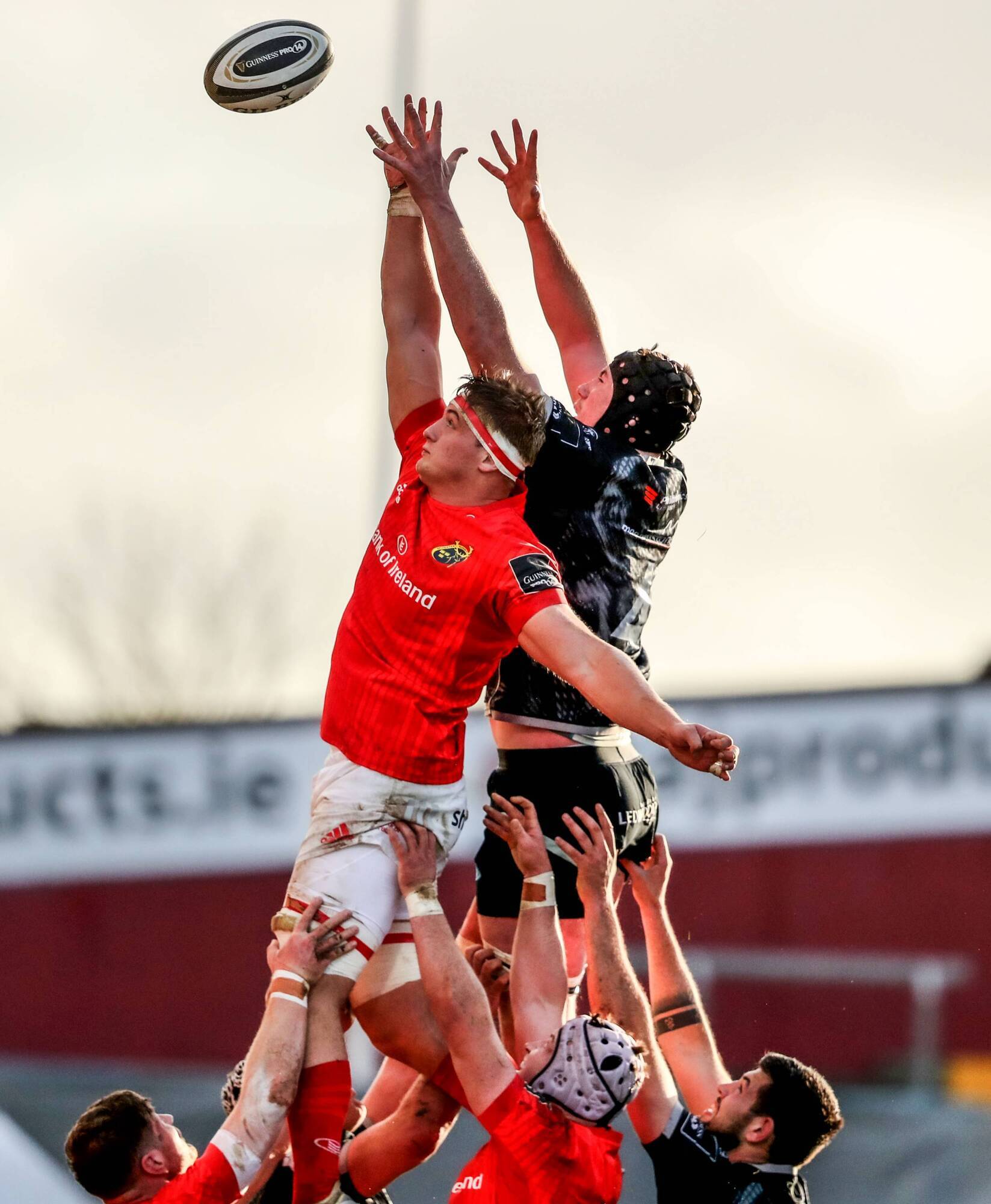
Munster's Gavin Coombes and Adam Beard of Ospreys compete in a line out at Thomond Park last month. Picture: INPHO/Dan Sheridan
Given December 1 as a starting point, what are your expectations for the coming year, and where is Munster Rugby as things stand with regard to those ambitions?
for Munster, the short-term expectations are simple - get into the knockouts of the European Cup, win all their home European games, pick up five points on the road as a minimum, beat Leinster in Thomond Park and pick up an away win during the interpros. Sounds easy when it’s written out, right? Munster are capable of producing that kind of return in the medium term but there is an element of doubt over how the rubber will meet the road against Clermont.
Munster’s PRO14 form has been quite good and, while you could question the strength of some of their recent opposition, Munster’s best two wins of the season to date came against strong Scarlets/Edinburgh and Cardiff Blues sides before everyone broke up for the extended test window.
Anything longer term than that depends on the luck of the bounce with injury and the possible return of guys like Snyman, Carbery and others before season’s end. That said, it’s reasonable to expect Munster to at least make a European semi-final and make the final of the PRO14 this season. The quality is there, the youth have stepped up in a tangible way and there seems to be growing confidence amongst the playing group that they have a style of play to match up well with anyone.
What is the key barrier to Munster taking the next step and competing consistently again with Europe's elite?
Munster are a few key forwards away from being an elite challenger at European level. This is a game of size and power and while Munster have some very promising young players who look like they can be the answer to that question, we’ve got to see it against the likes of Leinster and Clermont to be sure. I think players like Coombes and Wycherley are very close to making that breakthrough but more will be needed - Hodnett’s Achilles injury was a sickener for him so close to Europe, Thomas Ahern looks like he could be a very special athlete and that’s before you start looking at talents like Josh Wycherley, Keynan Knox, Roman Salanoa and, further down the track, Scott Buckley, Alex Kendellan and others.
If Munster can bring through those young forwards and deliver on their potential, they’ll be very close. The future of half-back looks incredibly bright with Craig Casey, Ben Healy and Jack Crowley being standouts but it’s the pack that will decide Munster’s medium- and long-term level in Europe.
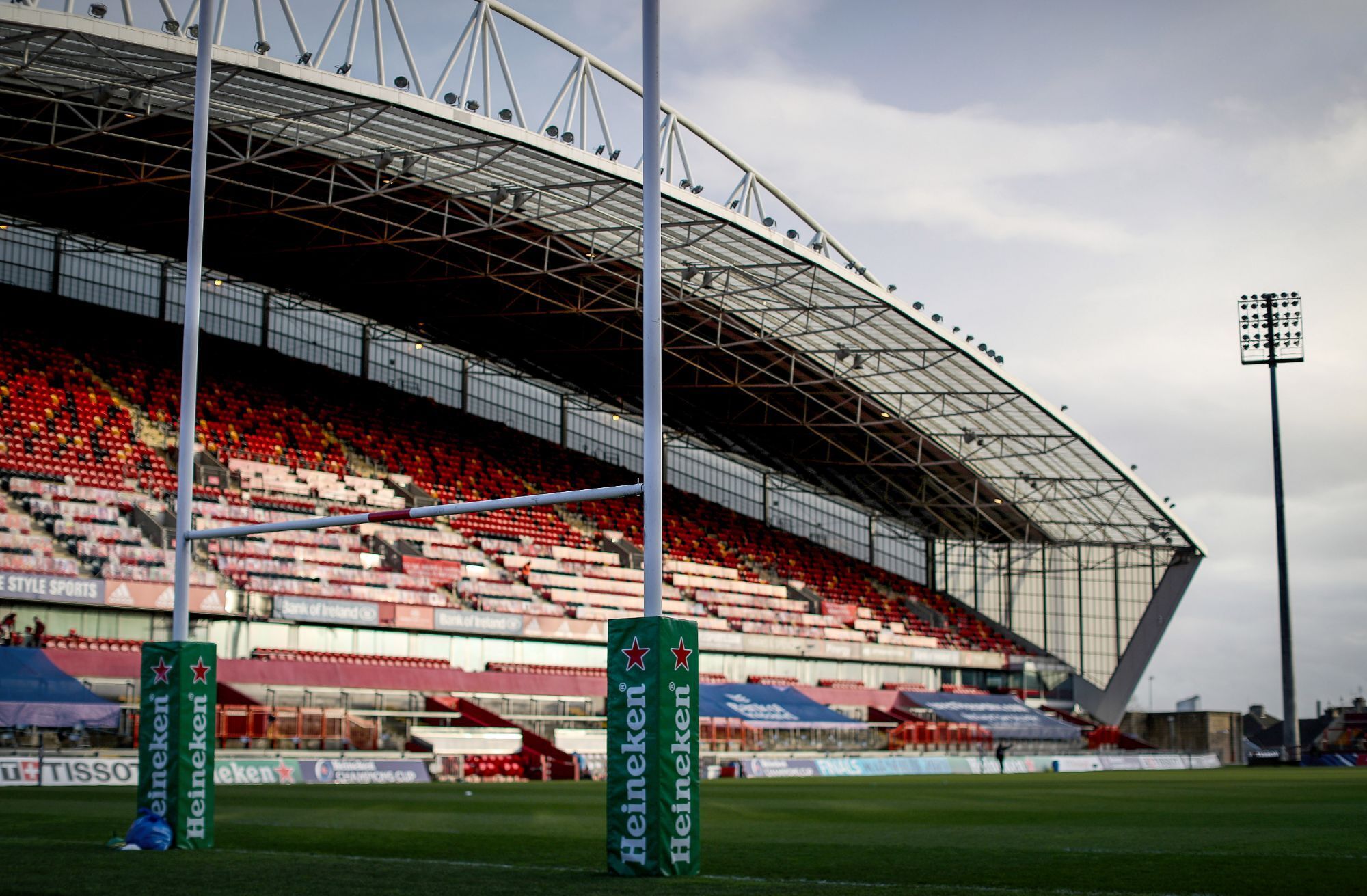
Thomond Park. Picture: INPHO/Dan Sheridan.
Would you say Johann van Graan and his coaching team have progressed Munster (and the project) to the point where those ambitions are attainable?
Van Graan has done a very underrated job as Munster’s head coach. His time in charge has coincided with the rise of Leinster in the era of peak Saracens dominating Europe for five or six years. When a coach is on the losing end of multiple semi-finals - especially to a local rival - it’s easy to paint him as being a guy who can’t get his team over the line. When you add in last season’s failure to qualify from the pool stages of the Champions Cup, that painting gets a little bigger.
Yet, in context - which people never like to consider - he’s lost out domestically to a side that most people would say have been one of the best club sides in the world over the last four years in Leinster and has consistently lost out at the penultimate stage of Europe to Racing 92 and Saracens.
If you look at the young players Van Graan has promoted over the last two seasons and his willingness to bring in big outside voices like Larkham and Rowntree, he deserves a lot of credit for building a squad that looks to be capable of challenging in the post-Saracens era.
Who or what is the most exciting prospect in/about Munster Rugby for 2021?
The youth. Full stop. It’s hard to pick out just one and that’s the point. It’s taken a few years to sort out but Munster have finally managed to get a chain of succession going in a few key positions. It isn’t at the scale of Leinster quite yet but players like Craig Casey, Ben Healy, Fineen Wycherley and Gavin Coombes are ready to be big players for Munster right now, and that’s before you get to the guys waiting to make that step up.
In the post-Covid world, the ability to produce the vast majority of your starting squad in-house AND have them at a level to compete with the very best of their peers will be worth its weight in gold. When you look at the last two or three seasons at U20 level, a lot of the Grand Slam-winning teams have had a strong Munster core.
France have started to reap the benefit of that at test level, it’s time for Munster to do the same.
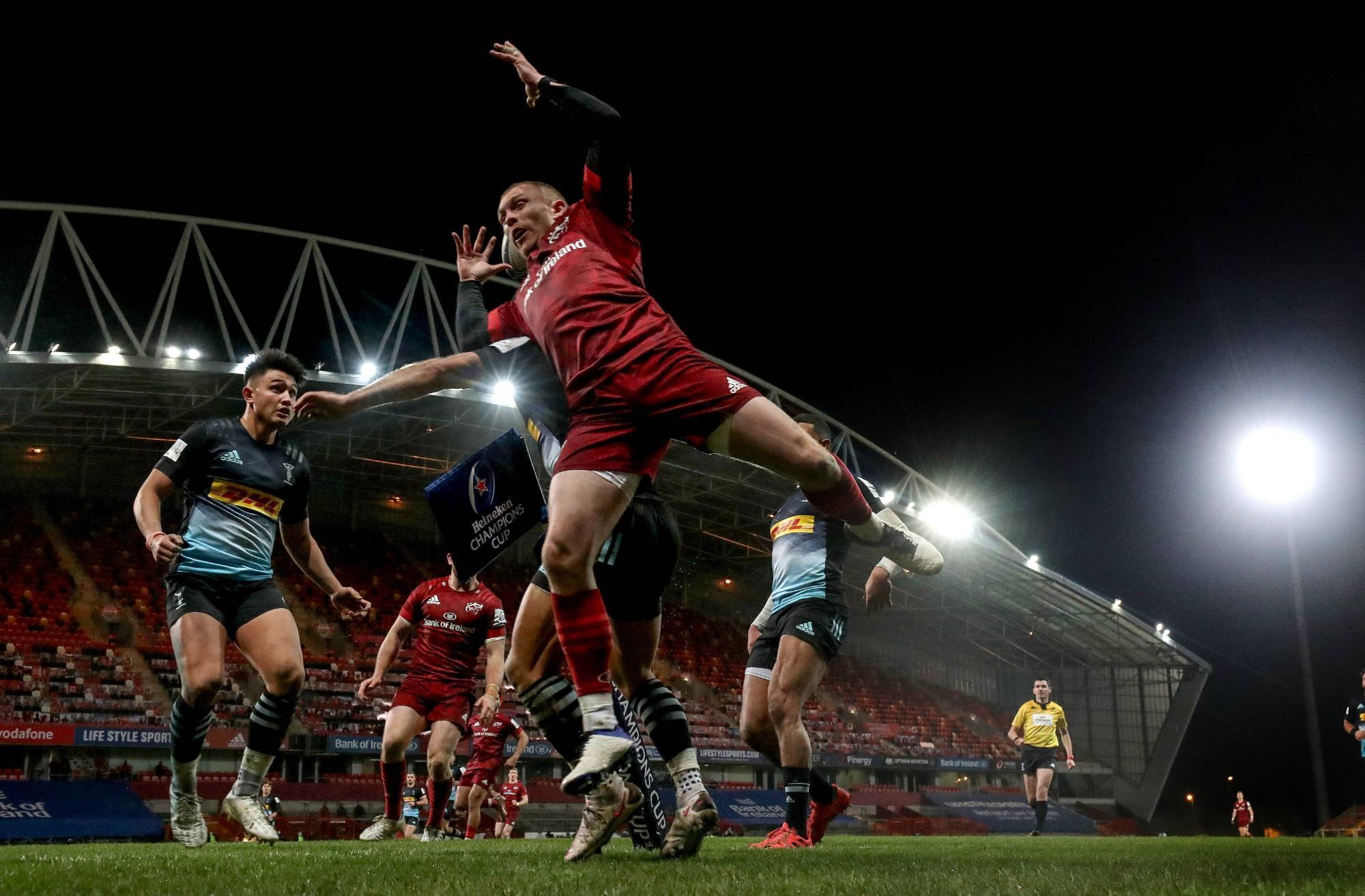
MY BALL: Keith Earls of Munster in action against Danny Care of Harlequins in last weekends 21-7 win to Munster in the Champoins Cup first round. Picture: Sam Barnes/Sportsfile
Of the up-and-coming prospects, who would you most like to see given his chance and allowed to develop, even if it means short-term frustration?
Alex Kendellan. This backrow looks like the real deal and could be a guy with the ability to go through the levels extremely quickly. I’ve seen him play a few times for Pres and he always looked a level above most of the guys he tangled with. He’s captained sides at underage and looks to have the physicality you need to stand out quickly at a professional level. They won’t rush him - look how good Gavin Coombes looks in his second season as a professional to get an idea of the value of “readiness” - and he needs a bit of luck with injury as all players do but I really believe that he’s got everything he needs to be a top player sooner rather than later.
In terms of Munster's all-important identity, are you happy that the best traditions of the province are being utilised - or is it time to put all that SUAF stuff to bed and find a different mojo?
Identity is a weird thing. Sometimes you only know it by its absence. I really believe that the identity of any rugby club is its fans, and the club must be a mirror to what its fans want.
The easiest identity of all is ‘we win trophies’ but, as we know, it isn’t always possible to win. If your identity is based on always winning, the fans won’t like what they see when the club does not win. I think that was Munster in the early to mid-2010s as the general fanbase came to terms with Munster not being the side that was perennially challenging for top-end silverware.
Remember the days when Munster would win a Celtic League and it would be seen as an afterthought if it wasn’t followed with a Heineken Cup? That was Munster’s identity as much as it was about ‘the parish’, the Fields and ‘Ireland by Birth, Munster by the Grace of God’. In 2020, I think Munster are in a good place after the difficult 2010s. The first major crowd at Thomond Park for a big home game or Interpro will be the tester. If a youthful Munster side can start frightening the life out of a big English or French team in front of a packed Thomond Park, Thomond Park will respond in kind. If they start beating these big sides, the journey will begin again and, when you think about it, that has always been Munster’s real identity. A shared journey from being Undesirables to Undeniables.
SIMON LEWIS
Eight in a row and home quarter-final top wishlist
SIMON LEWIS, Irish Examiner Rugby Correspondent
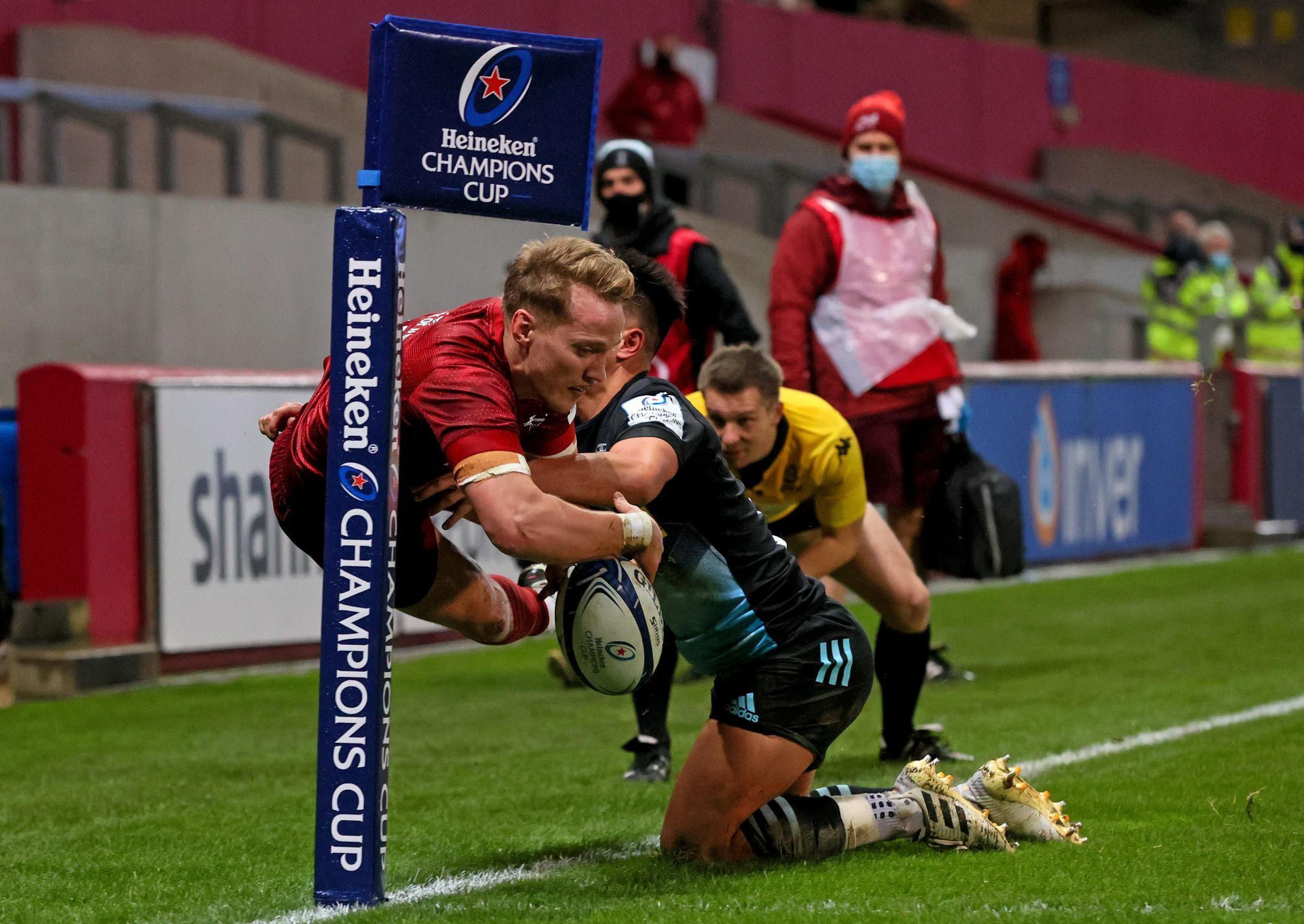
COVER IMAGE : TRY AS HE MIGHT: Munster’s Mike Haley fails to ground the ball for a try due to pressure from Marcus Smith of Harlequins in their Heineken Champions Cup game at Thomond Park. Picture: Gary Carr
Given December 1 as a starting point, what are your expectations for the coming year, and where is Munster Rugby as things stand with regard to those ambitions?
with the flying start Johann van Graan’s squad has made to the Guinness PRO14 campaign, eight wins from eight, not securing the home play-off semi-final the South African has craved since his arrival three years ago would have to be seen as a major collapse.
With only four pool games from which to qualify for the knockout stages, that momentum has never been so important at the start of a Heineken Champions Cup campaign. Though there are two tough away trips in the offing, to Clermont’s fortress Stade Marcel-Michelin this weekend, and Harlequins’ Stoop in the New Year, an eighth win a row at Thomond Park last Sunday has provided ignition for lift-off. Just as a fast start is more vital than ever, reaching the quarter-final and a guaranteed home leg will also be top of the must-do list, for CEO Ian Flanagan as much as van Graan and his players. With the coffers running dry in every rugby front office due to empty stadia, a home game on the first weekend in April with, fingers crossed, the supporters back at Thomond Park, will be a much-needed financial injection for Munster.
Would you say Johann van Graan and his coaching team have progressed Munster (and the project) to the point where those ambitions are attainable?
Yes... but just as winning last season’s PRO14 title and reaching the Champions Cup quarter-final was attainable. Munster could have won their league semi-final at Leinster and also progressed from a pool containing both Saracens and Racing 92.
Both were stiff challenges but not insurmountable. Poor execution let them down in both competitions, and van Graan has argued things might have been different had he not lost Peter O’Mahony, Tadhg Beirne and John Ryan to injury before or during the Saracens away game 12 months ago.
Munster are definitely a better package this season and that disappointing PRO14 semi-final defeat seems like light years ago. The head coach deserves a lot of credit for the summer signings and not just the World Cup-winning Springbok duo but full-back Matt Gallagher from Saracens and young tighthead Roman Salanoa from Leinster. Also, for persuading coaches Stephen Larkham and Graham Rowntree to invest in his project to return to Europe’s top flight.
Last season was an anomaly in so many ways and nothing to do with the Covid-19 pandemic. A World Cup campaign meant the senior internationals had little access to the new coaching team and their re-integration on return from Japan did not run smoothly.
Yet while long-term injuries to the incoming RG Snyman and Gallagher as well as to Joey Carbery and Dave Kilcoyne have delivered further blows, van Graan appears to be managing his squad well. Peter O’Mahony looks like a player reborn, Conor Murray has his mojo back and getting Beirne fit again after his ankle fracture at Saracens is like welcoming a new player to the fold. And then there is the next generation.
The potential rolling off the production line right now is frighteningly good and again, van Graan delivered a masterstroke by allowing the youngsters to train with the seniors. The decision has been bearing fruit in the early part of this season, now Munster need to execute better and make the positives count on the European stage.
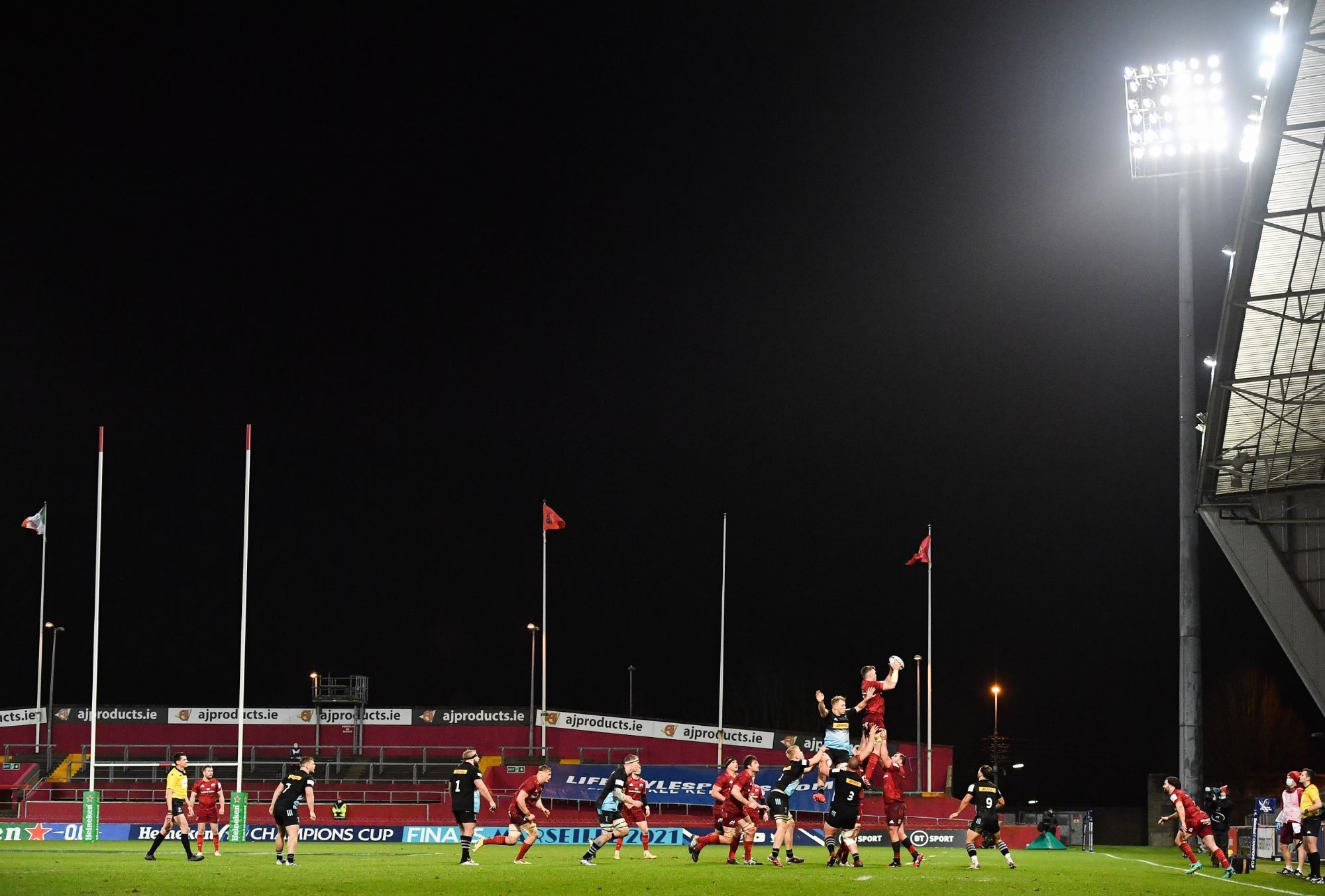
A line-out during Munster's Champions Cup 21-7 win against Harlequins at Thomond Park last weekend. Photo by Sam Barnes/Sportsfile
What is the key barrier to Munster taking the next step and competing consistently again with Europe's elite?
The treatment table remains Munster’s greatest obstacle. Signing Damian de Allende and RG Snyman were significant coups recognised as such around the world, the final pieces in the jigsaw to finally elevate the province back onto club rugby’s top table. So, to lose Snyman to a serious knee injury after just seven minutes of his debut in August was a massive blow. Van Graan has offered hope that the giant lock could be back on the field for the tail end of the season and having got a brief glimpse of his set-piece prowess, the prospect of Snyman’s re-introduction will be keenly anticipated. Ditto Carbery. Kilcoyne’s absence is also a major loss, for Ireland as much as Munster, and the ball-carrying threat he can bring would bolster any team. No club goes a season without maybe one or two such losses but Munster are missing three key components from line-up that could potentially contend regularly in Europe.
Who or what is the most exciting prospect in/about Munster Rugby for 2021?
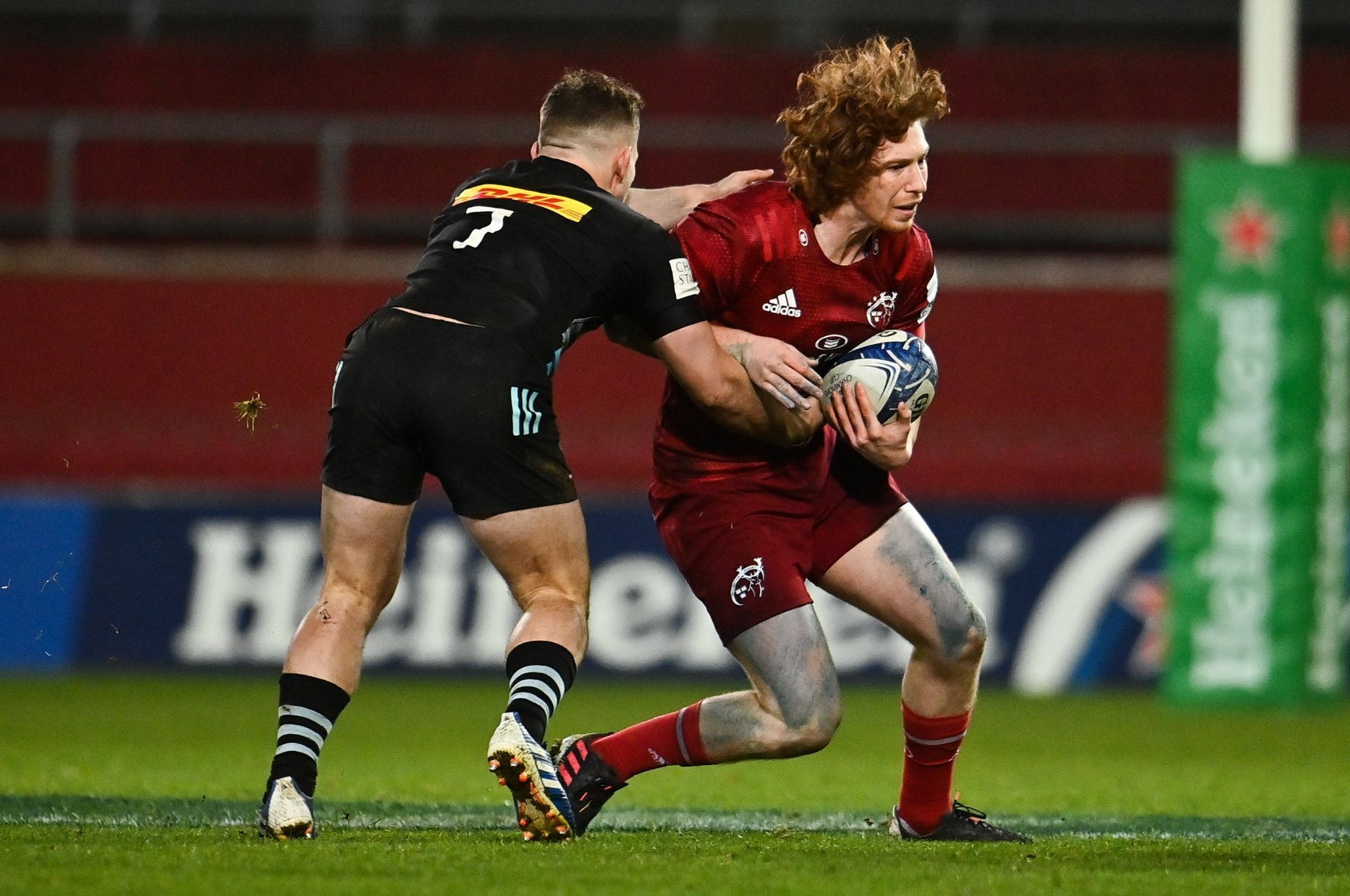
For once there is no need to scratch the head and pore over the squad lists. For Munster heading into 2021 the names just roll off the tongue and it would be impossible and unfair to single one out. So let’s call them the Class of 21 - scrum-half Craig Casey, fly-half Ben Healy, wing Sean French, lock Thomas Ahern, prop Josh Wycherley, back-rowers Jack O’Sullivan, John Hodnett, and Gavin Coombes. There are others, some older like lock Fineen Wycherley, wing Liam Coombes, and versatile back Shane Daly, one or two younger such as Ireland Under-20 fly-half Jack Crowley, and some imported - tighthead props Keynan Knox and Salanoa - who can also become established stars of the future but there is plenty to get about excited about if you’re a Munster supporter.
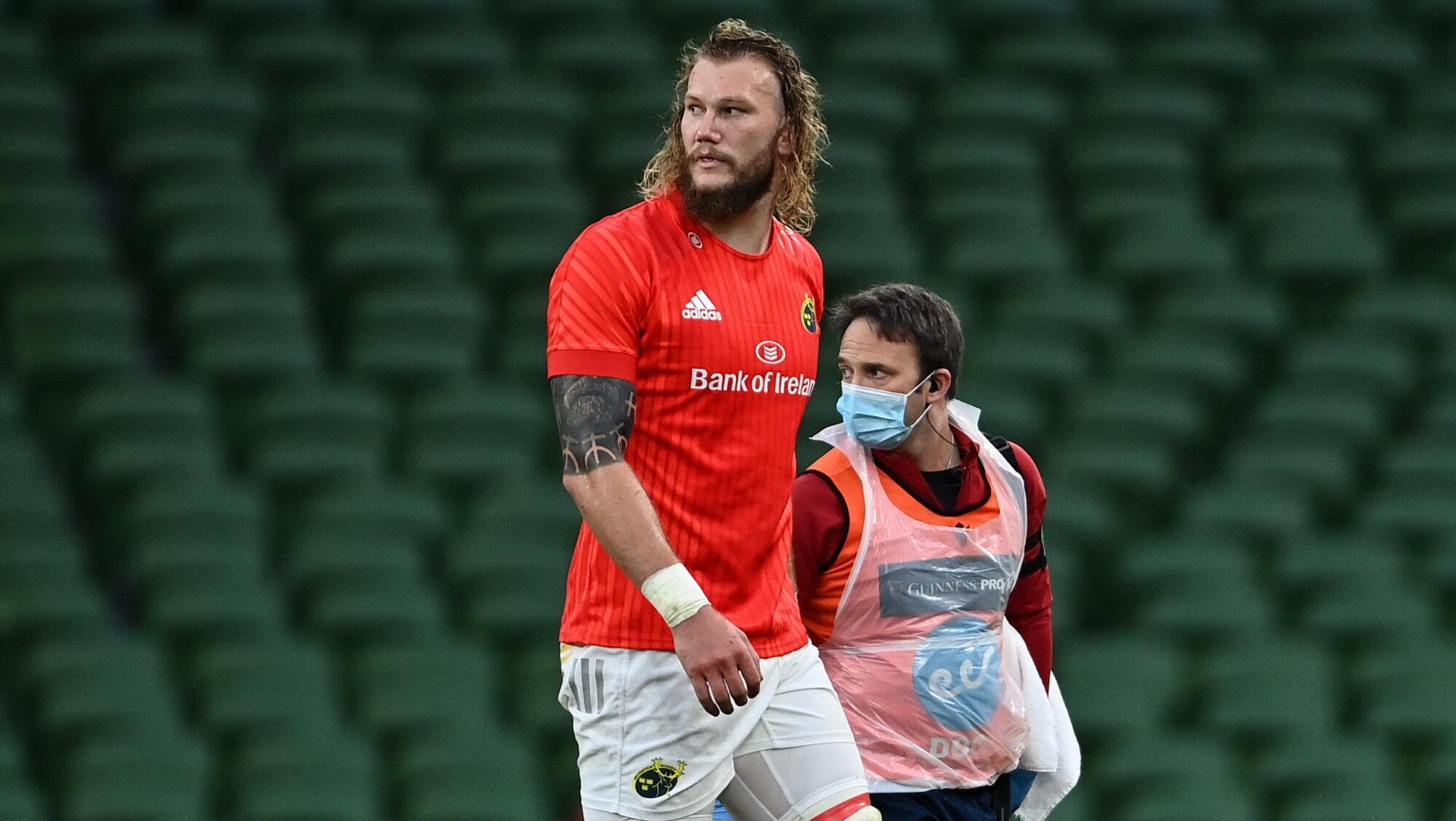
Munster's RG Snyman leaves the field with an injury seven minutes into his debut against Leinster at the Aviva Stadium. Photo by Ramsey Cardy/Sportsfile
Of the up-and-coming prospects, who would you most like to see given his chance and allowed to develop, even if it means short-term frustration?
It would be brilliant to see all of that Class of ‘21 deployed during the European windows either side of Christmas, their reward for helping to steer the good ship Munster so successfully through the autumn when the Irish internationals were on Test duty. Most of all, it's great to see Gavin Coombes in a Champions Cup back row alongside Peter O’Mahony and CJ Stander.
In terms of Munster's all-important identity, are you happy that the best traditions of the province are being utilised - or is it time to put all that SUAF stuff to bed and find a different mojo?
To hear some of the grumblings about Munster’s so-called loss of identity is a little like listening to a Brexiteer bleat on about sunlit uplands, trapped in a vacuum of delusion about a halcyon age that can never be repeated. Stand Up And Fight and ‘all that stuff’ has not gone away and nor should it, but neither should van Graan stop looking to improve his squad in any place he chooses, within reason (by which I’m thinking of Rassie Erasmus’s ill-advised signing of Gerbrandt Grobler).
As has been outlined above, the success of academy and the fostering of young rugby talent from across all six counties of Munster is bearing fruit and that needs to continue so there is no need to go shopping in Leinster’s school system and academy. Casey is from Limerick, O’Sullivan and French from Cork city, Ahern from Waterford, back-rower Jack Daly, handed his debut three weeks ago, from Kerry and the others all hail from west Cork. If that is not the best traditions of Munster rugby not only being utilised but enhanced, then I’m Boris Johnson.
DONAL LENIHAN
Munster look to have the dressing room chemistry just right
DONAL LENIHAN, Munster Hall of Famer, Irish Examiner writer.
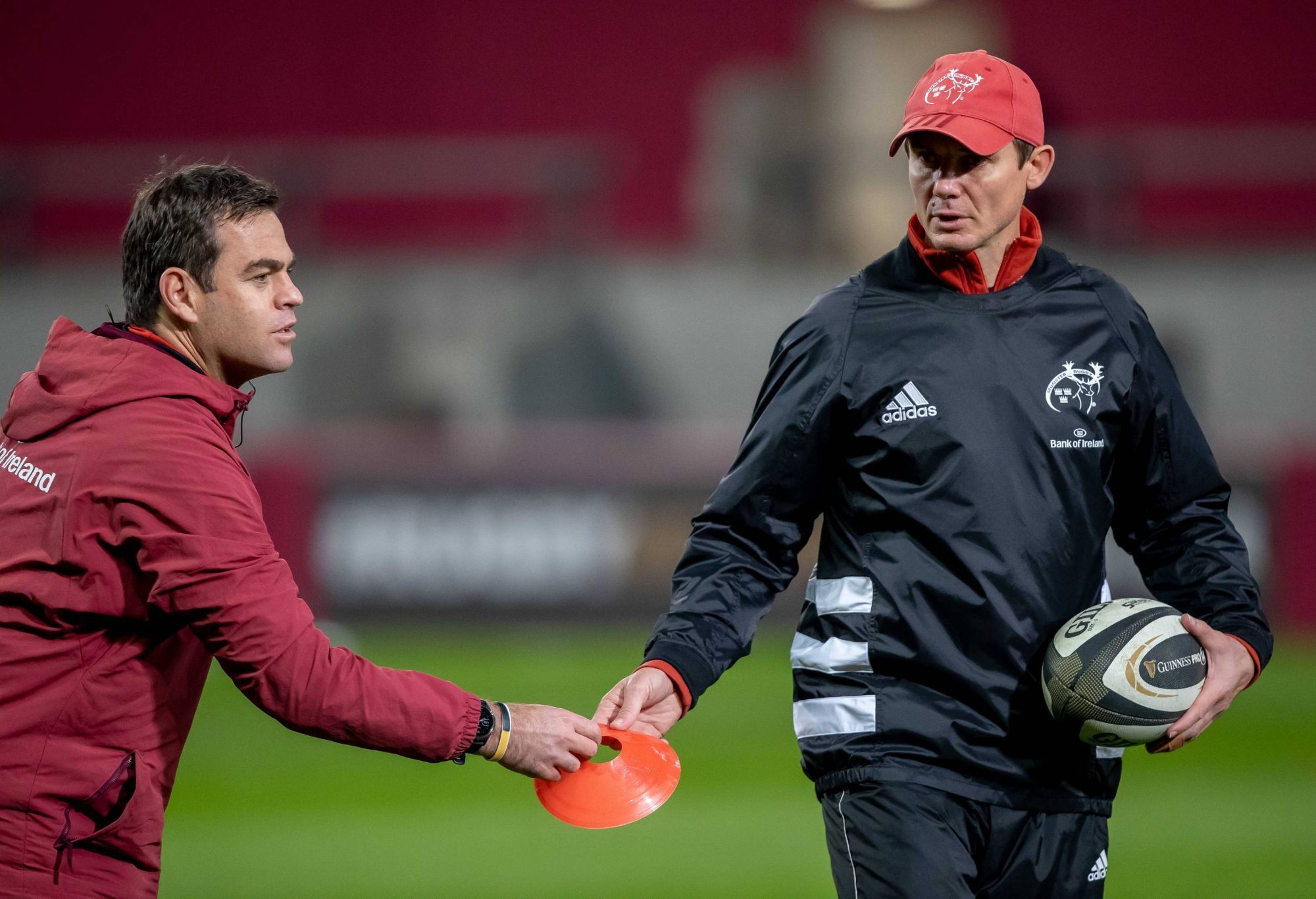
COVER IMAGE : BRAINS TRUST: Johann van Graan with Stephen Larkham. Picture: Morgan Treacy
What are your expectations for the coming year, and where are Munster as things stand with regard to those ambitions?
regardless of the familiar failings at the penultimate stage of domestic and European competition, the level of expectation Munster carry into every season doesn’t change.
On the domestic front, the failure to secure a home semi-final in the Guinness Pro14 by topping their conference has not only cost Munster financially but resulted in them having to face Leinster at the penultimate stage in Dublin in recent seasons.
As a starting point that has to change and a 100% return from their seven games to date which has propelled them into a 12-point lead at the top of Conference B has set them up perfectly to secure that.
The only uncertainty as I see it is, what happens if the big four South African sides join the tournament in the second half of the season. If their entry is delayed until next season then, even at this early stage, it’s highly likely Munster will end up playing Leinster in the final.
Europe is more complicated this season with just four pool matches. The draw has been decent in giving Munster a home game against Harlequins which they duly won. A minimum return of a losing bonus point when they visit the magnificent Stade Marcel Michelin to play Clermont Auvergne would be great as that is always a tough place to win. Are they capable of that? The Guinness Pro14 is so lopsided at present I will reserve any clear judgment on where Munster are until they have negotiated those pool games before Christmas. I would be concerned that the lack of any real competitive rugby in the Pro14 of late might leave them undercooked for what’s coming down the line.
Munster are progressing nicely but not quite there yet when it comes to going all the way in Europe. A fit RG Snyman could change that. With Johann van Graan's Ireland contingent not long out of camp, he has had to back some of the younger players who have served Munster well over the last month which could benefit the province massively heading into the future.
What is the key barrier to Munster taking the next step and competing consistently again with Europe's elite?
A few key ingredients are still missing even if the Munster professional board have moved to plug the holes. No side has ever won a Heineken Cup without a highly influential figure controlling operations from out half. Munster addressed that when signing Joey Carbery but, so far, injury has ruined his move from Leinster.
Even if he returns to action in the new year, Carbery is so lacking in game time that it will take him time to get back to the level required. In any event the pool stage will be completed by then. Ben Healy offers cause for optimism but requires exposure to the top level of the European game to continue his progression.
Munster also needed a world-class performer in the front five to match the physicality that Saracens, Exeter Chiefs, Racing 92, Leinster and Toulouse bring to the knockout phase. Again Munster addressed this when signing Snyman. How cruel to lose him after only seven minutes of action on his debut last August. It’s cruel in the extreme that those two players, who along with Damien de Allende should be instrumental in closing the gap, are present in camp every day but unlikely to play any role in Europe this season. That will only serve to make things as challenging as ever, despite the encouraging progress that has been made to date.
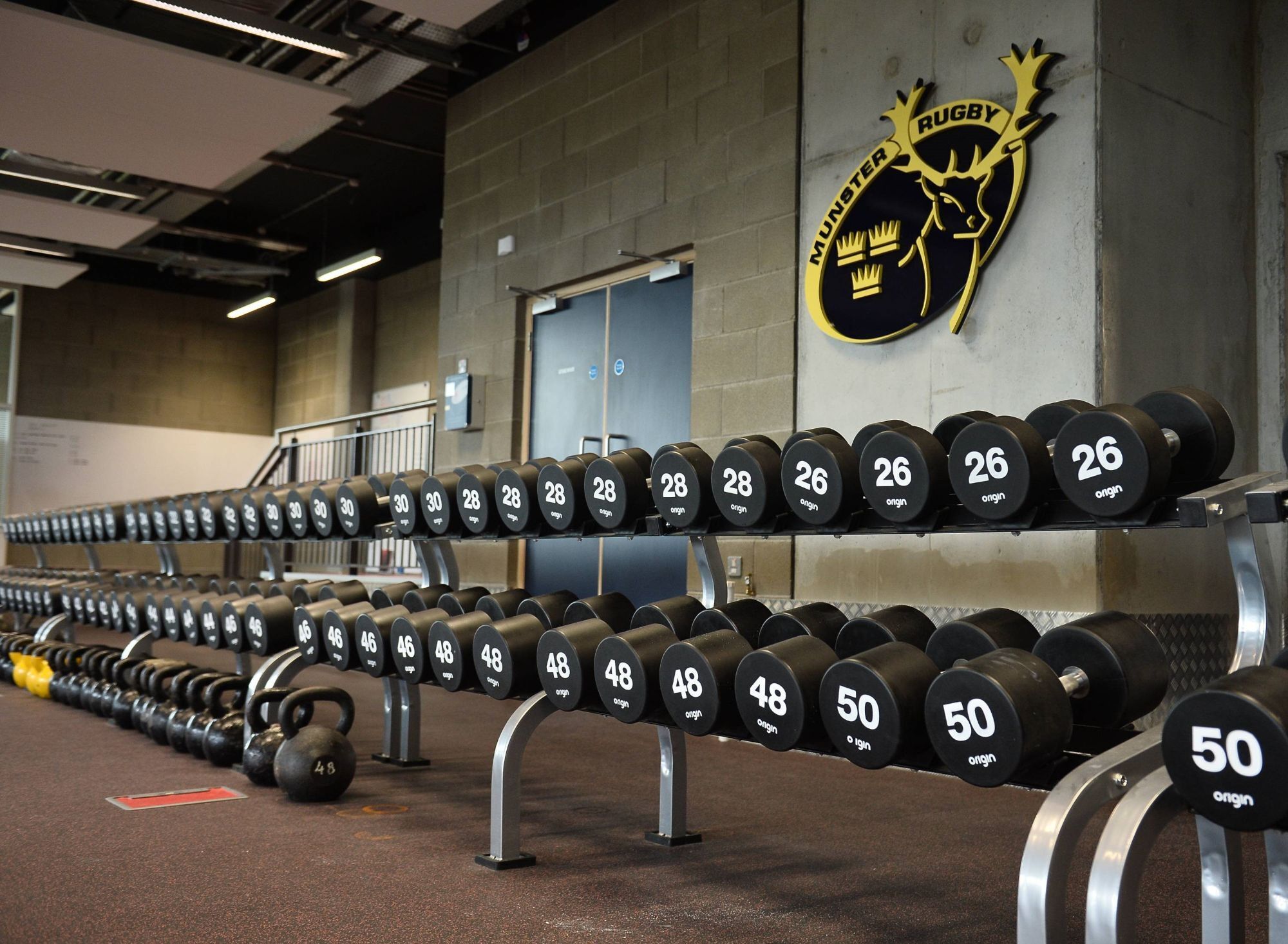
Gym facilities in the Munster Rugby High Performance Centre at UL. Photo by Sam Barnes/Sportsfile
Would you say Johann van Graan and his coaching team have progressed Munster (and the project) to the point where those ambitions are attainable?
Much done with a lot more to be achieved before Munster can dine at the top table. The lockdown period appears to have been used productively, on and off the field. On the evidence presented since the start of this season, it appears Graham Rowntree has had a positive impact on Munster’s scrum while their line out maul is back to where it was in the days of O’Connell, O’Callaghan and Hayes.
Stephen Larkham is now over a year into his tenure and his impact is more recognisable. It helps that he’s had so much time with the emerging players and it would appear that Craig Casey and Ben Healy have benefitted majorly from this. One hopes that the next layer in Jack Crowley, Liam Coombes and Sean French will reap similar rewards down the track.
Van Graan deserves a lot of credit for seizing this claustrophobic period and turning it into a positive. He has facilitated and encouraged a lot more integration between the academy, the emerging professionals like Gavin Coombes who has been sensational lately, and the senior players. There is a new leadership group within the squad and everyone is benefiting. That’s there for all to see in the Pro14 games to date with the body language of the players exuding positivity.
Getting the mood and culture right in the dressing room is crucial to success. How many times do you scan through the squads available to some of the French clubs, Montpellier being a classic case in point, and wonder why they are so far down the league table. Despite the depth of quality in any squad, the chemistry in the dressing room has to be right if you want to be successful. The Munster management appear to have the mix just right on that front and with more time to make the subtle technical and tactical adjustments, Munster look in a good place right now.
With Saracens no longer competing in the Champions Cup, a big obstacle to Munster’s ambitions in recent times has been removed. Time will tell if they are good enough to avail of that but the evidence suggests that the players and management are on the right track. That said, this period of Champions Cup pool action will tell us a lot.
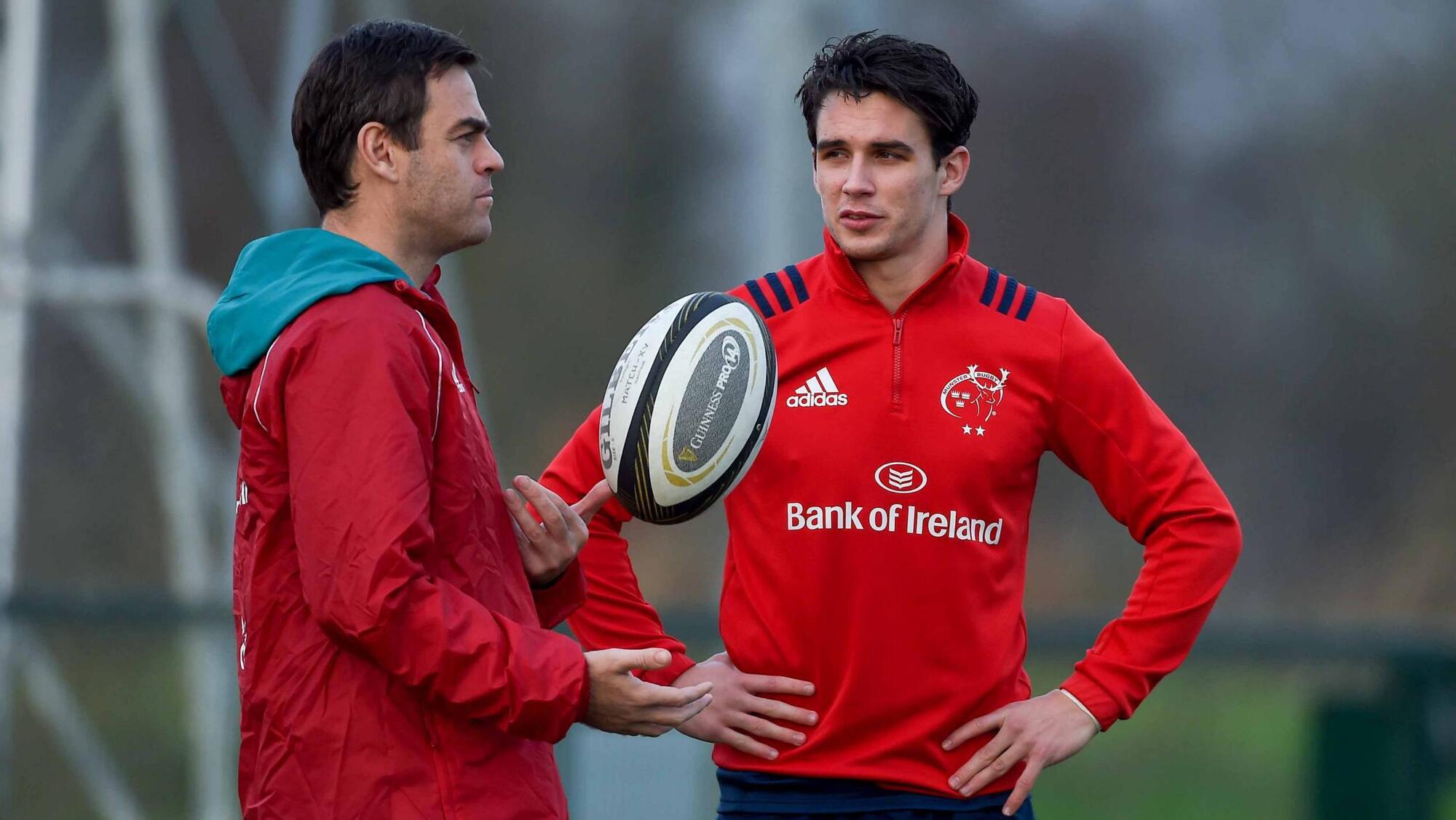
Head coach Johann van Graan and Joey Carbery in conversation during a Munster training session at UL. Photo by Diarmuid Greene/Sportsfile
Who or what, in your view, is the most exciting prospect about Munster Rugby for 2021?
The most encouraging thing about Munster this season is the amount of genuinely promising, home-grown talent being afforded the chance to make the breakthrough. Some of those players are been fast-tracked out of necessity with the Irish squad players operating in the national bubble for two months.
At long last, the exciting cohort of Munster academy players who performed such a key role in the Grand Slam winning Ireland U20 side in 2019 are being given a chance. Up front, Josh Wycherley has shown up well at loose head prop and looks capable of having a big impact in the years ahead.
Thomas Ahern has finally made his debut in the second row while John Hodnett continued to show great promise before suffering a long term injury. The greatest excitement surrounds the faith being shown in the half back pairing from that U20 side in Craig Casey and Ben Healy.
Casey offers something different to Conor Murray and that presents the Munster coaching ticket with options in altering the way they want to play. The time has come for the management to trust those two in Europe, be it off the bench or from the outset. Working with Larkham on a daily basis will also bring Healy on in leaps and bounds.
Sean French is the latest from that very talented Irish crop to make is Munster debut with another starter from that great U20 side, academy winger Jonathan Wren, still biding his time in the background. While one has to factor in the quality of Pro14 opposition, the confidence that this talented pool of players have bagged during this period is encouraging.
It’s imperative that management continue to invest in this group of players and give them further game time in the Pro14 in the company of the international stars.
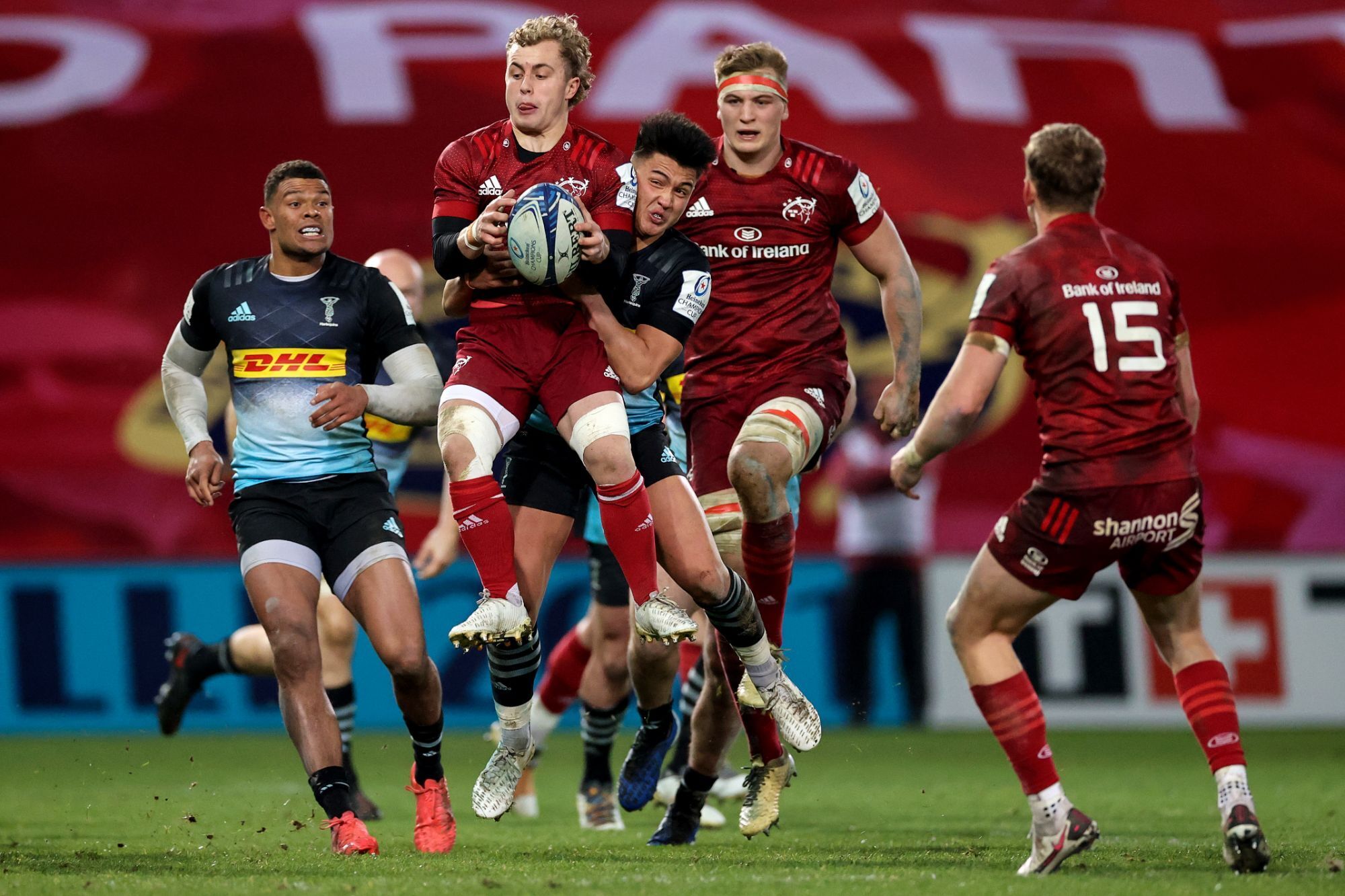
Munster's Craig Casey is lifted into the air by Marcus Smith of Harlequins. Picture: INPHO/Gary Carr
Of the up-and-coming prospects, who would you most like to see given his chance and allowed to develop, even if it means short term frustration?
As a former second row, I am really keen to see how Munster handle the development of Thomas Ahern. Munster just don’t produce too many 6’ 9” specimens with the range of skills and athletic ability the big Waterford man has to offer.
The fact that he played much of his underage rugby in the backs means he is more than comfortable standing in the wide channels, is composed in traffic and in making decisions whether to pass out the back, off load or carry into contact.
Given that skillset, he has the perfect mentor at hand in Snyman. The Springbok World Cup winner is a bit of a freak of nature, blessed with amazing pace for such a big man, has brilliant hands but also a hard edge and a grounding in the traditions of Springbok forward play. In the circumstances, I can’t think of a better tutor for Ahern to learn from. He could also learn a thing or two by picking Billy Holland’s brain when it comes to structuring and calling line outs.
Ahern is in the infancy of what promises to be an outstanding career but at 22, the time has come to invest in his future by giving him more regular exposure. While he has a way to travel, he is such a unique talent he needs more exposure having scored on his competitive debut in the big win over Zebre recently. Once he matures physically, he has the capacity to become an integral part of the Munster front five for the next decade.
In terms of Munster's all-important identity, are you happy that the best traditions of the province are being utilised - or is it time to put all that SUAF stuff to bed and find a different mojo?
Munster have a traditional identity - stretching back decades to when the best touring sides from New Zealand, Australia and South Africa visited - that most professional outfits not only crave but have invested fortunes trying to replicate.
For a variety of reasons, Munster often struggled in the amateur era against the likes of Ulster and Leinster in the interprovincial championship. But when the call to arms went out to showcase the best the province had to offer and to uphold the great rugby tradition of going toe to toe with the best international sides in the world, Munster were never found wanting. Even on the terraces, the decibel levels at those games went up several notches. Everyone knew their roles.
That innate desire to beat the odds, to embrace the underdog tag and make life as miserable as possible for all overseas visitors immediately took on a new meaning when the best club sides from England and France came calling in the early days of the Heineken Cup.
Munster found a new cause and the natural synergy between the terrace and pitch, traditionally reserved for the likes of the All Blacks, re-emerges naturally when the fancy-dans from Harlequins, Wasps or Stade Francais came calling.
Munster had no need for chorus lines of cheerleaders or motorised cars to bring the kicking tee onto the field. They already had a highly educated support base who knew what was required. None of that was fake and there were so many great European contests, in Thomond Park and beyond, when the crowd played their part in dragging the team over the finish line.
It goes without saying that, in the professional game, a knowledgeable and raucous support base isn’t enough to generate success, something Munster will appreciate more than most given their many failings at the semi-final and final stages of competition over the last decade, but it is certainly a help.
What is even more important is the sense of responsibility that comes from connection. Yes, you are being paid but it is difficult, even for an outsider, not to recognise that you represent something far bigger than yourself.
There’s a huge amount of professional players out there playing for clubs that never find that level of connection. After experiencing a Heineken Champions Cup game in Thomond Park for the first time, there isn’t an overseas signing who doesn’t immediately get sucked into the feeling that he is representing something far bigger that himself. No amount of money can buy that.
While it’s part of Munster’s DNA that I sincerely hope the province never loses, it’s equally important to recognise that, in itself, it’s not going to win you any silverware.
DUNCAN CASEY
Ahern should be played as much as possible
DUNCAN CASEY, former Munster and Grenoble hooker
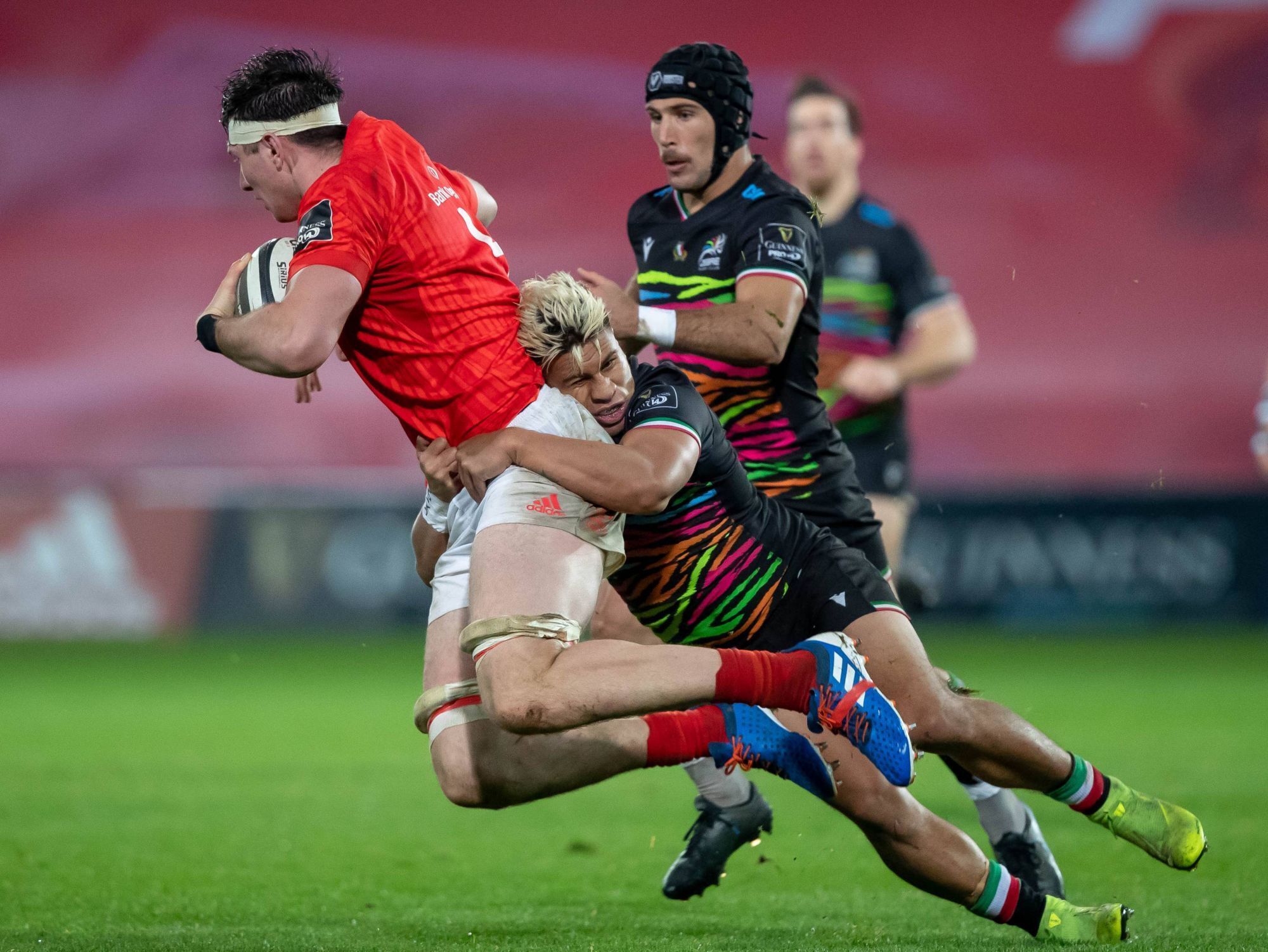
COVER IMAGE : Munster’s Thomas Ahern, tackled by Zebre’s Junior Laloifi in the Guinness PRO14 at Thomond Park. Picture: Morgan Treacy
Given December 1 as a starting point, what are your expectations for the coming year, and where are Munster as things stand with regard to those ambitions?
if asked after the Pro14 semi-final against Leinster in early September, I would not have been terribly optimistic about what the year ahead had in store for Munster. The team seemed to have picked up where it left off, and the hope that we would see a reinvigorated side return from their Covid-induced layoff appeared to have been dashed.
Since then, I'm very happy to say my perception has completely changed. Munster have started the new season with a completely different philosophy that is undoubtedly reflective of Stephen Larkham's influence finally beginning to show. The term 'team in transition' gets thrown around a lot in relation to Munster, which is understandable given the turnover of coaching teams in the last decade (there have been five different head coaches in the last nine years, and many more assistants). It's a meaningless term in my book unless you can actually see evidence of a transition - something to indicate change is afoot, other than a new signing or a new member of staff.
The first eight games of the new season have shown us change in abundance. Players are being encouraged to move the ball, to keep it alive, to try things. Finally - for the first time I can remember - there are a huge number of youngsters getting an opportunity, and they sure as hell seem set on seizing it with both hands.
As such, my expectations (following the pleasure we've gotten from watching a newly energised, fresh-blooded team fly out of the traps in the last couple of months), are that Munster will continue to do what they are doing. Changing a style of rugby from highly conservative to highly ambitious takes time and doing it with youngsters takes even longer.
This winning streak won't last indefinitely. There will be hard nights; probably some bad losses, but it's crucial that Johann van Graan, the players and indeed the organisation as a whole make it clear that they believe in the direction Munster are heading and commit themselves fully to this very entertaining journey the club appears to be on.

Munster's CJ Stander is tackled by Scott Baldwin and Glen Young of Harlequins. Picture: INPHO/Gary Carr
What is the key barrier to Munster taking the next step and competing consistently again with Europe's elite?
Depends how you define 'competing consistently'. Is it being regular semi-finalists or actually being in a position to win a European Cup? If it’s the former, Munster have the quality in their squad to make it to the last four but have not looked strong enough to go further than that. If it's the latter, there is still quite a bit of work to do.
The obvious requirement up front is another big, powerful ball carrier or two. RG Synman could very well have been much of the answer to that, but the rugby gods determined that Munster were going to have to wait another season for that experiment to start. The nature of rugby today means that teams without players of the stature of Billy and Mako Vunipola, for example, will always struggle to succeed at the very top level of European rugby.
Munster have traditionally relied on having a mobile pack rather than a huge one and have prioritised work rate over physicality when it comes to selection. That has served them well up to a point - but that point is the semi-final. As someone who was light for his position for most of his career, I love seeing players selected based on their skillset as opposed to their size. Unfortunately, I think Munster will need to prioritise the latter eventually if they want to win another European Cup.
Another lineout caller is also needed. As it stands, Billy Holland is the only out and out lineout caller in the squad as far as I'm concerned. Tadhg Beirne has moved into that role since his arrival, but he's not a natural. You need a natural running the show to win trophies, in my opinion. This is fine if Billy is selected to start in big games but the last couple of seasons indicate that he probably won't be in the starting 15. It's undeniable that the lineout has struggled when Billy hasn't been on the pitch in big games. As such, there needs to be a concerted effort to work with Tadhg Beirne to ensure he continues to progress to that level, if he's going to be the man tasked with the responsibility. He needs to call regularly in league games, regardless of whether he's playing in the backrow or not, and regardless of whether Holland is on the pitch at the same time. Without the opportunity to grow into the role, the problem is not going to go away.

Munster's Liam O'Connor at training in UL. Picture: INPHO/Bryan Keane
Would you say Johann van Graan and his coaching team have progressed Munster (and the project) to the point where those ambitions are attainable?
If you take the end of Rassie Erasmus' reign as the measure, I don't believe you can say that Munster have progressed in the last three years. At that stage, they had made the final of the Pro14 and the semi-final of Europe the previous season, and while they have repeated the latter twice since, they have been comprehensively beaten in both of those outings. The failure to win a league or even get to another final is a concern and illustrates the fact that currently, Munster are a semi-final team.
There is no shame in that - it takes an extraordinary level of consistency to reach a European semi-final three years in a row ('17, '18 and '19). We need to be realistic about what our expectations are. Being a top-four team in multiple competitions means you are one of the best sides in the business. But that has been the story of Munster for much of the last decade. One of the best teams in Europe, without ever really looking they might become the best.
Silverware is a very arbitrary measure of success, and clubs who neglect all the other factors that ensure the longevity of success pay the price. Take Toulon for example - they were an unbeatable side for a number of years because owner Mourad Boudjellal was willing to throw whatever money was required to fill his team up with world class imports. Some key people left, and things fell apart. They have tried to replicate what they had done previously, and it has failed to have any impact. Now, they are a club without a clear identity and supporters that cannot understand why they are no longer the side they once were.
For an organisation with the tradition of Munster, progress has to be multi-faceted. What happens at every level of the club is central to that. In this area, it hasn't been a great few years either. Since Johann has taken over, three S&C coaches have left. Aled Walters, PJ Wilson and Aidan O'Connell were immensely popular men who left for various reasons to take up new opportunities. These things happen, but it's never a good reflection for an organisation to lose key members of staff like that in quick succession.
At an academy level, it was pointed out around a year ago that there were more players from west Cork in the Munster Academy than there were from Limerick. This is worrying and indicates there is a problem with the production line that needs to be sorted. Unless these secondary issues are also addressed, it will be hard for holistic progress to be made for the club as a whole.

Shane Daly in action during his Ireland debut against Georgia last month. Picture: INPHO/Ryan Byrne
Who or what is the most exciting prospect in/about Munster Rugby for 2021?
There are both 'whos' and 'whats' to get excited about in 2021. I'll start with the ‘whos’. From the front row to the back three, there have been new additions that have made a seamless transition to first team rugby. Josh Wycherley and Diarmuid Barron in the front row, Thomas Ahern in the second, Gavin Coombes and John Hodnett in the back row. Behind them, Craig Casey, Ben Healy and Shane Daly have all shown maturity far beyond their years and have played an integral part in the success of the early part of the season.
The ‘what’ is probably the thing to get most excited about. Munster are playing a completely different brand of rugby to what we have grown accustomed to seeing over the last few years. An ambitious, adventurous mentality is clearly being cultivated in the minds of this side, and, slowly but surely, we can see everyone grow more and more comfortable in their approach.
People don't realise it, but if you are naturally a very good offloader, for example, it is very easy to have that skill coached out of your game by a boss that wants to play a conservative style of rugby. This was illustrated in the Irish side during Joe Schmidt's tenure in charge. Offloading, being an inherently risky thing to do, was discouraged, so players stopped doing it. It takes a while to reignite that natural instinct to keep the ball alive after playing a conservative style for a number of years, and that is what we are seeing in Munster right now.
You can't just switch it back on and expect to be perfect - players need to have the confidence and the freedom to make mistakes in the knowledge that this is part of the bigger picture. Stephen Larkham has blessed Munster with the freedom to play with ambition, make mistakes and get better as a result. I sincerely hope that the wonderfully expansive rugby we have seen in the last two months doesn't go out the window when it comes to playing against better quality opposition. That will be the litmus test of how committed Johann really is to Larkham's project.

JMunster's Josh Wycherley is congratulated by team-mate Tadhg Beirne after his side win a penalty during their Champions Cup match against Harlequins. Photo by Seb Daly/Sportsfile
Of the up-and-coming prospects, who would you most like to see given his chance and allowed to develop, even if it means short term frustration?
I'm sure the vast majority of people would say Craig Casey. That's understandable, given how impressive he has been. But I don't think there's any doubt that Craig is going to play a large amount of rugby this year and get plenty of opportunities to grow into the number 9 jersey. Others are not so sure of having that chance when the international boys come back. For that reason, I would focus on some others.
First is Thomas Ahern. We haven't seen much of Ahern in the first couple of months of the season and he only made his first start in red against Zebre due to a forced change on the day of the game. He is quite the specimen, standing at 6' 9”, but doesn't suffer with the lack of mass that affects many particularly tall European second rows. He is incredibly dynamic for such a big man - great in the air, very quick, and a terrific off-loader that you don't see too often in second rows. He reminds me of a young Richie Gray, who changed people's perception of what a second row can be expected to do with ball in hand when he broke onto the scene.
Munster haven’t been producing second rows in the last few years at the rate they were previously. In particular, there has been a glaring lack of lineout callers in the ranks. Billy Holland's contract is up at the end of this year and if he wants to continue, he will be afforded the opportunity to do so. Even at that, whenever Billy finishes up, there will be a huge hole in the lineout department at Munster. This issue has not been helped by the fact that the second rows Munster have signed in recent years, while of a very high calibre (RG Snyman, Tadhg Beirne, Jean Kleyn), have not been natural lineout callers. Munster need to be proactive about fixing this and getting Thomas Ahern as much game time as possible this year is one way of doing it.
Additionally, John Hodnett has been excellent any time he has played. Comparisons have been made with Sean O'Brien and I can understand why - he is aggressive, powerful and brilliant at playing the ball through contact. The backrow will always be the most crowded place for a youngster to try and muscle his way in, but both John and Gavin Coombes have shown enough promise to expect plenty of opportunity this year.

Munster's John Hodnett is tackled by Olly Robinson of Cardiff Blues at Thomond Park. Photo by Ramsey Cardy/Sportsfile
In terms of Munster's all-important identity, are you happy that the best traditions of the province are being utilised - or is it time to put all that SUAF stuff to bed and find a different mojo?
I am a bit conflicted about this. Munster has an aura. We grow up watching the club in the belief that it is something special, something unique. Those of us lucky enough to make the dream of pulling on the red jersey a reality is fully convinced of the fact that it is a special, unique club to play for. And it is. There was no better illustration of this for me than going to play for Grenoble, a team that was up and down, turned over about half its squad every season, and had very few local guys playing regularly for the senior side. It was a fantastic place to play, a club that had a very proud culture and genuinely could not have done any more to make it feel like a home, but a very different place without a doubt.
Munster is different, but it's also the same as everywhere else, and becoming increasingly so. The identity and tradition of the club is rooted in it being full of local lads, with a few exceptions. That's what we had in the glory period of the noughties and is the foundation on which Munster as a rugby institution is built. That's not really the case anymore, at least certainly not to the same extent. There's nothing wrong with that - it's inevitable in professional rugby unless you have a production line like that of Leinster, and they don't really exist anywhere else these days.
When your identity is predicated on the prevalence of local players, however, it's hard to argue that this development doesn't dilute it by a certain amount, and we shouldn't kid ourselves into thinking it's the same as it was back in 2008.
Failing to retain both local players and staff has an impact here. While we will now always rely on signings from elsewhere to ensure the squad is as strong as it can be, certain decisions have been questionable, and guys capable of playing at the highest level moved on unnecessarily, in my opinion. Dave O'Callaghan is a prime example of this. Someone who had proven he was capable of playing at the highest level of European rugby over the years. Bad luck with injury, of course, but his credentials were there for all to see. He was phased out in favour of Arno Botha, a good player but not someone that provided anything Dave couldn’t. Dave moved to the beautiful Pays du Basque and is now an indispensable part of a Biarritz side battling for promotion to the Top 14. I doubt he has any regrets about his decision to leave. If Munster are serious about keeping their identity as strong as it can be in the era of ruthless professionalism, this kind of thing needs to be avoided.
OWEN HARRISON
‘Stand Up and Fight’ still resonates
OWEN HARRISON (Lifelong Munster fan, freelance journalist @OverTheHillProp).
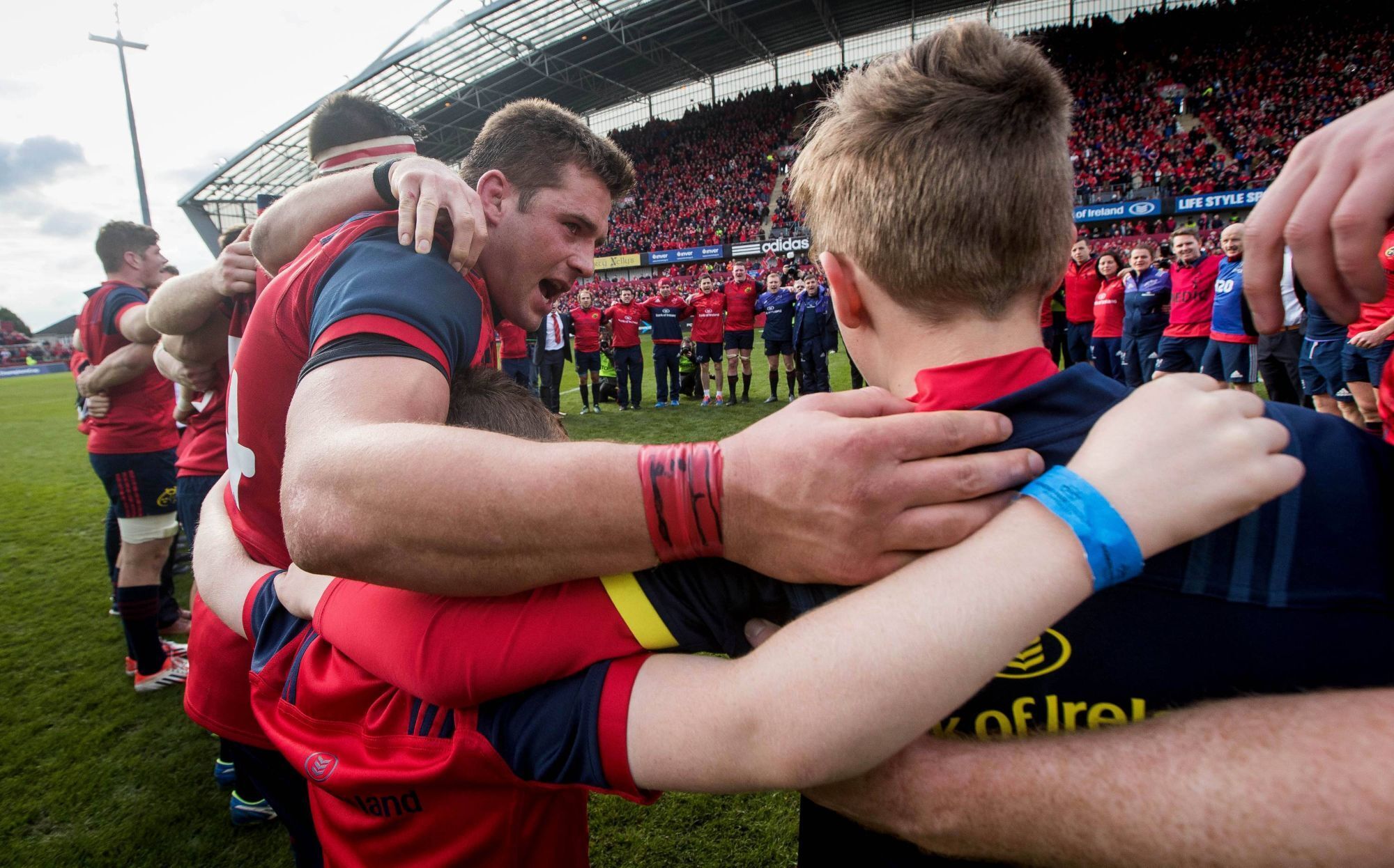
COVER IMAGE : Munster’s CJ Stander with Tony and Dan Foley after the famous Champions Cup win over Glasgow at Thomond Park in October 2016. Picture: Ryan Byrne
Given December 1 as a starting point, what are your expectations for the coming year, and where are Munster as things stand with regard to those ambitions?
there are a number of caveats and unknowns for the next twelve months, especially with Covid, the introduction of the new South African teams into the league and how the economic downturn will impact the IRFUs contracting process. But for Munster this season, the minimum has to be reaching a final and hopefully winning a trophy. The Pro14 is the obvious aim given Munster’s terrific start, but I wouldn’t rule out European silverware especially if Munster are ranked between fifth and eighth after the pool stages and qualify for the European Challenge Cup. The Champions Cup has always been the benchmark against which Munster’s performance is measured, but the difference between winning the trophy and making the knockouts, which is still very much a realistic aim this season, is worlds apart.
The Champions Cup format changes tilt the odds hugely in favour of the tier one sides and Munster being in tier two will require some luck and results going their way if they are to qualify for the expanded knockout stages. Munster will have to target both games against Harlequins, a win at home against Clermont and hope for some match points at the Stade Marcel Michelin. As seen last season, winning home games and bonus points are the key to success in the pool stages and despite the new format I don’t see that altering.
Munster are actually in a very good position to make a final due to the start they’ve made to the season. Despite injuries to a number of key players they are undefeated in the league and several of the young players have really put their hands up as genuine contenders for European match day places and even International honours. If they can maintain their league form over Christmas and the New Year, then finishing top of Conference B in the Pro14 would be all but guaranteed and the home semi-final that comes with that improves the chances of the final appearance and potential silverware. The first eight games have built the foundation for the season, the next six games, which include the Champions Cup pool stages and Christmas Interpros, will decide how successful it could be.
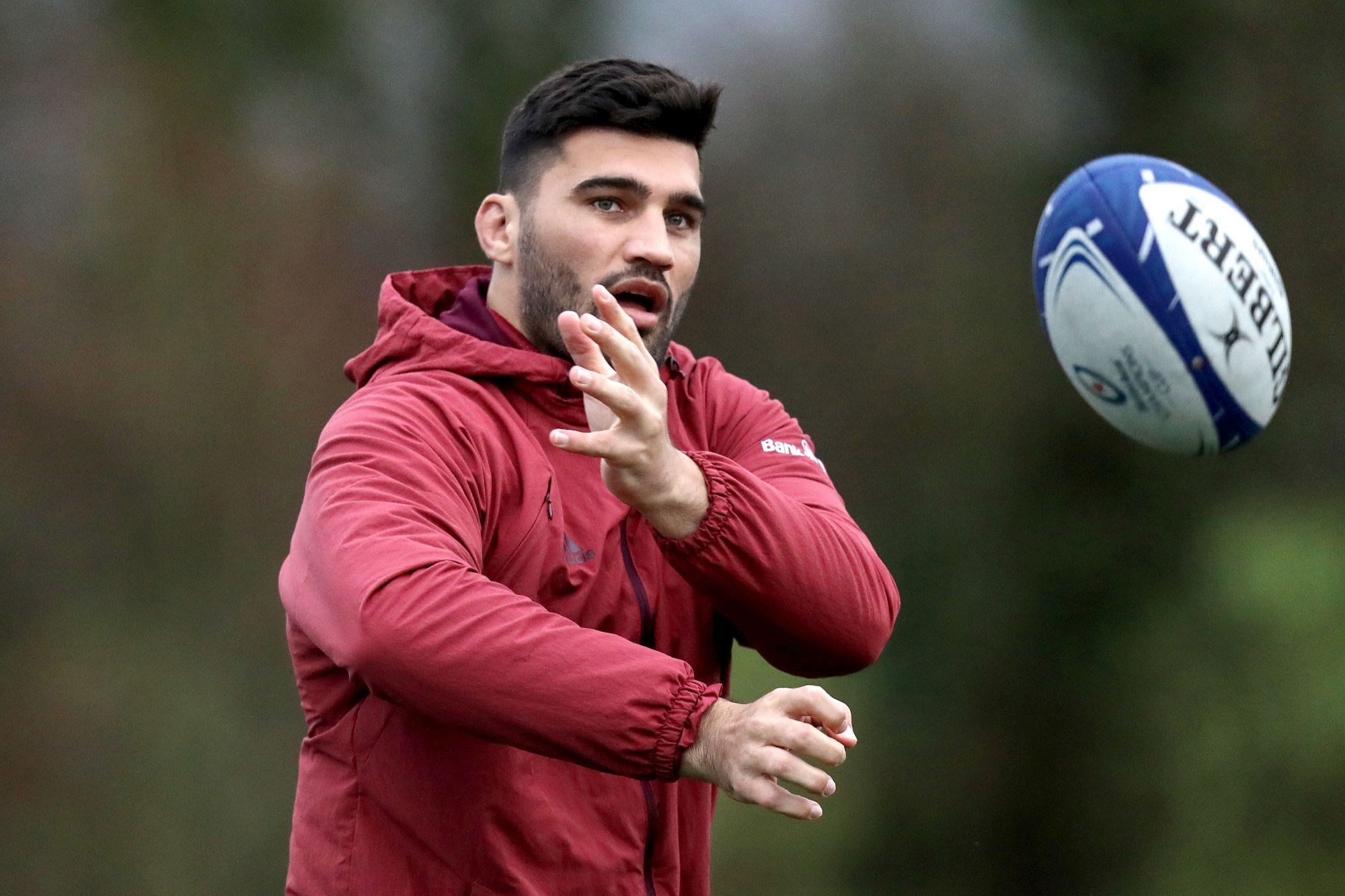
Munster's Damian de Allende. Picture: INPHO/Bryan Keane
Who or what is the most exciting prospect in/about Munster Rugby for 2021?
There are both 'whos' and 'whats' to get excited about in 2021. I'll start with the ‘whos’. From the front row to the back three, there have been new additions that have made a seamless transition to first team rugby. Josh Wycherley and Diarmuid Barron in the front row, Thomas Ahern in the second, Gavin Coombes and John Hodnett in the back row. Behind them, Craig Casey, Ben Healy and Shane Daly have all shown maturity far beyond their years and have played an integral part in the success of the early part of the season.
The ‘what’ is probably the thing to get most excited about. Munster are playing a completely different brand of rugby to what we have grown accustomed to seeing over the last few years. An ambitious, adventurous mentality is clearly being cultivated in the minds of this side, and, slowly but surely, we can see everyone grow more and more comfortable in their approach.
People don't realise it, but if you are naturally a very good offloader, for example, it is very easy to have that skill coached out of your game by a boss that wants to play a conservative style of rugby. This was illustrated in the Irish side during Joe Schmidt's tenure in charge. Offloading, being an inherently risky thing to do, was discouraged, so players stopped doing it. It takes a while to reignite that natural instinct to keep the ball alive after playing a conservative style for a number of years, and that is what we are seeing in Munster right now.
You can't just switch it back on and expect to be perfect - players need to have the confidence and the freedom to make mistakes in the knowledge that this is part of the bigger picture. Stephen Larkham has blessed Munster with the freedom to play with ambition, make mistakes and get better as a result. I sincerely hope that the wonderfully expansive rugby we have seen in the last two months doesn't go out the window when it comes to playing against better quality opposition. That will be the litmus test of how committed Johann really is to Larkham's project.
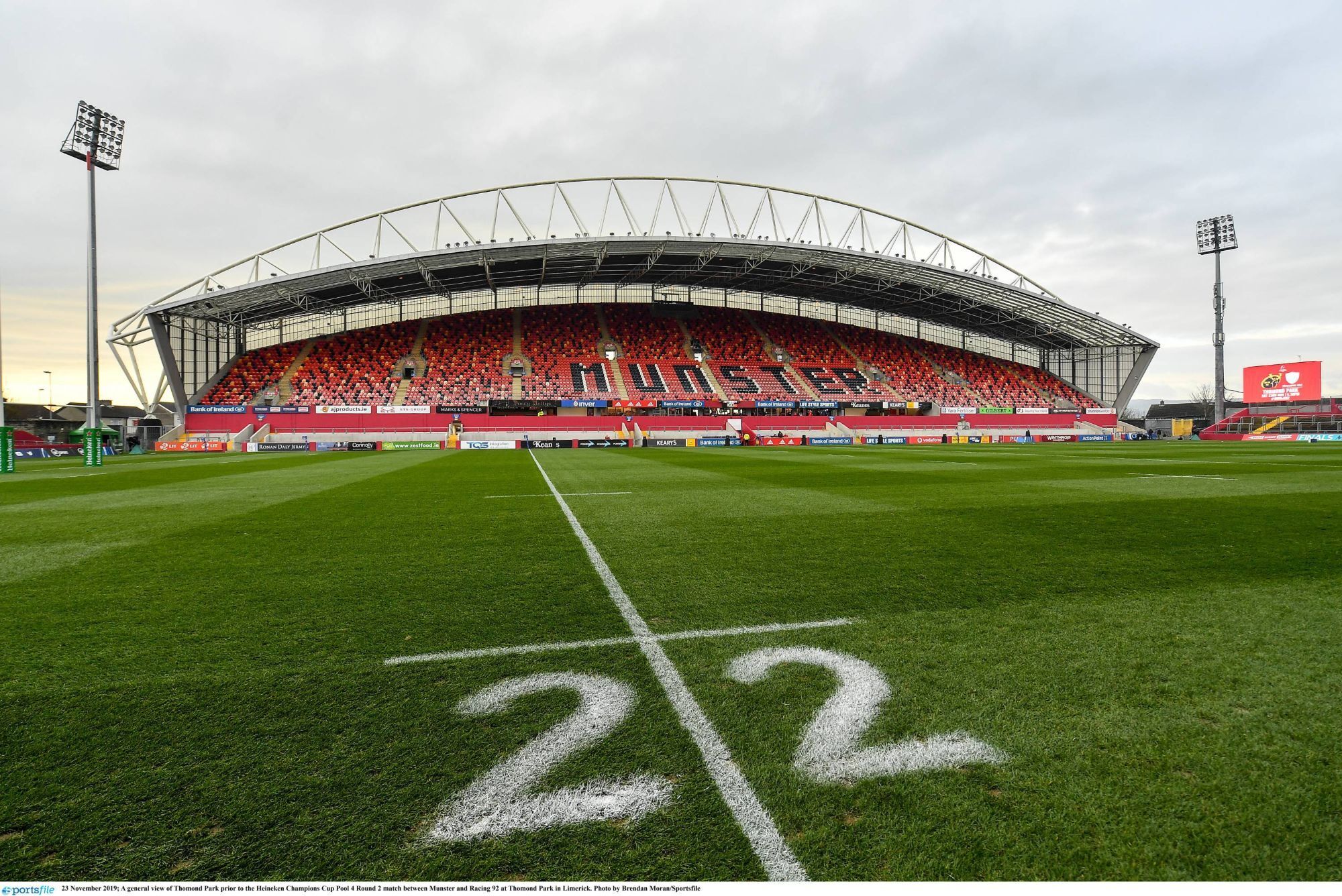
Thomond Park. Photo by Brendan Moran/Sportsfile
Would you say Johann van Graan and his coaching team have progressed Munster (and the project) to the point where those ambitions are attainable?
This might be van Graan’s third year, but it still amazes me that Munster have had five different head coaches in the last ten years. That’s five head coaches with potentially five different visions of where Munster were going, how they should play, what type of player should be recruited and what players should be retained or cut from the squad. Add to that changes at CEO and assistant coach level and you begin to see the level of change that Munster have gone through in the last decade. That level of change is never good for any organisation.
Under van Graan, Munster have evolved their style of play in the main because they had to. When he arrived, Munster had reached a ceiling against the top tier teams that they just couldn’t push past. They were trying to play a style of rugby similar to those elite teams – possession rugby and trying to physically dominate the opposition.
That worked against the vast majority of teams but against elite sides who are bigger, have the ability to produce or buy greater squads and don’t allow you to get over the gain line, you’re going to struggle as Munster did.
Stephen Larkham is having a material impact on Munster’s style of play and that can be clearly seen in how last season was split into three distinct blocks. Early season saw van Graan and Larkham have a full pre-season and block of games with the internationals away at the World Cup in Japan. They were able to work with the players and help transition the team away from the traditional low risk option of forwards charging head down into a wall of defenders and recycling the ball back to another pod to continue until they box kicked, to a style where forwards have to read the defensive line, pull passes behind them to the backline or tip passes to support runners who change the angle and point of attack.
The second block saw the internationals return and they were faced with a completely new way of playing to which they couldn’t fully adapt in the short timeframe and that played a part in Munster’s failure to get out of the Champions Cup pool. The third block was the restart of the season after lockdown and was marred by injuries. The first block of this season has seen all the players being able to work with Larkham and Rowntree and the results so far have been extremely promising.
The last three years have given Munster stability and a consistent vision at the top. Van Graan has made the team, squad and coaching ticket his own and now this season I think he has to deliver silverware to back up the faith shown in him. I think he can do it.
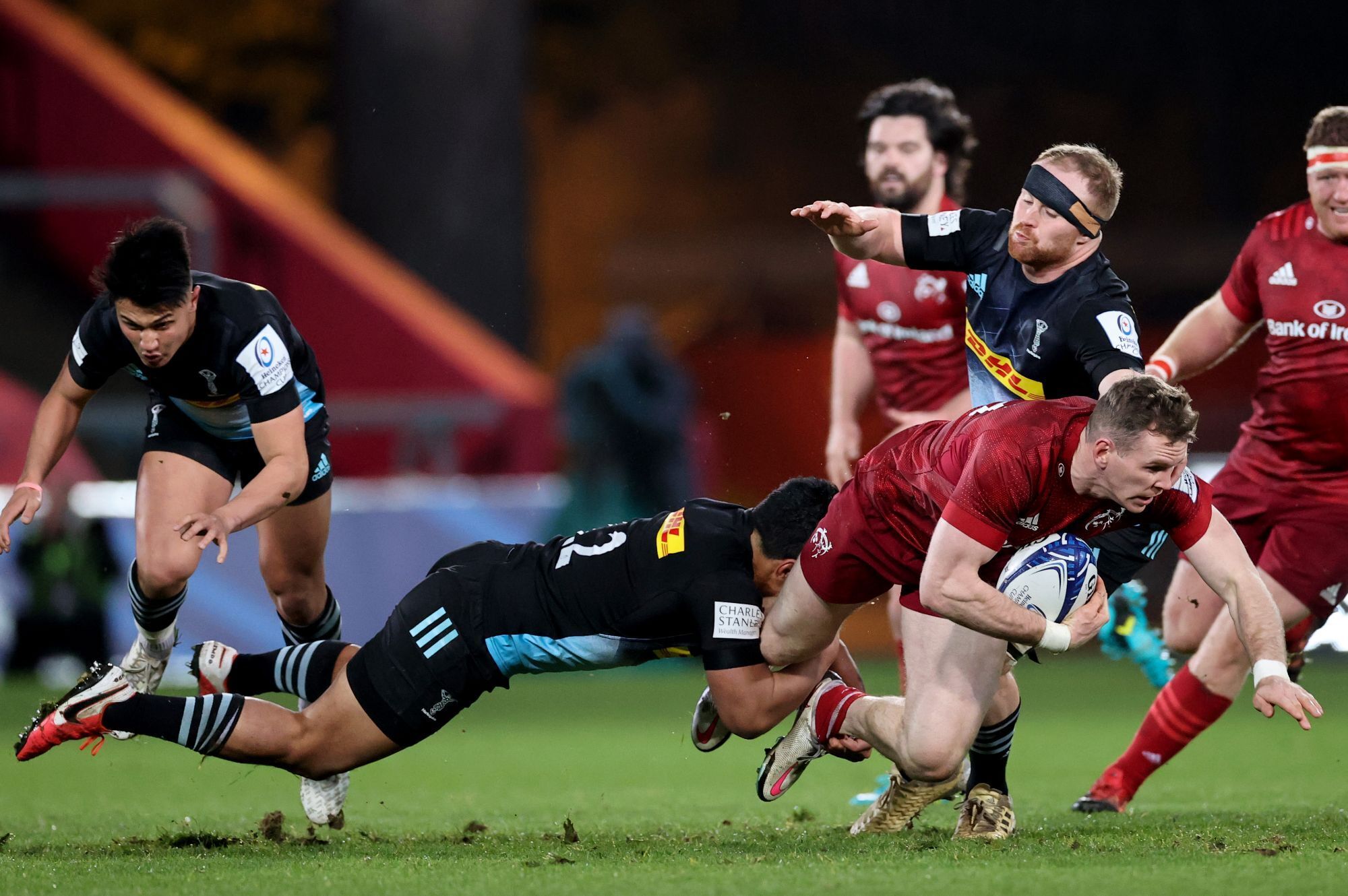
Who or what is the most exciting prospect in/about Munster Rugby for 2021?
For me I’d have to say it’s all the new players coming through the system. While I think the addition of De Allende and Snyman might have caught most of the media attention in the last 12 months, it’s the talent coming through from the academy that has the potential to drive this team for years to come.
The Autumn Nations Cup saw Shane Daly win his first Irish cap, something that Johann van Graan predicted nearly three years ago when he first saw Daly’s potential. Craig Casey and Ben Healy have formed a half-back pairing at Pro14 level this season that has shown a maturity and calmness under pressure that belies the fact both are only 21. It’s surely only a matter of time before Casey is capped and if Healy can make the Munster ten shirt his own for the European campaign then he has the opportunity to get a step ahead of some of his competitors for the green jersey who won’t be starting big games. Gavin Coombes’s physicality and handling have earned him multiple player of the match awards already this season and if, as anticipated, he gets a chance to perform in Europe over the coming weeks he can expect to spend some time in Carton House in 2021.
The players I’ve mentioned already are on most people’s radar and are likely to be in discussions around Ireland squads in 2021 but there are a number of others who are just starting to break through into the Pro14 line-up that have huge potential but may take more time to fully develop. Players like Josh Wycherley, who has performed so well when given the chance recently, John Hodnett, who van Graan name checked as a potential European standard player before his unfortunate injury, Keynan Knox, who at 21 is currently more than holding his own at tight head prop and Jack O’Sullivan who made his Champions Cup debut last season.
Of those mentioned above, Healy, Hodnett and Wycherley are still in the academy which also has players such as Thomas Ahern, Jake Flannery and Alex Kendellen who have huge potential and the ability to make their own mark in a Munster jersey in 2021.
Of the up and coming prospects, who would you most like to see given his chance and allowed to develop, even if it means short term frustration?
Plenty of talent coming through and quite a few of them are likely to represent Ireland in the future but there is one player that stands out for me and that’s Thomas Ahern.
Guys with his athletic prowess just don’t come along very often. He’s 6 foot 9 inches tall and despite being 110kgs already, it seems his frame will allow him to further bulk up in the coming seasons. Rugby is not a contact sport; it’s a collision sport where size, strength, speed and power matter so if Ahern can add bulk for the tight exchanges without compromising and losing too much speed, he could really turn into a top-level X factor player for Munster. Given he started out playing in the backs and only switched to the second row in his late teens he has great pace and good handling skills. He has come primarily through the Youths system so even at this point may not be physically conditioned as well as his national contemporaries which only leaves further room for improvement.
What he has shown at AIL and Ireland under 20 level is that he has the potential to do the job of a second row and also add that something special around the field. At AIL level we’ve seen him catch a kick-off and race untouched for a try, for Ireland under 20’s we’ve seen him outsprint opposition wingers when running in tries from the halfway line and for Munster against Zebre recently we saw him collect a chip over the defensive line and carry the ball over 50 metres before being taken down. This isn’t what you would normally expect from your second rows and is comparable to the impact we saw from RG Snyman during his stint in Japan. Snyman looked like a man playing against an underage team at times prior to his move to Limerick and given his experience and similar physical attributes to Ahern, it’s hard to think of anyone better for Ahern to learn from in the coming years.
It’s up to Ahern and Munster now to manage the situation and make sure that potential is translated into on field performances, but there is a chance Munster have a real super star in the making.
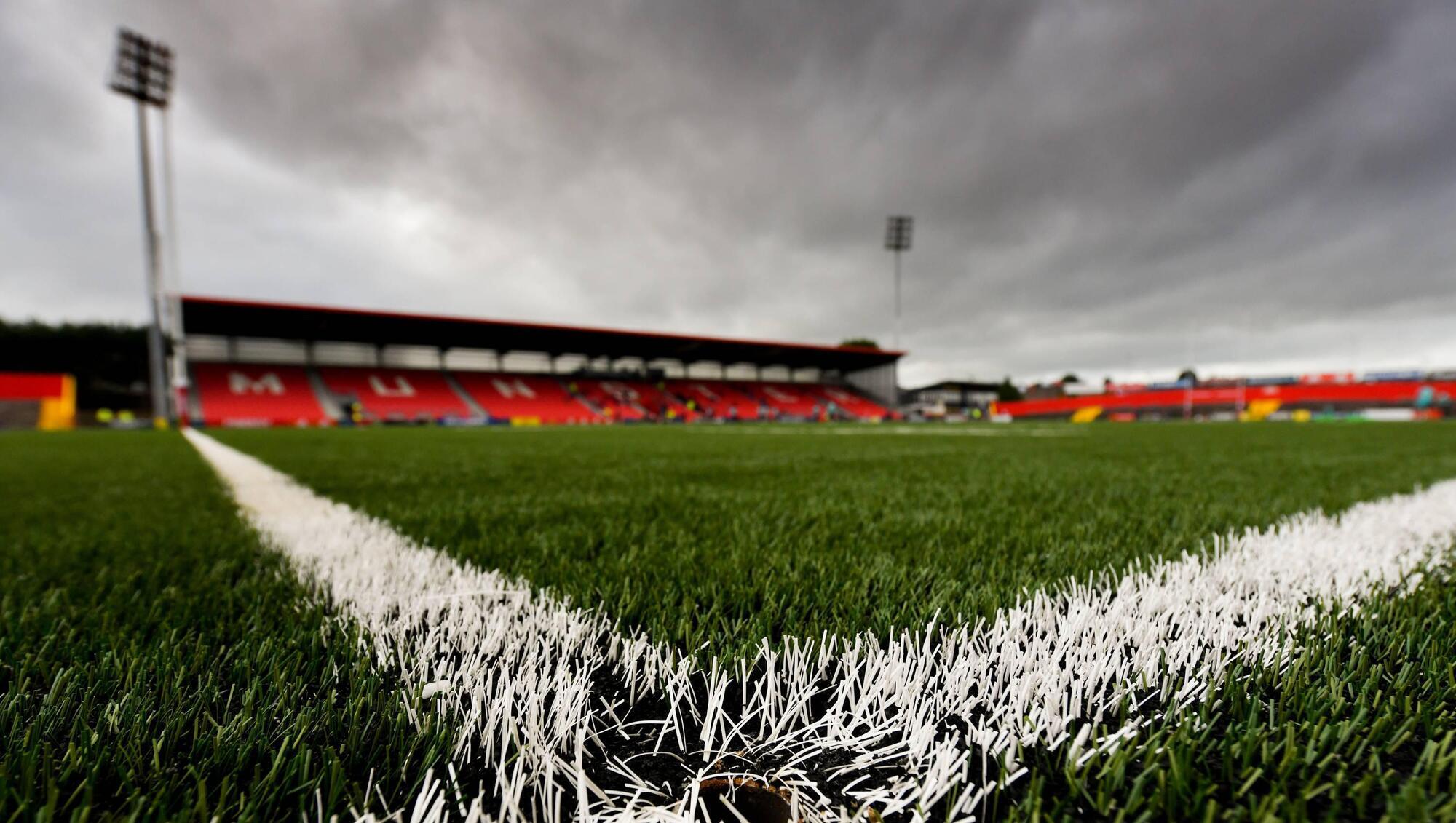
Musgrave Park. Photo by Diarmuid Greene/Sportsfile
In terms of Munster's all-important identity, are you happy that the best traditions of the province are being utilised - or is it time to put all that SUAF stuff to bed and find a different mojo?
Munster’s historical identity was founded on the basis of players and fans, temporarily leaving aside club allegiances and uniting under a provincial banner. However, professionalism, academy development of players and IRFU strategy have all combined to de-prioritise the club game to the point where now it plays a relatively minor role in the Irish rugby pathway, leaving Munster to be more of its own unique identity rather than the collective we have historically known.
In the noughties the media focused on the wider social appeal of rugby in the province (especially in Limerick) and comparisons with GAA structures, along with on-field success helped to draw in the casual fans but the 2010’s saw the decline of the club game and the lack of on field success for Munster occurred in parallel which created the question marks around the provinces identity.
I also don’t buy the idea that because a team has always played a certain style that they should continue to play that style forever. You need to be able to tailor your game plan to match the attributes and skills of the team. Playing a game tactically that doesn’t suit your players seems to be a pretty quick way for a coach to get his P45. On-field success is the be-all-and-end-all of professional sport and traditionalism generally takes a back seat.
For me ‘Stand Up and Fight’ works because it offers something unique to fans. Anyone can pump rock music into a stadium to try and create an atmosphere but it rarely works and they may have to play it again and again during the game itself to generate the false idea of excitement or atmosphere. ‘Stand Up and Fight’ took root in Munster through Brian O’Brien in the late 90s and was adopted by the players and later by the fans. It works because it’s organic and hasn’t been forced.
While the 2010s may have led to people questioning Munster’s identity the rebirth of the connection between team and fan has its genesis in ‘Stand Up and Fight’. It took Anthony Foley’s untimely death and the unforgettable match against Glasgow for that to happen and in the centre of the pitch at Thomond Park that afternoon we saw players and fans both celebrate and grieve and as one they sang ‘Stand Up and Fight’.
No ‘morketing guy’ can come up with that.
Irish Examiner Longread