Jack Anderson: In sport, ethical concerns are rarely based on moral values alone
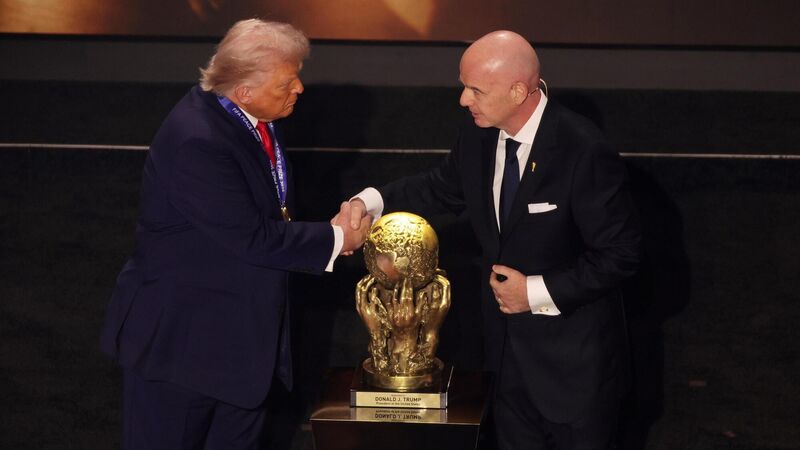
US President Donald Trump is presented with the inaugural FIFA Peace Prize award by FIFA President Gianni Infantino. Pic: Sam Corum/PA Wire.

For the past few years, the Irish Department of Foreign Affairs and Trade has, to mark St Patrick’s Day, released a video montage of Irish people at home and abroad: aid workers; artists; entrepreneurs; electricians; nurses; doctors; soldiers in Lebanon and of course, sports people. For those of us away, the clips generate feelings both of poignancy and pride.
The soundtrack to this year’s video is Kodaline’s “High Hopes”. In the middle of it all was Troy Parrott’s goal and the man himself holding a sign with the eponymous song title.
Ah stop. No, I’m fine kids, just cooking with onions.
Next week, we look forward to the World Cup qualifier against Czechia. The tournament itself co-hosted by the US, Canada and Mexico now looks like it will be the most political sports event in living memory.
Great goals giving way to geopolitics has also been a feature of the women’s Asia Cup currently taking place here in Australia. On field, the Iranian’s women’s team did not make it out of the group stages; off the field was where all the drama lay.
As the first American and Israeli attacks began on Iran and, tentatively, it looked as if the horrific Islamic Republic regime might topple, the young Iranian team stayed silent during the playing of their national anthem (one associated with the regime).
It was however an uncomfortable silence, they knew that their silent protest would be loudly condemned by the regime at home (and it was, on state television). They knew that they might be personally vulnerable when they returned home or their family would be, if they didn’t.
Asylum was offered by the Australian government and at one stage federal officials waited on the sideline to whisk away those who wanted to claim refuge. The majority of the squad departed for Iran without doing so but seven remained. Subsequently, five of the seven changed their mind and went home, only two of the Iranian team have stayed in Australia.
Reports in the local media suggest that players received audio messages from family in Iran, pleading with them to come home.
Who knows what those who returned will face; a bombed country and a regime-friendly football federation who, ever before the recent attacks, tightly controlled their international women’s team. As one former Iranian football told ABC News, “Everyone is telling you to keep your hijab on, roll your sleeves down, don't do makeup.”
It’s a reminder that the regime in Iran is not one that should engender any sympathy: the people who suffer under it yes; the regime, no.
The UN Special Rapporteur on human rights in Iran, Mai Sato, reported this week that January’s protests against the regime, led mainly by the young, resulted, conservatively, in 20,000 deaths. The Rapporteur said that many in Iran were afraid to testify to her about what happened to family members and that it was common that families had to pay the regime to have bodies returned.
Much of this was written across the drawn faces of the Iranian women’s team as the world and the regime watched them at the Asia Cup. Does any of the above of itself justify the most recent bombing of Iran which for most neutral commentators is in breach of international law? And contrary to what you might read on polarised, polluted social media platforms it is possible to hold two positions at once: the bombing is illegal; the regime abominable.
In contrast, FIFA holds no position on the plight of the Iranian women’s team. The world governing body has said nothing, despite having human rights commitments written into its regulations.
The only thing that FIFA said recently about Iran relates to the men’s team, when it seemingly rejected a request by Iran to move its group games in the World Cup from the US to Mexico. Trump has said that the Iranian team can come to the US for the tournament, but he cannot guarantee their safety, which probably is a breach of the host contract which legally underpins the whole event.
The FIFA President, Gianni Infantino, who is very close to Trump, will ignore all this. Infantino was appointed to the US President’s Board of Peace, ostensibly established to oversee the Gaza peace plan. Infantino, who is also an IOC executive (sports politics is the most incestuous politicking of all) has faced claims that his close association with Trump means that he is in conflict with and in breach of obligations under both the Olympic Charter and FIFA’s Code of Ethics.
Article 16 of the Olympic Charter requires members to act “independently of commercial and political interests” and not to accept “from governments, organisations, or other parties, any mandate or instructions liable to interfere with the freedom of their action and vote”. The complaint against Infantino was rejected by the IOC last month on the ground that FIFA, by supporting “comprehensive sport recovery investment programmes” in Gaza means that they and their President are acting in line with the fundamental Olympic principle of solidarity.
In short, if you rebuild a few soccer pitches in a country that is razed and ravage of even basic services; well then, Gianni, you are good to go.
The separate FIFA Code of Ethics investigation is ongoing. The legalese of that complaint is encapsulated by the image of Infantino at the inaugural meeting of the Board of Peace donning a red, Maga-like baseball hat, embroidered with USA and 45-47.
Infantino’s hat wearing is similar to reports that Trump guesses the shoe size of male cabinet members and then sends them his favourite brand of shoe, which they must wear. The Secretary of State, Marco Rubio, has been pictured wearing shoes that are far too big for him, but he clops around in them anyway. Trump apparently is of the view that shoe size tells you a lot about the man. The White House, once a place of global respect, is now a frat house.
But for FIFA’s Infantino the cap still fits. The reason really has nothing to do with Trump, it’s all about FIFA’s finances. At the last World Economic Forum in Davos, which Infantino attended (of course) he spouted about a WTO study showing that the FIFA World Cup could generate $80 billion in gross output globally and add up to $41 billion dollars in US GDP. What Infantino didn’t say then is that FIFA hope to generate $US11 billion from the tournament.
In the world of sport, considerations of all things ethical are rarely based on moral values alone.
We have seen this with the GAA’s decision to retain its sponsorship with Allianz, as based on problems in extracting the Association from a long-standing contract, the loss of commercial standing if they did and the difficulties in finding another bespoke insurer. The same with the FAI’s decision to go ahead with games against Israel in the UEFA Nations League where concerns about disciplinary action, loss of standing with UEFA and the difficulties of repairing that relationship were all noted. This is not to say that organisations such as the GAA or the FAI do not sympathise with the people of Gaza, of course they do.
While for those of us safely on the outside, the ethical path seems clear and the “right” response predictable, for those in the arena of sport and of war, such as the Iranian women’s football team, today’s world is anything but.
High hopes indeed.