Colin Sheridan: No doubting Thomas when it comes to nailing kicks
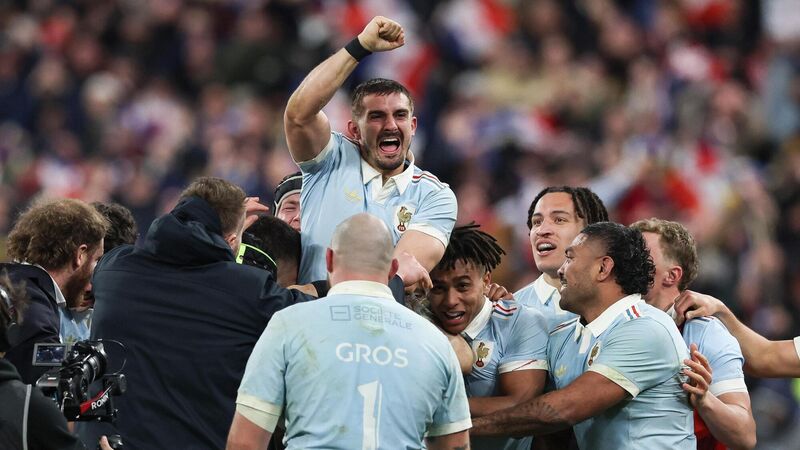
France's Thomas Ramos celebrates with team mates after he kicks the match winning penalty.
In all the hullabaloo of the final moments of France v England in Saturday night’s Six Nations finale, one man stood apart from the almost insane theatre unfolding in the middle of the Stade de France pitch. As Antoine Dupont and Maro Itoje remonstrated with match referee Nika Amashukeli about the position of the penalty that would decide the game - and the destination of the tournament trophy - Thomas Ramos, the French full-back, calmly followed them around with a kicking tee, like a dolly grip trying to set up the golden-hour shot for a narcissistic director.
When the point of the kick was finally decided upon - 46 metres out from the posts, a little left of centre - the Toulouse kicker wasted little time, perhaps unwilling to milk the moment for any more drama, but much more likely switching into a metronomic state of hypnotic repetition. He did what he almost always does. He trusted his technique and nailed the kick.
He did it so quickly the kick itself almost immediately became an afterthought, as if - because of his brilliance - it was a foregone conclusion. It was, of course, anything but. A 46-metre kick on an angle is a damn hard strike in practice, never mind as the decisive act in a game where Ramos was anything but a passenger.
Gone are the days of rugby teams carrying a kicker. In a break with the most Gallic of traditions, Ramos is as brilliant with ball in hand as he is with ball on the tee.
When you grew up - as I did - watching French teams in the 1990s treat the selection of goalkickers with hilarious contempt, you became used to certain trends. Just as commentators loved to remind us watching at home that you never quite knew which French team would show up, I often wondered if they would bother to bring a kicker at all.

The irony was that, in the 1990s, many games finished 9–6 or 15–12, so an Eric Elwood was much more valuable than a Simon Geoghegan. Not to France, it seemed. Famed for having penalty-kicking scrum-halves - long before it became de rigueur - the most egregious example of their collars-up, two-fingers-to-convention approach was a curly-haired chap called Christophe Deylaud: a little magician of a fly-half who appeared to have little interest in winning, rather he simply wanted to entertain.
There was nothing entertaining about goal-kicking back then. It was the era of the giant sandcastle. Pre-kicking tee, and in Deylaud’s eyes, I’m guessing, a postmodern pursuit he had little interest in perfecting. Yet the French saw fit to entrust him with the responsibility. He did love a good drop goal, which I respected, but he almost seemed to miss penalties and conversions on purpose - as if to antagonise the selectors for thinking so little of his talent. (Remember that France also had the scrum-half throw into the lineout.) Far fewer penalty goals are attempted now than at any other time during the professional rugby era, it’s all about going for the corner now - a stats-driven muscle flex that will hopefully yield your team a convertible try.
Counterintuitively, it makes us think much less about goal-kicking.
I would argue that, from a selector’s perspective, Sam Prendergast’s Six Nations would have a very different sheen had he converted all his kicks. The highlight reel might be a little diminished - shorn, perhaps, of the no-look passes and super-soft hands - but the meat-and-drink reliability of a guy who makes his nudges when he absolutely has to is difficult to quantify.
Similarly, Jack Crowley. The Munster man kicked well on Saturday against Scotland in what can only be described - in international rugby terms at least - as a medium-pressure environment. His team were purring. So was he. Ireland were clearly superior, and he kicked commensurate with the occasion and the expectation. But that’s not the issue. That’s a kicker - in Roy Keane speak - just doing his job.
It certainly isn’t Ramos.
When I was a kid I had the privilege of watching my brother become one of the best kickers in Gaelic football. That’s quite a statement to make, but I can say it with absolute authority. In fact, I didn’t just watch him - I was part of the process, first as a ball collector, later as a pair of eyes who understood the desired outcome and could react accordingly. Like a golfer’s caddie.
He was obsessive, but in the way a master obsesses over his craft. There were no kicking coaches, no video sessions, no trade fairs where he could swap secrets with kickers from other teams. It was just him and me, and a bag of balls.
Eventually I moved from behind the goals, collecting, to standing alongside him, watching his strike at the point of impact. His follow-through. His standing leg. His breath count. We talked about new ways to hit the ball: a fade, which required a straighter run-up and an entirely different impact area on the ball; a straight-on kick, effective in difficult winds.
I genuinely saw him as an artist experimenting with form.
There was symbiosis in the collaboration. There were also many facets of his approach that I later understood when I (belatedly) applied them to writing, running, and golfing.
I’m sure Prendergast and Crowley et al think about kicking in exactly the same way, only they have to balance many other things too. Perhaps they are being asked to do too much. Ramos - arguably the best kicker in the world - does not have to quarterback a game from number 10.
But whatever his extra responsibilities, when the referee blew his whistle and raised his arm to signal a penalty, even as the captains quibbled, there was almost zero doubt about the outcome of the kick.
Enter Monsieur Thomas Ramos. A master at work.
Somewhere in the training fields of Quantico this week a scene will unfold that will feel less like a serious law-enforcement initiative and more like a deleted sequence from a straight-to-DVD action movie. A group of FBI agents - the people tasked with investigating organised crime, terrorism and financial fraud - were being coached in combat techniques by Ultimate Fighting Championship stars. The pitch was that fighters such as Justin Gaethje, Jorge Masvidal and Renzo Gracie would help agents sharpen their “combat readiness.” On paper, perhaps, it sounds vaguely plausible. Mixed martial artists know how to grapple. FBI agents occasionally need to detain people. The leap between those two things, however, is about the same distance as the one between cage fighting and accounting - which, inconveniently, is what a lot of FBI work actually looks like. The whole exercise has the faintly comic whiff of a teenage boy’s idea of governance: badges, muscles, famous fighters and maybe a protein shake afterwards. The driving force behind it is FBI director Kash Patel, whose tenure has been notable less for quiet institutional competence than for an ongoing attempt to become the federal government’s coolest bro. He’s appeared on podcasts, posted gym selfies with agents and even celebrated a hockey victory by chugging beer in the locker room. So naturally the next logical step was to bring the UFC to Quantico. None of this is meant to diminish the UFC athletes, many of whom are extraordinary technicians in their own field. But the idea that a session with cage fighters will transform the investigative capacity of the FBI is faintly ridiculous. Only in Donald Trump's America could law enforcement be performed under bright lights with a referee and a ring card girl. Forget the paperwork. Paperwork doesn’t look great on Instagram. And that, you suspect, might be the real point.
Mayo’s defeat to Kerry in Kerry in the National Football League might not have been part of the grand plan, but it could prove useful all the same. Wins in Tralee tend to set unrealistic hares running back home, and the Heather County has had quite enough of those over the years. A loss, on the other hand, lowers the temperature nicely. While the outside world quietly revises its expectations, manager Andy Moran can get on with the unglamorous business of building a team. In Mayo, progress rarely happens in bright lights anyway - it’s usually done quietly, out of sight, somewhere in the dark.
Another round of UEFA Champions League knock-out matches, another gentle cough in the direction of the Premier League’s favourite boast - that it is, without question, the “best league in the world.” Chelsea laboured. Manchester City looked oddly mortal. Liverpool and Arsenal both discovered that continental nights are less forgiving than Saturday afternoons against mid-table familiarity. Only Newcastle emerged with genuine credit - though the looming prospect of a return leg in Catalonia suggests that particular adventure may soon end. We have been here before. The hype machine whirs loudly each Sunday afternoon, only for Europe to administer its periodic reality check. Perhaps, just perhaps, a little introspection is overdue