Tommy Martin: The cost of taking a stand on Israel proved too high for FAI
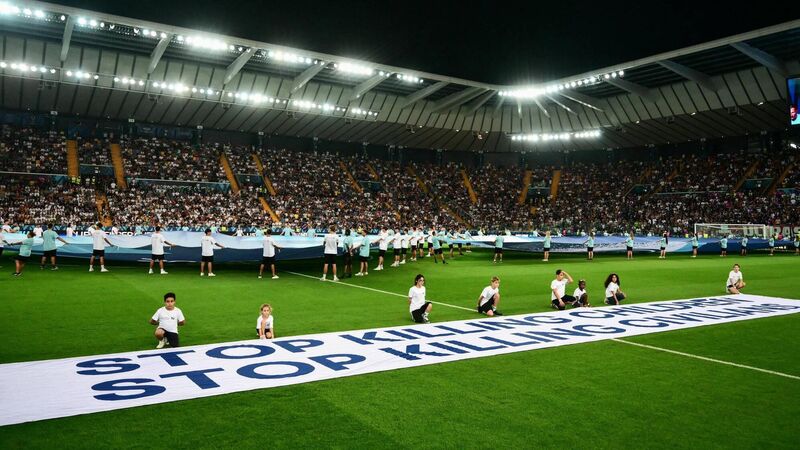
Mascots hold a banner which reads "Stop killing children, Stop killing civilians" on the pitch ahead of the 2025 UEFA Super Cup final football match between Paris Saint-Germain (FRA) and Tottenham Hotspur FC (ENG) at the Friuli stadium, in Udine, on August 13, 2025. Photo by MARCO BERTORELLO/AFP via Getty Images

In general, any political stance taken is only worthwhile when it costs you something.
Just ask Vladyslav Heraskevych, the Ukrainian skeleton athlete who was disqualified from the Winter Olympics for wearing a helmet that commemorated athletes killed during the invasion of his country by Russia.
Heraskevych was banned under the International Olympic Committee’s athlete expression guidelines, which say that an athlete enjoys freedom of expression at the Games as long as they don’t bang on about politics and wars and stuff.
Unfortunately for Heraskevych, commemorating dead comrades was judged to be a bit too much of a distraction from the real point of the Winter Olympics, which is people doing risky things on ice while wearing lycra.
To be fair, the IOC gave Heraskevych every chance to back down and save his Olympic dream, proposing that he wear the helmet before he raced and afterwards in the media mixed zone, thereby promoting his message of remembrance, but just not while he was in the act of plummeting down an icy death tunnel at 100kph on a sawn-off ironing board.
The Ukrainian, however, would not compromise. "Expression guidelines - what do you consider as expression?” he said. “Many others here in this arena have helmets with different colours and I believe that is also a kind of expression.
"Some others had national symbols, that is also expression. For some reason, their helmets weren't checked and they were allowed to compete but I am not. I believe they [those who have fallen] deserve to be here because of their sacrifice. I want to honour them and their families."
At the time of writing Heraskevych was appealing the decision to the Court of Arbitration for Sport (CAS), which holds ad-hoc meetings during the Games for precisely this sort of knotty issue. Most likely, though, his unwillingness to bend on moral principle will cost him the chance to do something to which he has presumably dedicated countless hours of his life and at considerable risk to his orthopaedic wellbeing.
The FAI board was put in a similar situation when members of its General Assembly voted to submit a motion to Uefa to ban Israel from international competitions last November. No sooner had the vote passed by an overwhelming majority than the association’s president Paul Cooke made it clear that, were the situation to arise, and unlike our Ukrainian friend, the FAI would not be putting its money where its mouth was on this one.
Back then Cooke said the FAI had contacted their Israeli counterparts prior to the vote "out of courtesy and respect" and made it clear that "straight off the bat, we would play them, provided it was part of a Uefa competition" when asked whether the FAI would follow up the motion with a boycott if necessary.
"We're members of Uefa. As anyone who has listened to me knows, we are a members organisation, we have been mandated by our members to take a certain action and will do that."
Cooke hardly sounded like someone preparing to don a keffiyeh and man the barricades over the issue of Israel’s continued participation in international sport. While those who voted did so with understandable conviction about the horrors inflicted by Israel on the people of Gaza, Cooke has also spent time looking at the horrors of the FAI’s balance sheet.
So it was that when Ireland were duly lumped in with Israel at Thursday’s Nations League group draw, the association wasted no time in releasing a statement saying they would be fulfilling the fixtures, despite the sentiments expressed by their members the previous November.
Cooke and chief executive David Courell clearly felt the statement included all that needed to be said about the subject, as they were out the gap after the draw without fielding questions from media, allowing manager Heimir Hallgrimsson the privilege of dealing with the sticky subject matter.
For all their certitude, no sooner had Patrick Vieira walked off stage in Brussels after doing the dastardly deed than calls began for FAI to follow through on their headline-grabbing November vote and boycott the games. Further concerns were expressed about the security implications of hosting Israel in Dublin and the story quickly gained ground internationally as such gnarly sporting politics rammies tend to do.
In general, the whole thing can be expected to hog the agenda around the Irish international set-up in ways which will be a royal pain in the ass for an association whose focus was supposed be on the giddy buildup to next month’s World Cup play-off.
None of which can be expected to change the FAI board’s initial instinct to leave November’s General Assembly vote in the category of worthy moral gestures rather than inspiration for genuine political action.
The FAI’s motion wasn’t nothing – Ireland remains one of only a small number of UEFA countries, along with Norway and Turkey, to explicitly call for Israel’s removal from international competition – and demonstrated solidarity with the many Palestinian footballers killed, maimed or displaced by Israeli action in Gaza.
But in real terms it is barely worth the piece of paper it was written on, an item which presumably has been stuffed in a Uefa filing cabinet ever since. Cooke said that the FAI are Uefa members, but they are also Uefa’s debtors, an association that owes its continued existence to lines of credit offered by the European governing body, along with the government and Fifa.
The FAI’s debt currently stands at €38 million, with part of that consisting of advance payments from UEFA based on prize money for participation in competitions such as the Nations League. The upcoming tournament alone is worth a basic €1.5 million in prize money, with a possible bonus of that amount again if Ireland were to top their group, not bad for an organisation currently seeking up to 60 redundancies.
Uefa funds Irish football in other ways, through their Hat Trick fund for grassroots projects and Irish clubs’ participation in European football. No state or FAI funding into Irish football could come close to the almost €4 million Shamrock Rovers and Shelbourne earned from their progress in the Uefa Conference League, not to mention that €325,000 paid to every Premier Division club in Uefa solidarity payments.
The FAI bottom line eagerly awaits the spinoff from their hosting role at Euro 2028, while the association have just tabled a bid to host the 2029 Women’s Champions League final. All of which is to say that, much like Ireland in the aftermath of the financial crash and subsequent bailout, the FAI will remain good little Europeans for the foreseeable future, turning up when they are supposed to and pocketing the resulting cheques.
There was a brief window when it looked like Uefa was entertaining the notion of taking action against Israel, back in August when it displayed a banner featuring the words “Stop Killing Children” at the Uefa Super Cup final in Udine. That moment has passed with the current, dubious ceasefire. Judging by Fifa president Gianni Infantino’s recent comments about the possible return of Russia to international football, football’s rulers are clambering further away from the moral high ground, if that were possible.
Which will be a relief to the FAI, for whom the cost of taking a genuine political stance is just too high.