Peter Jackson: Who is Ireland's greatest sportsperson?
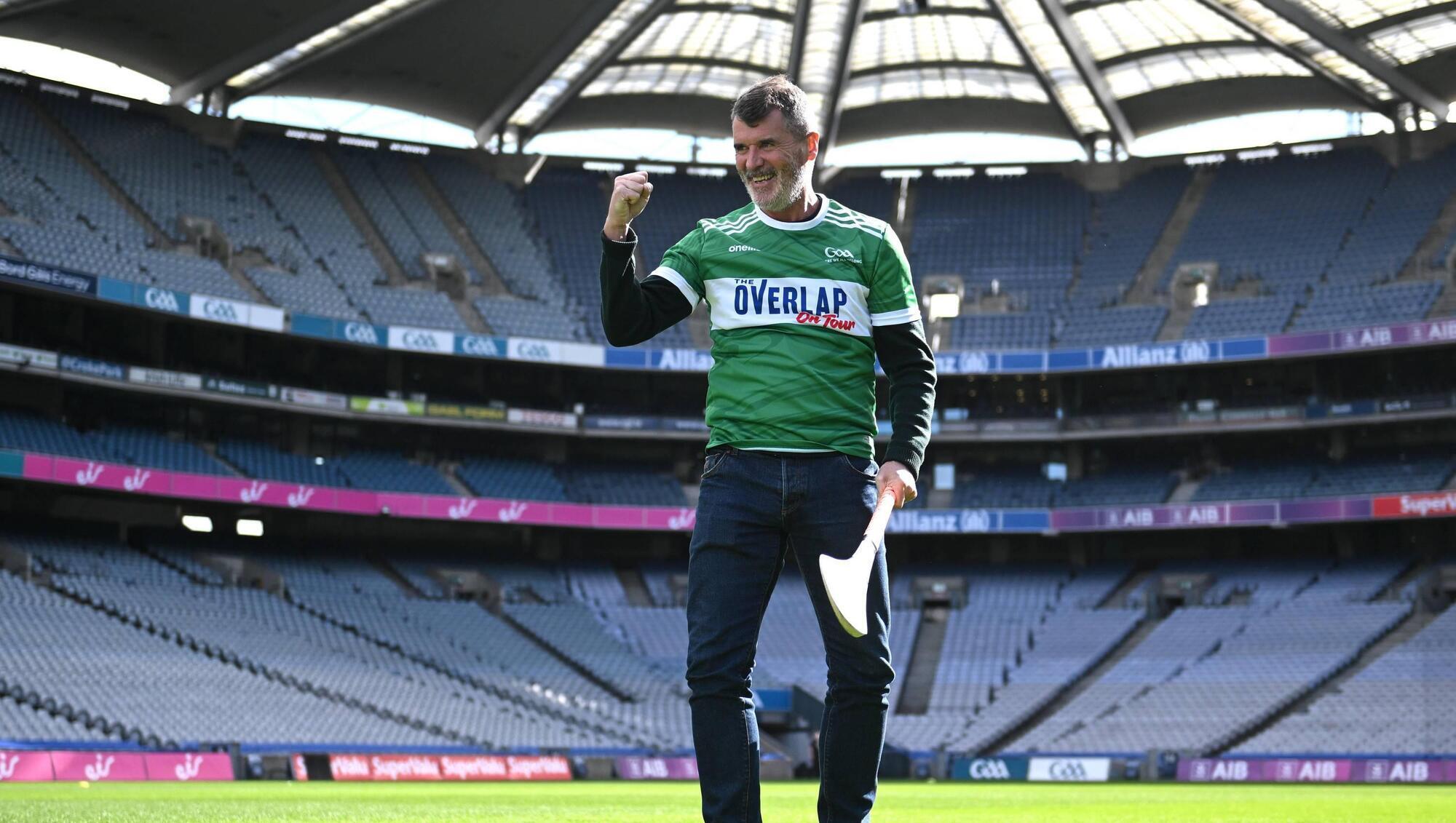
IRELAND'S GREATEST?: Roy Keane at Croke Park. Pic: David Fitzgerald/Sportsfile.
ONCE upon a time long gone, two little boys from the same village in Donegal set sail for distant shores. One landed on the banks of the Clyde, the other half a world away beside the Pacific Ocean.
The genesis of The Great Irish Sportsman can be traced back to their departure during the last quarter of the 19th century from Ramelton on the western bank of Lough Swilly. As three-year-olds, they went their separate ways by the same surname, just two more families uprooted by the chill wind of hard times blowing through their bones.
One set of Gallaghers, Presbyterians, emigrated after the collapse of their drapery business. Some 20 years later, the other Gallaghers, a Roman Catholic family living the proverbial stone’s throw away, somehow scraped enough silver shillings to buy a much shorter voyage out of their poverty to the greener grass around Glasgow.
The similarities extended to each making an involuntary single letter change to their name. The long-distance Gallaghers dropped the second g or had it dropped for them by immigration officials adamant about spelling the name as they had heard it, hence Gallaher.
The Scotland-bound Gallaghers also lost their second g shortly after disembarking at Clydebank, parental illiteracy ensuring that it wouldn’t have made a blind bit of difference anyway. For reasons beyond their ken, they became Gallacher and have remained so without further interference to this very day.
Dave Gallaher left Ramelton in the late 1870s, laboured at a freezing factory, enlisted in the New Zealand Army and within three years of returning from the Boer War ascended to a position of supreme status in Aotearoa: The Godfather of the All Blacks.
He played in their first Test match, captained ‘The Originals’ on their first European tour two years later, won 35 of his 36 matches as an All Black. For good measure the boy from the Swilly, no giant at 6ft and 13 stone, revolutionised the game through his re-invention as the prototype wing forward.
Patrick Gallacher left Ramelton as a spindly kid in 1899. The boy still revered in the green half of Glasgow as Patsy, can’t have been much less spindly at 5ft 6in and eight stone when Celtic signed him from a shipyard at the end of war they promised would end all wars.
Blessed by exquisite skill, gymnastic balance and an inexhaustible supply of courage, ‘The Mighty Atom’s’ 207 goals for himself and hundreds more for those around him, helped Celtic win ten titles in 14 seasons.
Suddenly, Ramelton had not one serious contender for the title of Ireland’s greatest sporting great but two.
Though Rory McIlroy, having waved his wand at Augusta National and then Bethpage Black, may now be about to seize that prize too and spirit it home to Holywood, Co Down.
No matter how demanding the criteria, McIlroy passes every one. No trouble for a strolling sorcerer able to make protruding trees bend to his will, as good a reason as any for his place in the Pantheon as the lone European among the six to have won the Grand Slam of majors.
Ramelton will polish up the monuments to their footballing greats and mobilise their defences against the tsunami of popular opinion sweeping everyone’s favourite golfer towards a status of such magnitude that Green Jackets and Claret Jugs tend to shrink and shrivel in its historical glare.
What constitutes greatness, as in the greatest Irish sportsman, or woman, of them all? Is it a one-off achievement, a first that can never be surpassed, something which grows in greatness the longer it remains unique?
Several fit snugly into that category.
The first batsman to hit a boundary in The Ashes, in the first one against England at the MCG in 1877, having emigrated with his family 13 years earlier. The only Irish man to captain Australia in the Ashes, he became a cricket journalist of renown. Ranked at No. 3 on the chronological list of Baggy Greens.
Ireland’s first Olympian to strike gold twice, as hammer-throwing champion at the Amsterdam Games in 1928 and again at Los Angeles four years later. His versatility knew no bounds, hence a spell in the US on the wrestling circuit.
Still Ireland’s only Olympic track champion, not any old event but the blue riband 1,500 metres, writing his name in gold before Herb Elliott, Peter Snell, Kypchoge Kaino, John Walker, Seb Coe, Hichem El Guerrouj wrote theirs.
Olympic pentathlon champion, Munich 1972. Has lived in Northern Ireland from the age of 11, launching her athletics career at Portadown College.
***
Talking of divided communities, greatness in exceptional cases can be found in an exceptional sportsman using his fame as a unifying force.
In that context, ‘The Clones Cyclone’ towers above the rest.
Featherweight champion of the world adored on both sides of the sectarian divide while The Troubles raged. "Both sides would say: ‘Leave the fighting to McGuigan.’ People loved to forget The Troubles for a while.
The fact that I wouldn’t wear green, white and gold or put on anything that said this is who I represent was powerful. It was a very mature and dangerous thing to do. I wouldn’t choose sides and people appreciated that.’’
Greatness also has to be measured as a test of time, the cumulative effect of a long track record – serial winners.
A soccer international who has long been by some distance the most decorated of all Irish boxers, males included. Regained all five global little-welterweight female world titles in July after the only defeat of her monumental career.
Gold medals galore in the lightweight double sculls, first with brother Gary then Fintan McCarthy from Cork. Reigning double Olympic champion after silver in 2016 plus seven world golds and three European.
Raised winning consistency to untouched Himalayan peaks as champion jump jockey for 20 seasons from 1995-96 to 2014-15. Rode almost 4,500 winners, a figure made all the more staggering by the fact that nobody else got within 2,000 of that total.
Not easy rank domestic kings of Gaelic games in an international pantheon but numbers must count for something. Nine All-Ireland titles as Dublin’s goalkeeper, captain in seven. Over the course of 138 years, nobody else has managed more than two.
Long acclaimed as the finest hurler. Passed the hardest test of all over four decades from the 30's to the 60's with flying colours, winning 36 major titles with Cork and Munster.
Paralympian gold by the bullion from five successive Olympiads, sprint doubles in Beijing (2008), London (2012), 100 metre gold in Rio (2016) and Tokyo (2020). Holds the T13 world records for both events. Won 14 more golds at World and European championships over 13 years from 2006.
The fulcrum of Irish rugby’s first Grand Slam team considered by many to be the finest fly half of all time. Better than Barry John, Phil Bennett and the other Welsh wizards. "Yes," according to the prince of Welsh centres Bleddyn Williams. "Why? Because there was nothing Jack couldn’t do and he did it better than anyone else."
Simply the best trainer of racehorses over jumps and the flat in the history of the sport. He trained six winners of the Derby, scored a hat-trick of triumphs at the Grand National and his stable included the peerless Nijinsky.
One of the outstanding runners of the Nineties from 1,500 metres to 5,000, on the track and cross-country. World champion over 5,000 in 1995, she won five more global titles and an Olympic silver at Sydney in 2000.
Rode in 14 Cheltenham Festivals, leading jockey in all but three. So good that Christy Moore recorded a song of tribute, The Ballad of Ruby Walsh.
Racing trainer par excellence, the most successful in the history of the Cheltenham Festival: 2 Champion Chases, 4 Gold Cups, 5 Champion Hurdles. And The last two Grand National winners, Nick Rockett and I Am Maximus.
***
Led Northern Ireland into the last eight of the 1958 World Cup, then captained the celebrated Spurs double-winning team of 1961-62 and of the only Northern Ireland team. Different in so many glorious ways not like his altruistic view of football.
"The great fallacy is that the game is, first and last, about winning. It’s nothing of the kind. The game is about glory. It’s about doing tyings in style and with a flourish about going out and beating the lot, not waiting for them to die of boredom.’’
By any yardstick one of the ten finest footballers of all-time, his genius underpinned by high-speed athleticism and the courage to keep going where angels fear to tread. None had a female following like his.
"I used to go missing a lot: Miss Canada, Miss UK, Miss France. They say I slept with seven Miss Worlds. I didn’t. It was only four. I didn’t turn up for the other three."
Six who changed the Irish mentality, from happy-go-lucky losers to ruthless winners:
Famous for many things, like a record five Lions tours in 12 years. Orchestrated the ‘99’ call used during the invincible 22-match trip round South Africa in 1974. If someone got thumped the other 14 piled before the victim could be counted out.
Won seven Premier League titles and four FA Cup finals in twelve years at Manchester United. Always calls it as he sees it, including his attitude to winning a game of football: ’’Aggression is what I do. I go to war.’’
WBO middleweight and super-middleweight champion. Never lost a title defence.
Two Scudettos with Juventus on top of iconic status with Ireland and Arsenal.
Two league titles and an FA Cup with Leeds and a reputation among the best midfielders of his era. Plus he modernised Irish football.
That he recovered from the shattering experience of missing all five shots at goal for Munster in a losing European final says everything about his mental fortitude. Now, fortified by his ‘Cork French,’ has become the most admired non-Test coach in the game.
Most-capped rugby centre of all time (133 Tests for Ireland, eight for the Lions) over a 15-year career. In all that time never once failed to put his body on the line, before and after the All Blacks maimed him in the first Lions Test of 2005.
Grand Slam gigantic rugby Lion of whom it was said: "Superman wears Paulie’s pyjamas." Rewrote the meaning of work ethic. "You hear a lot about a person having a God-given talent. I hate that phrase…that excellence is somehow preordained. It isn’t. The belief denies the incentive to practise and make that huge effort to reach your goal. Beware of this talk about God-given talent."
***
Has already gone down in history as England’s greatest one-day cricket captain.
Double world snooker champion.
Also world snooker champion.
To the distinguished American sportswriter Grantland Rice, on top of his game at a time when Joe Louis, Sugar Ray Robinson, Babe Ruth, Joe Di Maggio, Ben Hogan and Arnold Palmer were top of theirs, true greatness could never be judged solely on the size of the cheque.
‘Granny’ Rice spelt it out better than anyone: "For when the Great Marker comes to mark against your name, He won’t ask how many you won or lost but how you played the game.’’
On that score, a familiar name is surely to be found in his natural habitat at the top of the leaderboard, even one as crowded as that reserved for Ireland’s greatest sports men and women: