Tommy Martin: Persistence with O'Neill the big difference between Irelands north and south
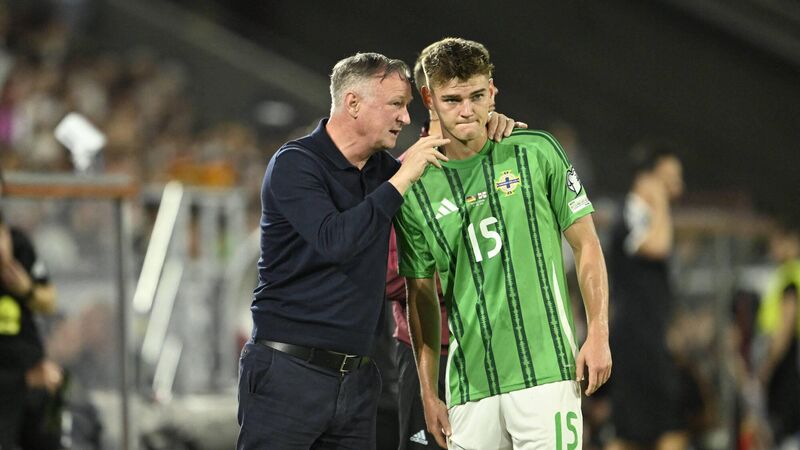
THE DIFFERENCE: Northern Ireland's headcoach Michael O'Neill (L) speaks to midfielder Justin Devenny during the 2026 World Cup qualifier with Germany (Photo by INA FASSBENDER/AFP via Getty Images)

Looking forward to the big game involving an Irish team in this World Cup qualifying window. It’s taking place in the city of Košice in eastern Slovakia tomorrow night.
Of course, the Republic of Ireland’s penultimate qualifier against Portugal at the Aviva Stadium is also a big game. If Ireland get a result, they go to Hungary still with a chance to qualify for the World Cup. Cristiano Ronaldo is in town again with his star-studded retinue. It’s a full house. There will be kids with cardboard signs asking for jerseys.
Alas, the sequence of events which would see the Republic of Ireland securing a World Cup play-off spot feels more like the clutching of a raffle ticket than a surefire strategy. A win or a draw over Ronaldo and co gives Ireland a chance. Hungary have to go to Armenia and get something. Portugal needed an injury-time winner to beat Ireland in Lisbon last month. Stranger things have happened.
But Ireland didn’t have a shot on target in that game in Lisbon. And Portugal will be fired up by the need for a win in Dublin to confirm top spot and automatic qualification. And Ireland, let’s be honest, haven’t been great lately. I’m not a gambler, but the odds don’t seem good.
If Northern Ireland, on the other hand, win in Slovakia (a team they have already beaten in the group), they will head into the final round of games level on points with their opponents in what is likely to be a battle for second place behind Germany. In Monday night’s decisive Group A matches, Northern Ireland play Luxembourg at home, while Slovakia are away to Germany.
So Northern Ireland have a decent shot at a place in the World Cup playoffs through their Group A performance, and if not, they have the backdoor possibility of a playoff spot through their Nations League record. They currently occupy the fourth of the four playoff places allocated to Nations League group winners. This is a fallback that the Republic of Ireland won’t be able to rely on.
In short, they’ve plenty work to do but they’re in decent shape.
Comparison is the thief of joy, and nothing was ever truer for an international football manager. It used to be, during the heyday of the Charlton years, that the English press would get great mileage during bad spells for their own international side by pointing out how well Big Jack was doing with the Oirish. This reached its apotheosis at USA ’94, when they sat at home while we sweated it out in Giants Stadium and Orlando.
The same phenomenon dogs Republic of Ireland managers when any of our Celtic neighbours are doing well. The four peoples that once battled it out for the Carling Nations Cup represent perfect laboratory conditions for whataboutery. All four consist of small populations with broadly similar football styles and challenges. All are perpetual underdogs in the shadow of a big neighbour and all like a pint and various fried foodstuffs.
Sadly for Heimir Hallgrimsson and his embattled corner of the Celtic quadrangle, the other three are doing just fine right now. Wales have only lost in close encounters with Belgium in their group and already have a playoff spot in the bag after winning their Nations League group. They have, under Craig Bellamy, a clearly identifiable playing style in keeping with their manager’s in-your-face persona.
Scotland were booed off the pitch after their last match, a scrappy 2-1 win at home over Belarus that secured their place in the playoffs. They could even top the group with positive results away in Greece and at home to Denmark and they are, remember, looking to add World Cup qualification to the achievement of reaching the last two European Championships under Steve Clarke. Booo! How terrible!
But it’s Northern Ireland that really bites. Anyone who caught their rip-roaring encounter with Germany in Belfast last month couldn’t fail to admire the organisation and aggression that Michael O’Neill’s team played with. Germany couldn’t have been made feel less welcome at Windsor Park had they emerged from the tunnel wearing Kneecap balaclavas.
Despite having only a third of possession, Northern Ireland had more efforts on target than Germany, had a goal disallowed and only conceded to a set-piece goal for Newcastle’s Nick Woltemade. They looked like a proper team, as O’Neill’s sides generally do. And all this the night before the Republic of Ireland’s grim affair at home to Armenia.
Comparison is a dodgy game. You end up comparing apples with oranges – no pun intended. But Northern Ireland are not under the spell of a golden generation, or being dragged along by a world-class superstar, unless you are being super-generous to Liverpool’s Conor Bradley (who was, incidentally, suspended for the Germany game last month).
They do have a handful of really promising younger players in the likes of Shea Charles of Southampton, Trai Hume at Sunderland and Justin Crystal Palace’s Justin Devenny. But otherwise, their squad is a similar mix of lower league pros with a Prem sprinkle as a certain other international team in green.
The big difference is, of course, O’Neill. Josh Magennis, one of the few survivors of his O’Neill’s first spell in charge, explained his methods. "First of all, obviously, he's tactically very, very astute,” Magennis said.
“He is a massive, massive believer in you having to be able to get about the football pitch. If you don't run, you will never play in his football team, regardless of how good you are on the ball. He's always managed to play players and play a formation that gets the best out of that certain player. It's not in terms of getting the best players on the pitch. It's what will bring the best out of this formation for his team."
Doesn’t sound too complicated, but there you go. Barring something mad happening in the next week, the Republic of Ireland are facing into another tiresome managerial hunt and ensuing rebuild. O’Neill signed a five-and-a-half year contract with the IFA at the start of his second spell in charge in 2022 and lost seven of his first nine games. There was no panic. They knew they had the right man. O’Neill will probably be making others look bad at least right up to Euro 2028.
Comparison is the thief of joy? Damn right.