Colin Sheridan: Green Jacket not the panacea we thought it would be for Rory McIlroy
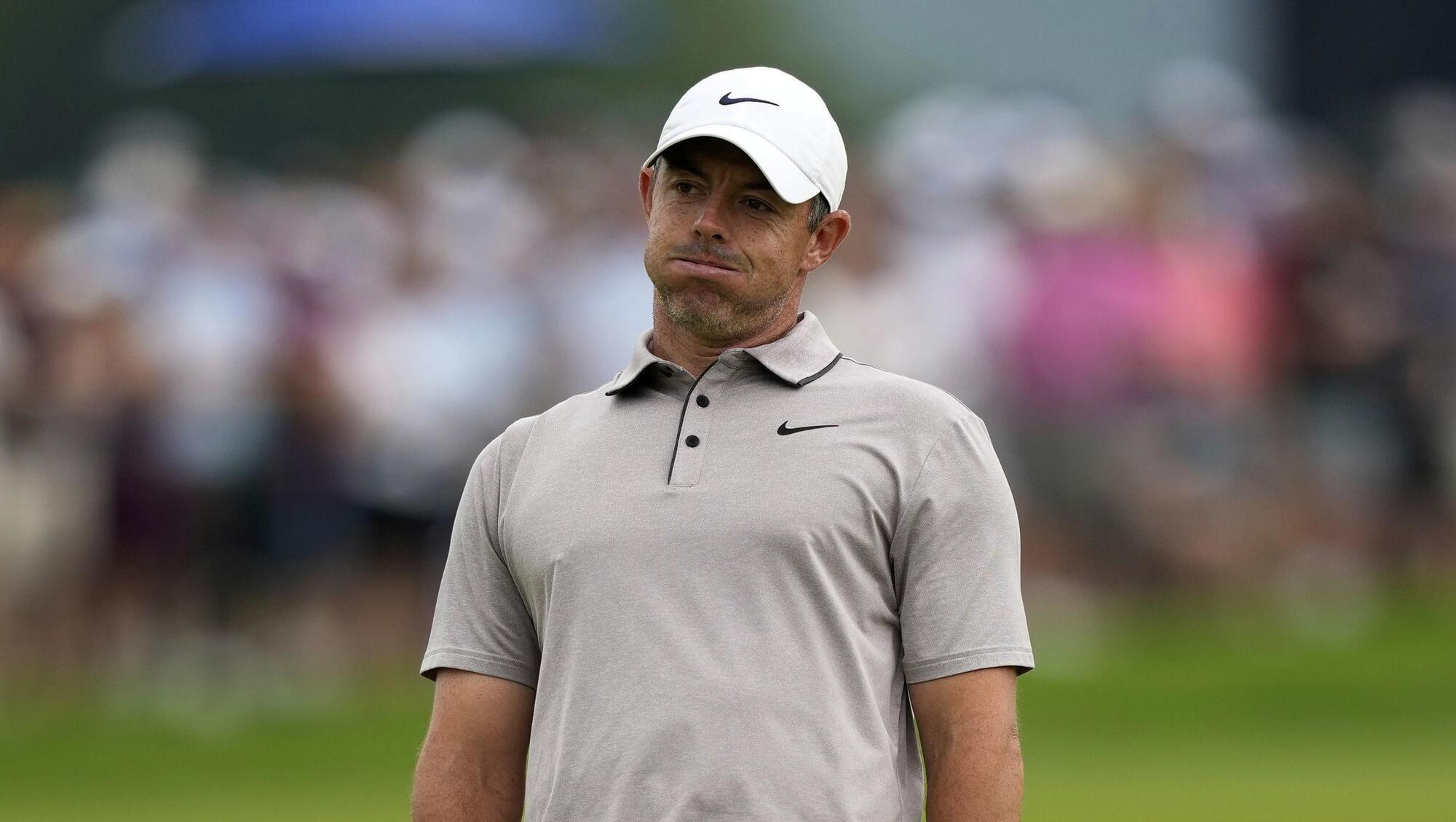
Rory McIlroy reacts after missing a putt on the eighth hole during the third round of the U.S. Open. Pic: AP Photo/Carolyn Kaster

We have known Rory McIlroy for a very long time. We knew him before he turned professional in 2007, eighteen years ago. He was a spotty teenager then.
Butty, with a mop of curly hair. Like a cast member of the hit comedy Superbad, just with an otherworldly talent for playing golf. When he emerged as an amateur, no Irish golfer had won a major since Fred Daly in 1947. A random European Tour victory for Phillip Walton was as good as it got for a lot of us coming of age in the early 90s.
What was rare was wonderful, and low expectations meant even lower returns back then. McIlroy always appeared unburdened by history, both on the course and - sometimes controversially in a political sense - of it. It was that sense of post-catholic guilt self-confidence that unnerved us a little about him. His flip-flopping on nationality.
His flip-flopping on love and marriage and Trump and sports agencies. Where there has been no flopping, where he has been unequivocal, is the expression of his golfing genius. He has delivered on that in ways we will never fully appreciate until he is long gone from the game.
Just two months ago, the proverbial monkey was blown from McIlroy’s back by his Masters victory, a triumph so multitudinous in its achievement and execution it served as a broader metaphor for his life, both sporting and personal. Those four days were like an authorised biography.
Full access to a mind at once tortured and completely at peace with the torture. Up until that very last iron shot into 18 on the first playoff hole against Justin Rose anything was possible and everything that could’ve happened had happened.
He had won it, lost it, won it again. The same with the crowd. The same with his inner demons. The entire experience was a meditation on love and life and the crosses we all carry. That McIlroy’s pursuit is a sporting one makes it no less significant, though we like to tell ourselves sport doesn't really matter. Had he lost to Justin Rose, we would’ve seen exactly how much it did matter.
My guess is that McIlroy would’ve disappeared like a heartbroken poet into the woods to stare at the sky and scream at the Gods. That he won, and wept uncontrollably in front of millions spoke directly to his ordinariness as a human being.
We got carried away then.
“Rory Slam,” we whispered, and speculated that Jack Nicklaus’s major record haul of 18 was once again under threat. Rory, 36, a father and a husband and now in possession of a career grand slam, had nothing left to prove. He was complete.
“Fear the man with nothing to lose,” so the saying goes, and by winning at Augusta, McIlroy made himself impervious to the dreaded asterisk.
He had achieved everything and had done so with all of us carrying his bag, reading his lines, and talking him out of going for it in two. Following him has been a gonzo-life experience, from the previous Masters meltdowns to the broken relationships and the Ryder Cup reversions.
The funny thing about golf - and life - is that, watching Rory McIlroy play golf on Saturday and speak to the media after, you never would’ve known Rory McIlroy won the US Masters two months ago. He looked and sounded on the verge of tears, as if he was about to break up with us all.
Oakmont, a penance of a course that offered little by way of forgiveness to anybody, especially the geniuses in the field, had reduced him to a state of fatigue-induced petulance we have seen many times before. He spoke about not really caring about making the cut. About his ambivalence toward the media (“you lot”), and about how, as a golfer, he’d "earned the right to do whatever I want to do”.
That last part is the type of thing you say when you’re vulnerable, sure, but something tells me McIlroy has been thinking it for a while.
That Masters victory - in theory - was supposed to open a release valve that would emit the noxious gases of unfulfilled potential, allowing McIlroy to win whenever he was in the mood. But the most obvious effect it’s had on McIlroy’s public personality has been an ingestion of truth serum.
He’s clearly too nice a guy to go full “and now we move on to liars,” but the Green Jacket has not been the panacea so many of us thought it would be.
As McIlroy was rebuking the press, Phillip Barbaree, fresh from seven straight missed cuts and with his wife on the bag, holed a five-foot putt in the rain in front of a handful of people to make the weekend at Oakmont.
Barbaree’s reaction to finding the back of the hole was to embrace his caddy as if he’d won the tournament. The relief he expressed was similar to Rory’s in the Sunday dusk at Augusta.
He entered yesterday's final round in tied 56th place, sixteen shots behind the leader. While sticking around was a monumental chore for one player, it was a privilege for many others.
McIlroy has earned the right to do a lot. With that right comes a set of non-prescribed responsibilities he has always questioned but never shied away from.
Let's hope for our sakes, he never does. He’s a lot more loved than he thinks.
Daniel Wiffen, like Rory McIlroy, has that incredibly unique quality of talking himself up in a very deadpan, un-Irish way, which can often unsettle those subscribed to supporting him. Having notions, after all, is often worse than taking performance-enhancing drugs when it comes to idiosyncrasies of the discerning armchair viewer.
But Wiffen, like McIlroy, has backed up every single claim he’s made about his talent. Two golds at last year's swimming world championships were memorably followed by a gold and bronze at the Paris Olympics. Aged 23, he has already fulfilled his potential, and notwithstanding talent and gargantuan work ethos, there is no guarantee he will add to his Olympic medal haul.
Professional swimming, too, is a poor relation in terms of earnings and commercial prospects. Of course, we all know and admire Wiffen, but how many of us have thought about him since last August?
It makes the headlines he made last week even more admirable when he announced he was donating his entire Olympic Legacy Fund totalling £25,000 to his former school, St. Patrick’s Grammar School, Armagh. The money will go to funding a new gym facility at the college, one he said on social media, “that will inspire future swimmers, GAA stars, hurlers, hoopers and more.”
Given the challenges elite athletes face to prepare and train themselves for competition, the donation was a phenomenal gesture of goodwill and charity from a young man who would never have been questioned had he used the sum to literally do anything else than what he did. We often assign the tag “role model” to sportspeople undeservedly.
In their defence, they rarely seek it out. Wiffen, by his actions last week and his demeanour generally, seems to glide through life as effortlessly as he does through the pool. To choose to give back when nobody expects it is a touch of class that will have a profound impact on young people in Armagh for generations.
The ceiling of Sophie O’Sullivan’s career is far from determined, but Saturday night’s victory in the NCAA 1,500m final was a fitting closing chapter to her college career.
In winning, she joins an elite group of Irish women - Valarie McGovern and Mary Cullen (both at 5,000m), Rhasidat Adeleke (400m individual, and 2 x relay), and her mother, Sonia O’Sullivan who won an incredible five NCAA titles across cross country, indoor and outdoor distances.
That O’Sullivan the younger claimed such a prestigious prize in her last race as a student at University of Washington in Seattle augurs well for a season that will send her to the World Championships in Tokyo in September.
Another reason to be excited for Irish athletics, and another reason for young girls to be inspired to run and compete.
The continued absence of Damien Comer from the Galway starting (indeed, finishing) lineup continues to be a frustration for fans, teammates and surely the player himself. Galway’s thrilling victory over Armagh on Saturday breathed new life into a stuttering campaign, but Comer - who was named to start - was again absent, this time due to a knock picked up at training just two nights before.
Every team who doesn’t win has an “if only” tale of woe. For Galway, so close the last couple of seasons, it was heretofore the availability of the exiled Peter Cooke. Now, the Moycullen man is there, but Comer is not.
On his day he is an absolute wrecking ball. It’s imperative for Galway they get him healthy. Take it from a Mayo man, this team does not need an “if only” to reflect on.