Christy O'Connor: Cork find new way to crack Limerick's defiant half-back wall
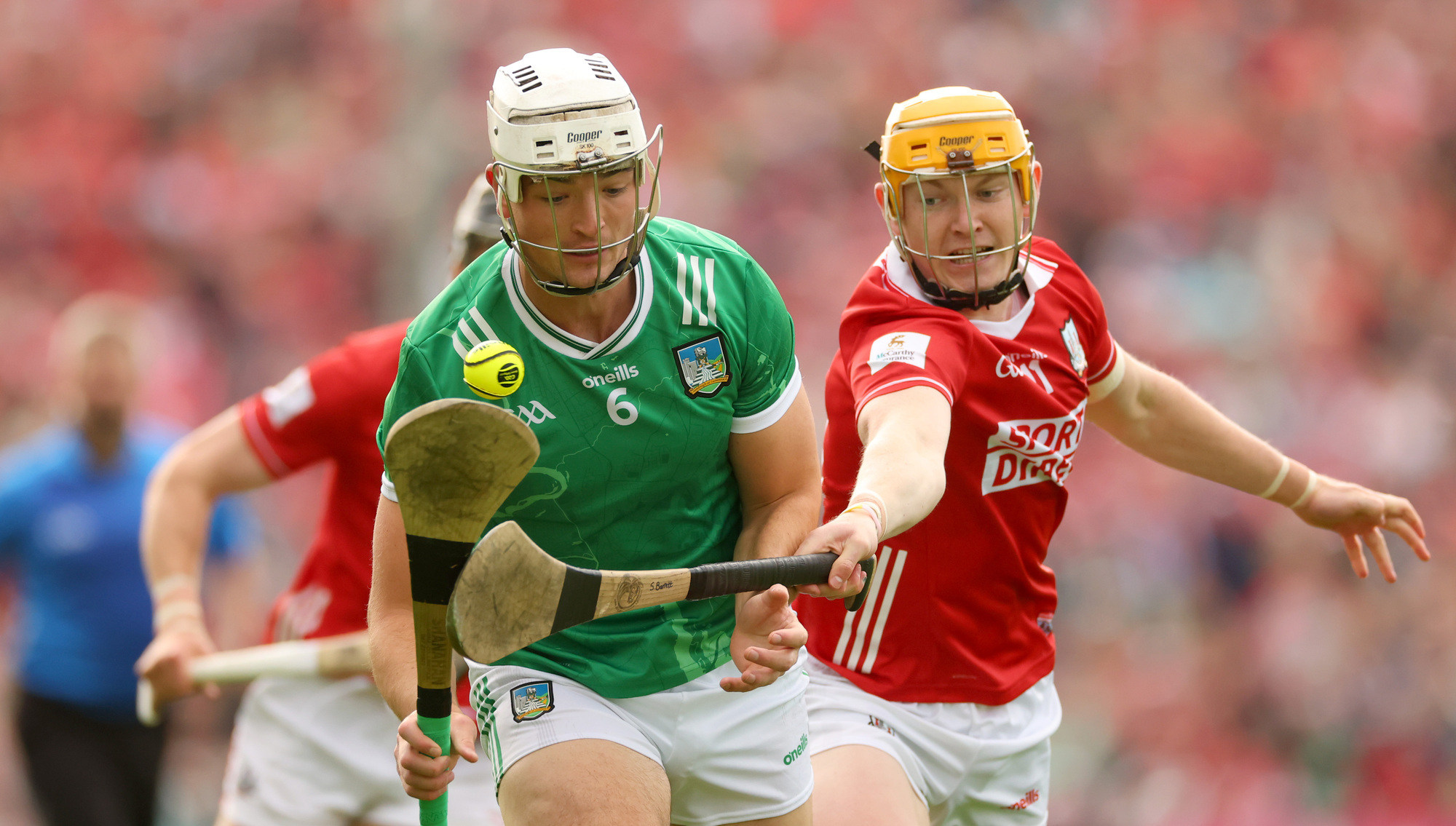
It took Shane Barrett a while to get into the game against Limerick in the Munster SHC final but when he did, the forward finished the first half with 1-3 from four shots. Pic: ©INPHO/James Crombie
After winning the toss on Saturday evening and electing to play with the breeze, which enabled Patrick Collins to pump his puckouts down on top of Brian Hayes, there were stages in the first half when Collins looked like he was hitting the ball up against a brick wall constructed by Kyle Hayes.
Hayes won four Cork puckouts in the first quarter. He looked like he was going to dominate the match on his own. Hayes’ direct opponent Shane Barrett had to wait until the 15th minute for his first possession but Barrett gradually began to get a foothold in the game and ended the half with 1-3 from four shots, as well as having an assist.
Limerick’s half-back line has always been their chief wall of defiance but the constant rotation of Cork’s half-forward line was causing cracks to appear and bricks to dislodge. Diarmuid Healy, who was outstanding in the first quarter when scoring 0-2 and assisting another point, was constantly losing Barry Nash in the chaos of confusion and movement.
Healy only had seven possessions and one more shot after the first quarter, but Healy never allowed Nash to be the dominant attacking and counter-attacking force he has invariably been in big matches.
Keeping the ball away from Hayes, as they had done last year with Declan Dalton, was critical to Cork’s gameplan but there were stages too when Hayes was flummoxed by who he was supposed to be marking with Cork’s constant rotation and movement. After having 11 possessions in the first half, Hayes only had four more possessions for the remaining 65 minutes.
Diarmaid Byrnes was constantly on the backfoot too from the warrior-type display of Seamus Harnedy, who was outstanding all evening. From 15 possessions, Harnedy scored 0-2, was fouled for three frees and had three assists.
Harnedy started at centre-forward on Hayes before switching to the wing after a couple of minutes but Cork’s rotation, pace and intelligent speed of movement continued to disorientate the Limerick half-back line. Harnedy got his first point off Nash and his second off Byrnes but Harnedy was also fouled twice by Byrnes for two of those frees.
When Cork beat Limerick twice last year, their long puckout was the platform for those victories, scoring an incredible 3-19 from long restarts over both games. Cork only won 13 of their 33 long puckouts on Saturday, but they turned that possession into 1-7.
The Cork half-forwards were nowhere near as dominant on puckouts as they were against Limerick last year. But they broke through Limerick’s defensive wall through different means this time around.
In the 68th minute of yesterday’s Leinster final, when Galway had just reduced the deficit to four points on a surging wave of momentum and optimism, Kilkenny desperately needed someone to win Eoin Murphy’s puckout. So where was Murphy aiming that puckout? Obvious answer. Straight down on top of TJ Reid’s head.
As you’d expect, even with a gang of Galway players around him, Reid rose highest and grabbed the ball out of the sky, before passing it to Adrian Mullen who drove the sliotar straight over the bar.
Reid was typical Reid, even if it didn’t look like being that way early on. The first three high balls that dropped in between Fintan Burke and Reid, Burke spoiled them. When Reid grabbed the next high ball, Burke and a couple of Galway defenders forced him into overcarrying.
Burke going off injured late in the half did give Reid more aerial licence but Reid had already begun to play further out the field and influence the match by then. From nine possessions overall, Reid only scored one goal but he engineered Mossy Keoghan’s goal when any other player would have tapped the ball over the bar, while he assisted another 0-4.
Read More
Reid is a genius but his ball-winning ability also underlined how much easier it was for the Kilkenny forwards to make the ball stick than it was for Galway – for most of the match anyway. The Galway inside forward line was underserviced for too long through either poor quality, or not enough supply.
Kevin Cooney was a prime example. From the six balls played into him, Cooney scored 0-3 and was fouled for three frees. The volume and quality of the supply into Cooney was just contaminated by too much wild shooting and headless Galway passing from out the field.
Kilkenny did take their foot off the gas but the game turned when Galway pushed up, pressed more on Richie Reid and started to marry quality deliveries with better movement inside. Of the last nine long deliveries Galway played into their full-forward line, they won seven and turned that possession into 1-6.
Galway were outworked by Kilkenny around the middle, but it just took Galway too long to make the ball stick close to goal.
When Laois goalkeeper Cathal Dunne made an incredible double save in the 40th minute of yesterday’s Joe McDonagh final to preserve Laois’s three point lead, it looked like being a potential turning point in the game – both for Laois, and Kildare. How much of a setback could that have been for Kildare when Laois had already clocked up ten more shots by that stage of the match?
It was a turning point alright – for Kildare. Within eight minutes, Kildare had registered six points from seven shots. Their greater athleticism, pace and stamina was already becoming obvious. After that double save, Kildare had an incredible 25 shots in the last 33 minutes, which is a shot every 80 seconds. They had 15 more shots than Laois in the second half. By the end of the match, Kildare had registered an astonishing 46 shots.
They ate Laois alive on turnovers, especially in the Laois attacking third in the second half when the Kildare defence was outstanding. Kildare mined 1-15 off turnovers. Their patience and composure on the ball was exceptional while the longer the game progressed, the more Rian and Cian Boran, James Burke and Jack Sheridan proved the class and brilliance they’ve long been showing for Naas and Kildare.
Those players more than deserve to grace the Leinster championship stage next year. And so do Kildare.
Walsh not the first referee to suffer injury in a Cork-Limerick championship game At the end of normal time on Saturday evening, referee Thomas Walsh spent an age stretching his calf muscle. Walsh thought he would make it through extra-time but he succumbed to the injury before being replaced by James Owens.
It was a strange sight but it wasn’t the first time a ref was injured in a Cork-Limerick Munster championship match in the Gaelic Grounds. In the drawn semi-final in 1983, Seán O’Meara pulled a muscle in the first half but kept going.
O’Meara was struggling but his linesmen, Johnny Flynn and Seamus O’Doherty were not asked to take over. However, it was a turning point in relation to referees and injuries. Tipperary’s George Ryan refereed the replay, but there was a standby referee - Waterford’s Noel Dalton – on the line for the first time in the Munster championship.