Subscriber

John Fallon: Ireland team has become the story through a single signal of resistance
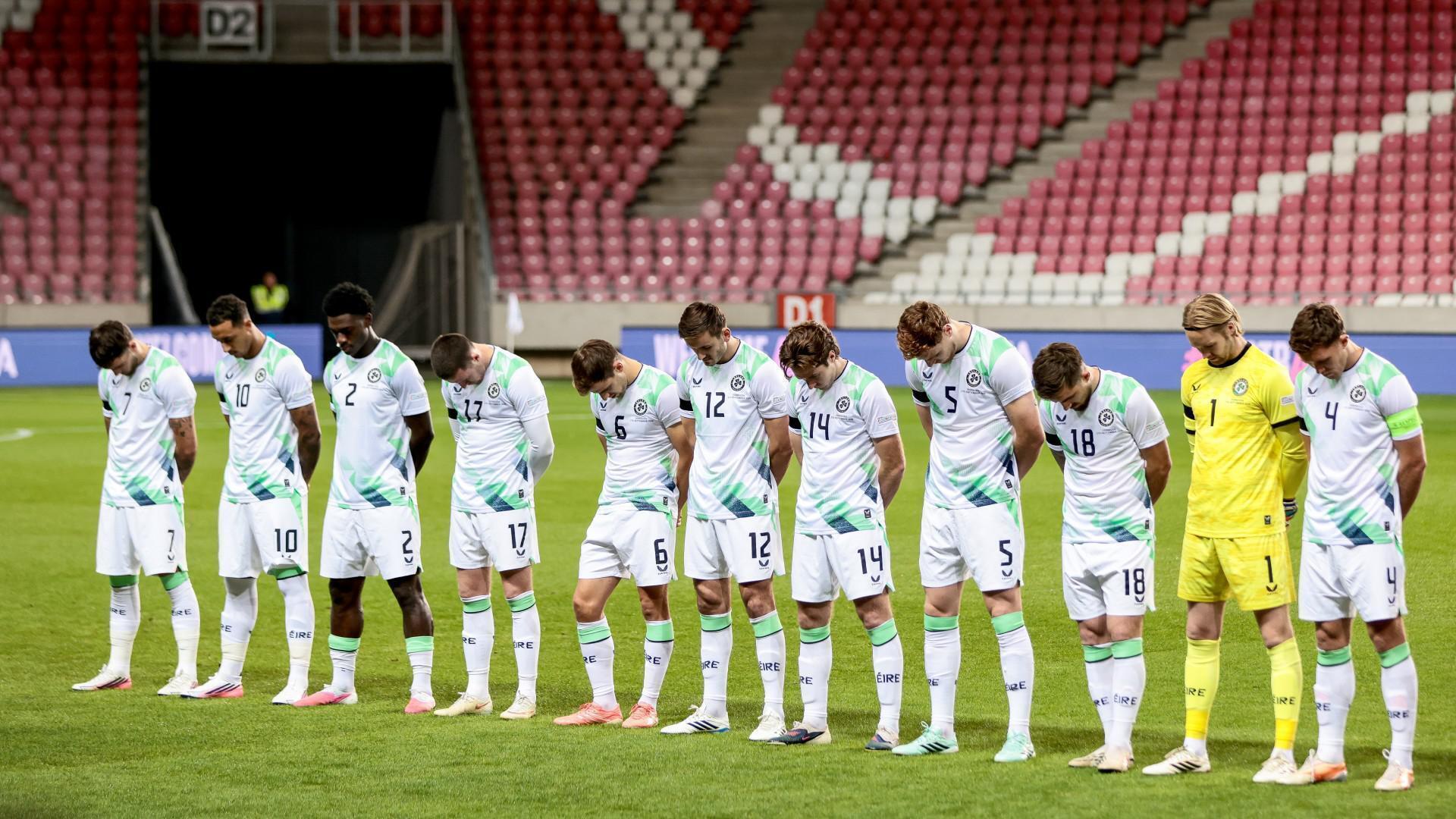
Everybody knows how close the Irish team came to vetoing Sunday’s first meeting in Hungary – even the manager felt on Saturday a no-show was imminent – but the array of gestures at the stadium spoke volumes of the feeling within the camp.
The Ireland team during the Israel national anthem. Pic: Inpho

The Ireland team during the Israel national anthem. Pic: Inpho

Seeing is believing. Heimir Hallgrímsson may have a point when declaring the actions of his players around Sunday’s game against Israel would have raised awareness about the plight of the Palestinian population.

Everybody knows how close the Irish team came to vetoing Sunday’s first meeting in Hungary – even the manager felt on Saturday a no-show was imminent – but the array of gestures at the stadium spoke volumes of the feeling within the camp.

That all from the FAI delegation refused to shake hands with the Israeli players, management and officials at any stage of the night was flagged, as was the wearing of black arms, but it was elevated to an entirely new level by bowing heads during their national anthem.

It was an image that swifty went global. Anthems are considered sacrosanct; the unique song associated with a country’s culture audible to the wider world at events like sports occasions.

There was nothing sensationalist by the New York Times circling this game as one of the most contentious of the century.

Discussions among the players on Friday and Saturday reached a conclusion that they didn’t, and wouldn’t, recognise Israel as a civilised member of the world order.

Customary protocols didn’t apply to a nation they’d no respect for due to the onslaught they’ve been engaged in, especially towards women and children. 

Footballers and journalists haven’t been spared their military assault. 

The statistics of the slaughtered are shocking and the supposed ceasefire hasn’t curbed the death toll.

Finn Azaz, proud of his Israeli heritage, had his own perspective on the situation but since the draw in February pitted Ireland against Israel, players have been conducting their own research.

It wasn’t just their own depth of feeling that mattered. Jamie McGrath, for instance, provided an insight in May when he spoke of consulting his family before deciding whether to participate.

As it transpired, the Hibernian attacker was forced to withdraw following an injury in the final club game before the window, so wasn’t among the 24 players in the room on Friday when the squad, for the first time, confronted their dilemma collectively.

It was only when together that true feelings emerged. There was anger about the FAI and Government failing to call a halt, leaving players in the ultimate position of decision-makers.

Stories were told of the campaign of terror by illegal Israeli settlers, how young families were evicted overnight from their homes. This wasn’t a normal existence for the Palestinians and the Irish players felt an onus to let them know they were in their thoughts.

By lining up against former members of the Israeli army, the point was raised about normalising their involvement in the face of Fifa and Uefa declining to suspend them.

Gavin Bazunu’s refusal to approve a statement outlining the list of gestures to be undertaken by the players raised concerns overnight that there’d be one absentee.

That was confirmed early Saturday morning to the manager and Bazunu had to be talked out of releasing his own statement until the players decided if they’d follow his lead with a full boycott.

Once that was eliminated on a vote of 15-8, the determination to ensure their visible discomfort at sharing the pitch with the Israelis was laminated.

Of all those, their approach to dealing with the national anthem being belted out at the Nagyerdei Stadion had the most profound impact.

Manor Solomon’s unhinged rant afterwards stemmed from his disgust at the gesture, along with some comments on and off the pitch later, and it’s believed the recent West Ham recruit had to be prevented from entering the Ireland dressing room afterwards to vent his ire.

There was no ambiguity around the Ireland players’ sense of dissension. While there was widespread support for a boycott, led by the Stop The Game movement, by design or otherwise, the team conveyed a message reflecting Ireland’s contempt for Israel’s genocidal ideology.

Fifty-eight years on from the Black Power salute at the 1968 Olympics, Tommie Smith and John Carlos are revered for highlighting racial inequality. 

They could have chosen not to accept those medals in Mexico City but their raised-arm salute with a black glove remains a visible timestamp of their struggles.

This Ireland team has become the story of the international window through a single signal of resistance.

That’s a legacy nobody can begrudge them and are entitled to take a bow for.

Will Kerr's criticism of FAI change stance on filling oversight committee spot?

Brian Kerr emerged as a central character in the weekend drama as the former Ireland manager had a direct line into exile Gavin Bazunu alone in his hotel room.

The two would encounter each other during Kerr’s brief return to the Ireland staff, as a backroom member during John O’Shea’s first camp as caretaker boss in March 2024.

It was former chief football officer Marc Canham who was behind Kerr’s first involvement since his abrupt 2005 sacking but his successor John Martin has also maintained contact.

Indeed, it’s believed Kerr was identified as a candidate for the oversight committee that is charged with being on top of the new State-funded drive to employ full-time staff across LOI club academies.

At his recent presentation, which for the first time outlined the execution of the €3m allocation, its chief Will Clarke introduced the concept of an oversight committee.

Its composition features former sports minister Michael Ring, now part of the league’s senior committee, former Ireland youth manager John Morling, as well as Nora Stapleton from Sport Ireland and Dr Áine McNamara, an esteemed academic in elite performance.

One spot had still to be filled, and Kerr was perched atop the targets.

Whether his acerbic criticism of the FAI over the Israel games, peaked by him calling for the entire board to quit on Saturday, affects the quest will be interesting to observe.

Jay McEvoy could well be the sequel to Ceadach O’Neill

It naturally got buried amid the saga of the senior team but Ireland’s U19s were denied a draw away to England by Max Dowman’s second half goal on Friday.

New boss Noel Hunt took charge of the team at St George’s Park, calling on the likes of Billy O’Neill, Cillian Tollett and St Patrick’s Athletic tyro Sam Rooney.

A closely-fought friendly was settled by a 70th-minute winner by Arsenal star Dowman.

Ireland have since moved onto Spain for another three matches, started by Monday’s 5-0 victory over Faroe Islands. They meet Qatar tomorrow and complete the camp against Azerbaijan on Sunday.

One notable absence was Manchester United starlet Jay McEvoy.

The 18-year-old was born in Dublin before his family moved to Manchester where he joined the Red Devils at U9 level.

Despite already representing Ireland, he’s had serious interest from Northern Ireland too, explaining his international pause.

Having not played competitive matches for either federation yet, this could well be the sequel to Ceadach O’Neill.

The Arsenal teen was an unused sub in Monday’s scoreless draw against Hungary but has committed to the Northern Ireland cause for the long-term.

E: john.fallon@examiner.ie

More in this section