Donal Lenihan: Leadership void and young talent questions hang over Ireland
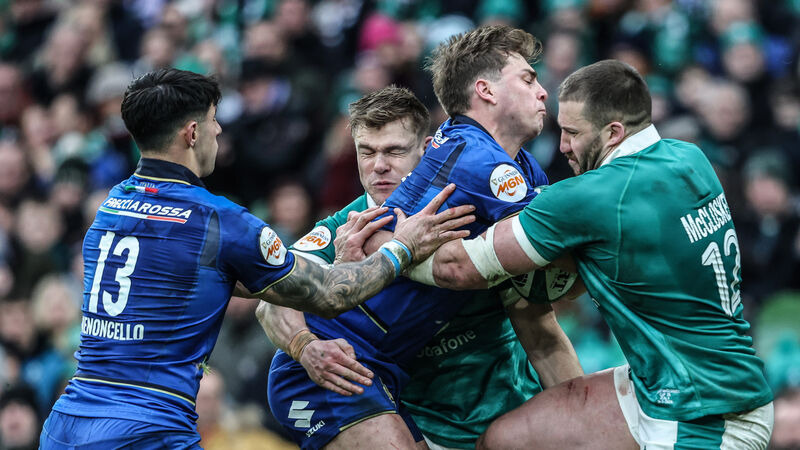
MIDFIELD CONUNDRUM: Italy's Leonardo Marin is tackled by Ireland's Garry Ringrose and Stuart McCloskey. Pic: Inpho

N historic tournament that keeps on giving, the Six Nations breaks unprecedented ground this weekend when, for the first time in a competition stretching back to 1883, the opening three games of the campaign will be played on successive weekends.
Given the increasingly physical nature of the modern game, this is yet another factor that plays into the hands of the countries boasting the deepest squads.
Up to now, after two punishing rounds of action, players would disperse for a few days and take a break, before reassembling for round three in two weeks’ time.
In a sport that talks a lot about player welfare, the demands at the top level are being ratcheted up even more.
That said, purely for a spectator’s point of view, the action can’t come quick enough.
Over the course of the opening two rounds, the tournament has delivered results that weren’t entirely foreseeable — even if Italy always had the capacity to beat Scotland in Rome.
Travelling to Murrayfield on the back of a 12-game winning streak, England were fancied to win, but appear to have a mental block when it comes to playing the Scots for the Calcutta Cup.
That proved the game of round two. Scotland delivered an incredible performance to explode the growing narrative about how good this England team is becoming.
There’s no question they’re on an upward trajectory, but it will be interesting to see if this setback works in their favour in the long term and if they have the capacity to deal with it in time to deliver the win against Ireland that most have been forecasting since the outset of the competition.
On the back of the Scottish win, there’s plenty for Andy Farrell to mull over in terms of the game plan adopted by Gregor Townsend to bring England down. Steve Borthwick’s men love to kick the ball.
Scotland used that strategy to pick the visitors apart through the excellence of their aerial play and counter-attacking skills from a back line brimming with talent — something they failed to utilise in admittedly challenging conditions in Rome.
It helped that England were forced to play without a winger for 30 minutes when Henry Arundell was yellow-carded twice in the opening half, resulting in a 20-minute red for the second
offence. Ireland can take a lot from Scotland’s performance, despite the fact they struggled for long periods to impose themselves against an excellent Italian side on Saturday.
Even with improvements across the board from the defeat in Paris, Ireland still appeared lacking in confidence.
Their organisation in attack showed more promise, but was blighted on far too many occasions by poor handling and execution when under pressure.
On the positive side, the build-up to Robert Baloucoune’s superb try was the best phase of attacking play Ireland has delivered for some time. If they can build on that for Twickenham, then they can expose a vulnerable-looking English defence.
Since the opening defeat at the Stade de France, there’s been much discussion around the lack of talented young midfielders coming through the Irish system.
This was heightened even more for me when France — the best attacking side in the tournament — selected a new centre pairing of 20-year-old Fabien Brau-Boirie and 22-year-old Emilien Gailleton, both from Pau, to start against Wales in Cardiff.
By the 14th minute, both had scored tries. Despite their age profile and comparative lack of experience, Fabien Galthie had no hesitation in selecting them when the Bordeaux-Begles centre pairing of Yoram Moefana and Nicholas Depoortere — 25 and 23 respectively, who started against Ireland — were ruled out due to injury.
Many were shocked when recent captain, 31-year-old Gael Fickou, was deemed surplus to requirements by Galthie in advance of the tournament after he and 27-year-old Toulouse centre Pierre-Louis Barassi featured against South Africa in November.
Over the course of the same international window, 33-year-old Stuart McCloskey has proved Ireland’s most consistent performer since taking over from 35-year-old Bundee Aki.
Garry Ringrose and Robbie Henshaw, 31 and 32 respectively, also featured — while 32-year-old Munster centre Tom Farrell also made his debut in November.
In comparison to the truckload of fledgling French centres benefitting from regular game time in the Top14, our midfield production line is pretty barren.
Read More
Connacht lead the way with Hugh Gavin and Cathal Forde set to benefit massively from the influence of Stuart Lancaster. Ulster’s Jude Postlethwaite is also making great strides, and has been called up to the Irish squad.
VER the last decade, we’ve been blessed to assemble an incredibly talented and mentally strong group of Irish players — in my opinion the best squad we’ve ever managed to produce at a single point in time.
We were also fortunate to avail of the residency rule that enabled Aki, James Lowe, and Jamison Gibson-Park play for Ireland. With that qualification period now extended to five years, that avenue has been all but cut off.
We’ve also arrived at a crossroads in attempting to fill the void which was left by generational players in Johnny Sexton, who departed the scene after the 2023 World Cup — along with recent retirees Peter O’Mahony, Cian Healy, and Conor Murray.
It’s very difficult to replace the aura and natural leadership that comes from that quartet. With them on board, Ireland’s achievements were off the charts.
Apart from being part of teams that delivered grand slams and Six Nations championships, they were instrumental in Ireland reaching uncharted territory: Beating the All Blacks for the first time in Chicago, and winning a Test series in New Zealand in 2022.
Ireland also beat the Springboks in South Africa in 2016 and 2024.
Generations of Irish players, even in the professional era, never came anywhere close to that. While Sexton and O’Mahony were very comfortable in the captaincy role, Murray and Healy were also massively respected within the group.
Their presence and quiet assurance remained a constant within the squad, even in their latter years when utilised more off the bench.
Current captain Caelan Doris deserves similar support from the likes of Dan Sheehan, James Ryan, Jack Conan, Lowe, McCluskey, and Ringrose to fill that void.
Doris can’t do it all on his own. He’s one of those leaders who inspires by actions rather than words. Right now, it appears as if he’s carrying that leadership role on his own. The time has come for his trusted lieutenants to share the load.
As for England, they return to their Twickenham headquarters with several question marks hanging over them.
Last Saturday’s game was the first time that this evolving team found themselves in the eye of a storm.
When South Africa had a second-row sent off in three consecutive games last autumn, you could see Rassie Erasmus sitting in the coaches box with a wry smile.
He almost welcomed the fact that his players had dug a hole for themselves and was keen to see how they’d react in adversity. On all three occasions, they found a way to win.
Presented with a situation where England had to compete and adapt without Arundell for 30 minutes, Borthwick would have hoped for a similar response from his players, and would have been bitterly disappointed when it wasn’t forthcoming.
That’s left them vulnerable when Ireland arrive in London.
Unfortunately, Farrell’s men aren’t exactly brimming with confidence either. The spontaneity and ability of old to react on the hoof to what’s unfolding in front of them appears to have deserted them at the moment.
Prior to Murrayfield, I couldn’t see anything other than a win for England in this game.
Last weekend has muddied the waters on that front.
Borthwick has already made his selection, leaving Farrell with much soul-searching to do before announcing his team.
Whoever gets the balance right on that front will have taken a major step in the right direction.