Ronan O'Gara: Jack Crowley still calculating the split second between club and test rugby
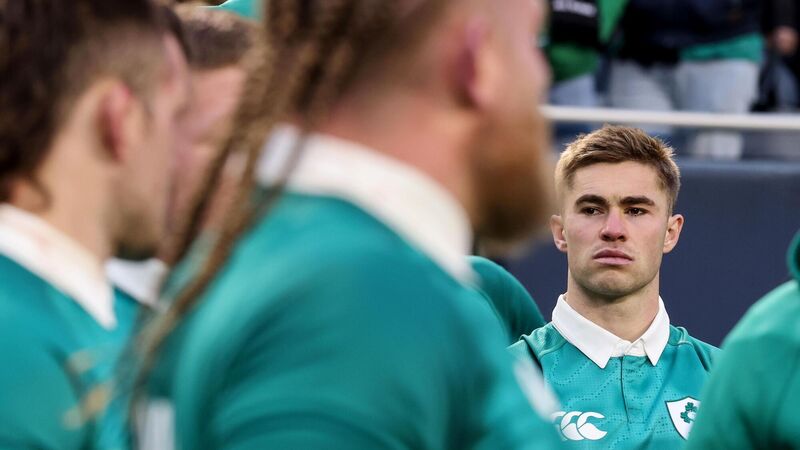
JACK OF ALL TRADES: Ireland's Jack Crowley dejected after the match against New Zealand. Pic: ©INPHO/Dan Sheridan

OUTSIDE Ireland, rugby’s big draw card this autumn is Saturday night’s meeting in Paris of France and South Africa.
On form, they are the top two sides in the world, and the intrigue is enhanced by the sense of psychological one-upmanship that a victory will deliver.
The Ireland-New Zealand World Cup quarter final from two years ago exposes a raw nerve in Ireland, and nothing that happened last Saturday in Chicago will ease that queasiness.
But 24 hours later in 2023, South Africa edged France 29-28 in another World Cup classic that was lavishly sprinkled with controversial moments and talking points.
Consequently, their Stade de France reunion has sparked a wildfire of conversations and plots this week in France. In naming his 23, and extended squad of 28, Fabien Galthie has done little to stymie the chit-chat, and maybe that’s no bad thing.
Our own Greg Alldritt is back in the 28, but not in the matchday 23 which means that, a late injury notwithstanding, he will be sitting in the stands while La Rochelle slug it out in the rescheduled Top 14 game in Toulon on the same day.
Meanwhile, included in the 14 players released by France back to their clubs (or inactive list) this weekend is Toulon’s Charles Ollivon. Grand job.
France will start Lyon’s Mickael Guillard, usually a lock, at number 8. Galthie needs to start looking at his alternatives for Australia in 2027, and the depth and breadth of what he has to choose from is self-evident from the established names who will not be involved against the world champions.
With South Africa’s demolition of New Zealand in the Rugby Championship in Wellington, we were exposed to the full rigour of the Springbok game, with the ball especially. It is not like Rassie Erasmus has gone rogue on the Bok birthright but it was intriguing to watch South Africa show a bit of leg, so to speak. In Paris tomorrow night, they will surely look to further evolution while leaning heavily on good old heft.
They will go after France up front, not least the two young props, Clermont’s Régis Montagne and Baptiste Erdocio, the loose head from Montpellier – not just in the scrum but in lineout and maul. Let’s test your pulse, boys.
Read More
That South African punishing style is suffocating but if any side is designed to elude and evade it is a French team looking to give plenty of work to the dancing Penaud and Bielle-Barry.
There is no Mathieu Jalibert option, he is injured and may have been more suited to a freestyle type of game, but Romain Ntamack will keep the Boks honest though he is more structured as a playmaker – certainly in comparison to French tens generally.
Tomorrow also sees New Zealand’s autumn bow in this part of the world, and given they have won 30 of the 32 test matches against Scotland (and drawn the other two), one might wonder why the Murrayfield encounter is worth more than a passing sentence.
It’s because, right now, I would apply the term ‘solid’ to the All Blacks, not in a pejorative way but certainly for the first time since I had a proper understanding of the global pecking order in test match rugby.
Leicester Fainga’anuku made a big difference against Ireland when introduced, so it’s little surprise to see him start alongside Quinn Tupaea this time. Scotland have left out Duhan van der Merwe for Kyle Steyn for a more defensively solid structure and while their scrum will creak minus Zander Fagerson one repeats the question: can we say New Zealand are anything more than a solid team?
They deserved their victory in Chicago, but it was a strange, unfulfilling night of rugby, like a bad curry. It left a bloated, stodgy aftertaste, and Ireland were well off it, for whatever reason, illustrated by Cam Roigard’s lateish try that put the affair to bed.
It wasn’t 100 degrees at Soldier Field so I am not that sure the undercooked and fatigued explanation works for Ireland. These are seasoned pros, they are mega fit. This isn’t beer belly rugby any more.
Notwithstanding that, the Tadhg Beirne loss to a shocker yellow card upgrade to red was disproportionately significant. The referee, Pierre Brousset is now regarded as France’s top officials. Make of that what you will. But Beirne’s red was not a Brousset decision, he went to the bunker and Wales’ Dan Jones, the foul play review officer (FPRO), upgraded it. The moment felt, and was, huge. Beirne has a bigger capacity for defensive X Factor moments than anyone in the world game at the moment. He comes up with three or four exquisite poaches per game which are incredibly important and energising for your defensive coach and team mates. His decision-making is phenomenally good when you put in context that his actions in the ruck are basically poach or penalty against.
In terms of managing the joystick, it wasn’t Jack Crowley’s finest eighty, but it’s not difficult to explain. In simple language, he is still learning how to operate in the paper-thin one-second windows that differentiate test match rugby from the URC. That is manifested in forcing things, pushing the envelope, in moments when he doesn’t need to. When momentary poise is the demand. He hasn’t made up that one second yet and he’s got flustered. Jack has already processed the speed of the club game, but he’s yet to mentally process the speed of the test game. That is normal. Chalk v cheese.
There was a comparable example. Both in Croke Park and Soldier Field, he receives the ball in broadly the same area against Leinster and the All Blacks. In the URC he does a beautiful tchik tchack (a bounce off one foot onto the other) and a goose step, danced away and turned it into a counter attack. He had the same picture in his head Saturday night in Chicago, but got caught by the big lock Fabian Holland, New Zealand poach, penalty, five metre lineout and try. That was the game.
In test match rugby, there are occasions you have to get the ball up the pitch. As in, lump it. You can’t make a break every time. Here we defer to the great Dan Carter and the philosophy of great out-half play – simple things done well. Simple things done well. Rinse and repeat. Don’t force it, then the gate opens.
That he is selected again for Japan on Saturday is no great surprise. This is Crowley’s series, it’s not a debate that demands a reheat after the All Blacks. Sam Prendergast remains a work in development and his levels are stages short of where Crowley has moved to.