John Fogarty: Hurling faces greatest inflection point in over 30 years
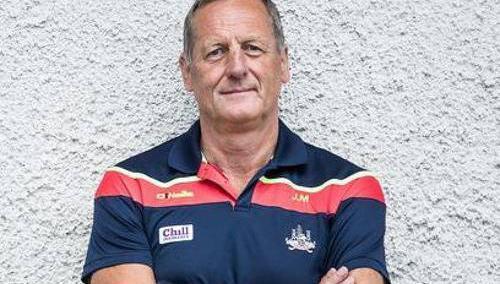
Former Cork boss John Meyler.
It says so much about the present state of hurling that there have been calls for John Meyler’s brief as chairman of an expert group to be expanded.
Former Laois manager Seamus “Cheddar” Plunkett is one of those who has argued there is more for the GAA to sweat about than the parameters of the game itself. If it’s not the structure or schedule of the hurling championship people want Meyler to review, it’s how the squeezed middle can be helped.
Meyler’s remit is limited to the rules, although two members of the hurling development committee (HDC), chairman Terry Reilly and national head of hurling Willie Maher, are part of his group.
Meyler mightn’t have been averse to looking at hurling as a whole package. Before he was appointed by GAA president Jarlath Burns in March, the former Cork and Wexford manager was making the point that hurling’s biggest issue wasn’t rules but demographics. He frowned on last year’s development roadshow as “a waste of time” and spoke of the challenges faced by the likes of Kerry where there are only pockets of predilection for hurling.
“Hurling is struggling in terms of development,” he told the last October. “It’s grand in Cork here and in the premier counties in terms of numbers and the counties in Liam MacCarthy are flying but it’s when you start to go to Joe McDonagh and Christy Ring, you’re now struggling and it’s about demographics. They need to look at structures and how we can get more people involved, more people playing, more people coaching.”
Read More
Plunkett has highlighted the need to preserve hurling in counties like Antrim, Carlow, Dublin, Laois, Offaly and Wexford. It is far more important than committing to those who have no notion of developing the game and, as Neil McManus rightly claims, “view it as a nuisance”.
If those counties are to be kept honest, their annual Central Council distributions should be contingent on hitting key participation indicators and giving meaningful calendar slots to club hurling.
It’s three years since the Central Competitions Control Committee (CCCC) withdrew their proposal to exclude Cavan, Fermanagh, Leitrim, Longford and Louth from the National Hurling League. The CCCC were moved to do so based on the small number of clubs in each county and the combined spend on the county teams of almost €1m per year.
Inter-county players applied pressure on their county boards and the move was jettisoned, but it’s not something that is unlikely to be forgotten when the counties in question struggle to expand the game.
It was suggested to the CCCC that the quintet should target a minimum of five adult clubs by 2028. Funding has been made available for such. As things stand, Cavan, Fermanagh, Longford and Louth still have three and Leitrim just two.
Two years ago, when the HDC announced they would be appointing a national head of hurling, this column asked chairman Reilly if the position would have “teeth” as former Antrim star Sambo McNaughton called for in 2022.
Reilly replied: “I would have thought that the conditions are primed now for the person in this role to have 'teeth' like never before because you have a president (Burns) who is fully behind what we're doing.”
Maher, like his predecessors Martin Fogarty and Paudie Butler, has been most proactive and enthusiastic but there is little evidence his role has much executive power. He doesn’t have a department and there is a sense he is another one-man band.
Of course, there is the HDC. The inertia in the five counties isn’t a reflection on them, although it isn’t an endorsement of them either. Neither is some of the initiatives in which they have been involved. Last year, they distributed refresher packs containing hurleys, helmets and sliotars, to 70 clubs across the 32 counties. In Cork, one went to Blackrock/Mahon, in Tipperary Roscrea received a kit, while in Galway Liam Mellows were also recipients.
Blackrock were premier senior champions in 2020 and runners-up two years later. Roscrea have been a senior club in Tipperary since 2023 and produced a dozen All-Ireland SHC medallists through the years. Liam Mellows won the Galway SHC crown in 2017 and competed in the following two finals. On the face of it, surely there were more suitable applicants?
In New Ross on Thursday, Maher and fellow hurling expert group member Ursula Jacob will form part of a discussion panel on the opening night of the Kennedy Summer School. Entitled “Talking Hurling”, they along with Michael Duignan and Tom Dempsey will chat to Paul Collins about the “history, challenges and future” of the game.
As hurling faces its greatest inflection point in over 30 years, it should make for an interesting debate. But for the organisation, the time for words has passed.
john.fogarty@examiner.ie
The cursed cruciate has come to the fore again with the spate of anterior cruciate ligament injuries particularly among Meath senior inter-county footballers.
Calls for further analysis on why the setbacks are so prevalent particularly in football are understandable. The easiest assumption to make is the new rules are having an impact but it’s not as if the Football Review Committee (FRC) tried to ascertain just how the changes would impact players. Inter-county teams weren’t particularly forthcoming with their data. Just four of 32 supplied their information.
As the FRC’s conclusion on high intensity running last year read: “This report provides some evidence that the rule enhancements are changing gameplay patterns in each positional line, especially during the last period of gameplay.
“However, this report is not without limitations. While every effort has gone into creating valid and reliable results, the depth of our analysis is restricted due to the limited amount of data submitted by inter-county teams to the GIU (games intelligence unit) for analysis.”
In its additional recommendations, the FRC called for further analysis to be done on the physical demands of the rule alterations during the 2026 season. “This analysis is essential before making any decisions on increasing the number of substitutions or introducing rolling substitutions.” Hurling isn’t immune to the cruciate tear either – just ask Ciarán Joyce – and not on an entirely separate topic, might there be a more conducive way of arranging the National Hurling League than playing the first three rounds in as many weekends?
Next year, the first two rounds will take place in January while, as before, there will be a break between Rounds 3 and 4, and Round 6 and 7. Because there are seven teams in each division, each team has a bye weekend, which offers a third weekend of respite, but four teams in each set (24 counties) will have three games completed by the first weekend in February. If that isn’t a recipe for injury, it sure is a promotional issue.
Score difference, yes that old chestnut, came to the fore in the concluding round of the Tipperary senior hurling championship this past weekend.
Clonoulty-Rossmore finished bottom of Group 2 despite their total score difference being four points better than Loughmore-Castleiney, who finished above them.
But as Tipperary operate the Burgess motion that was passed at Congress in 2023, the score difference from the games involving only the three teams tied on two points, Borris-Ileigh being the other, was considered. Moycarkey-Borris finished top with the full complement of six points.
Counties, provinces and Central Council can choose either score difference format to determine final positions. The Leinster Council also operate the Burgess option for their senior hurling championship, although that may change should it return to a five-team competition in the future. Total score difference operates in the Munster SHC and the National Leagues.
By virtue of their 10th consecutive West Tipperary title, Clonoulty-Rossmore are not yet out of the championship and have a preliminary quarter-final to anticipate. Lose that game and they face a relegation play-off.
They faced the same situation last year when after winning in the west, they finished bottom of their pool and narrowly lost their preliminary quarter-final to Drom & Inch before seeing off Mullinahone in a relegation semi-final.
In 2023, they won through to a quarter-final before defeating Upperchurch-Drombane in another play-off to avoid the drop. What a conflicting life they lead.
A collection of the latest sports news, reports and analysis from Cork.