Enda McEvoy: Heavenly Limerick conquer their afterlife too
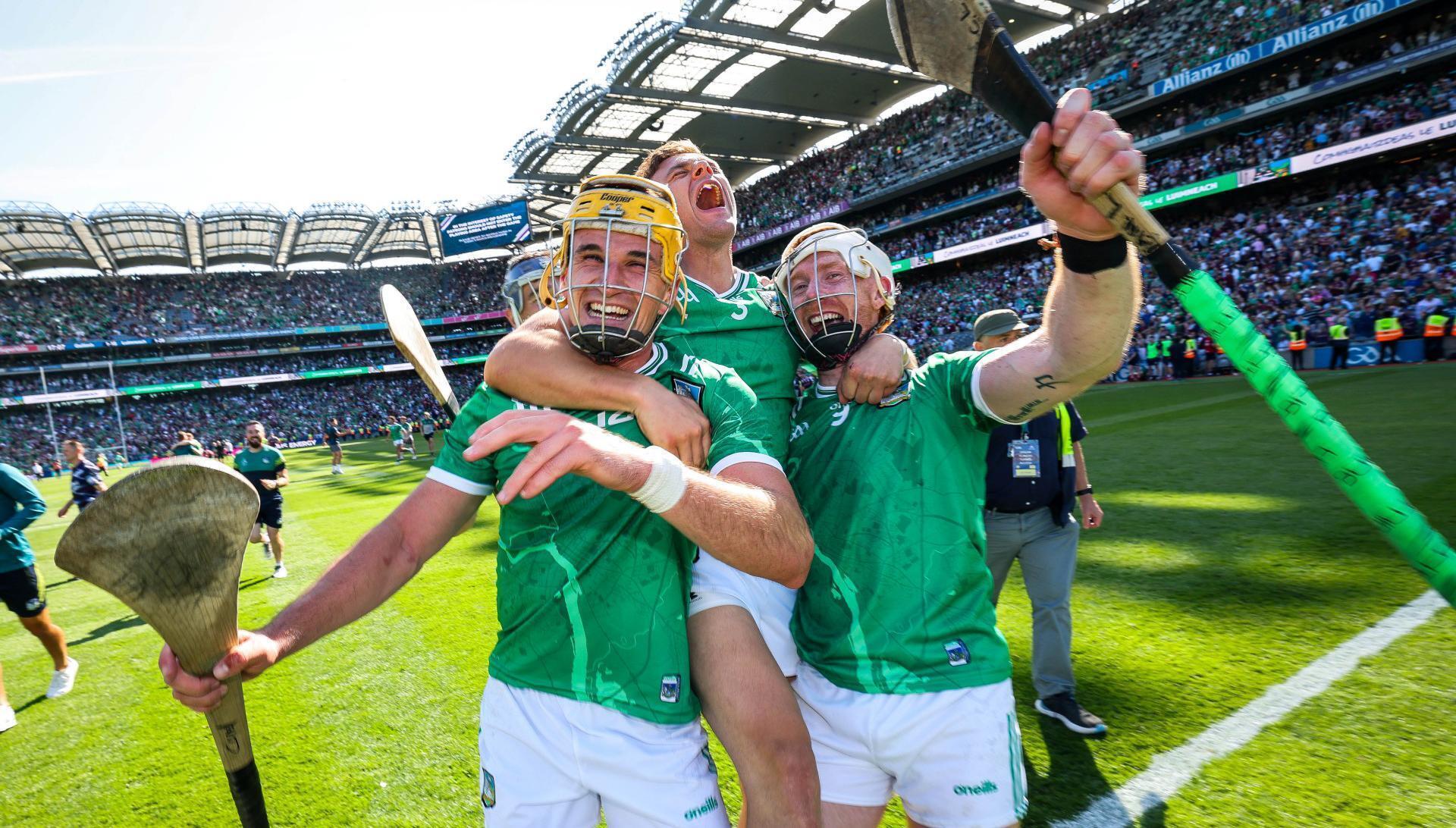
Limerick's Cathal O'Neill, Mike Casey and Cian Lynch celebrate after the match. Pic: ©INPHO/Ryan Byrne

Not that Limerick’s body of work under John Kiely required anything in the way of burnishing – their greatness was inarguable, their legacy long since enshrined in gold – but one supplementary item did remain to be added. “Remain.” Not “require”.
An afterlife. Coming back after a hiatus to win another All Ireland.
Like Cork in 1946 after their four in a row. Like Wexford in 1960 following the departure of Nickey Rackard. Like Kilkenny after 20210, rebounding to claim four in five.
Kiely’s Limerick had achieved almost everything and if they hadn’t achieved this it wouldn’t have mattered one way or another. But they did. How very Alexander the Great. No worlds are left for them to conquer.
Eleven points separated the protagonists after Galway’s injury-time penalty. Had the margin been 17 it wouldn’t have flattered the winners. This was one of their greatest days, all the more so for arriving half a decade after they were at the absolute height of their powers.
Old dogs for the hard road? A pack of ravening Alsatians, more like.
Early in the second half, with the outcome no longer an issue, the thought occurred that they might well be content to spend the remainder of the afternoon potting the reds, and thereby jabbing their opponents into insensibility, rather than putting the head down and attempting to rattle the net.
Barely had it occurred than the notion was rendered irrelevant, Aaron Gillane setting up Cathal O’Neill to motor on and slash one home. It was as though Limerick just wanted to show that they could. Or perhaps they were scratching an itch, determined to punish Darach Fahy for his temerity in making those two saves from Gearóid Hegarty.
Either way normal service was promptly resumed and the white flags continued to pile up. Twenty nine of them at the last whistle, one short of their sacred 30-point mark. Suddenly we were back in 2021.
Shortly before O’Neill’s goal the Munster champions had constructed a point that told a tale. After Diarmaid Byrnes skewed a free wide Fahy’s puckout went as far as midfield. The two men on the scene were both wearing green jerseys and one of them, Cian Lynch, set up the other, Barry Nash, to put Limerick seven ahead.
Read More
At breakdown after breakdown Limerick got bodies piled around the sliotar. If you fancy another animal metaphor try visualising a boa constrictor with a rattlesnake’s bite. Such were the coils in which Galway found themselves.
Lynch was as Lynch does. Getting passes. Giving passes. Doing the simple thing and doing it so very eye-pleasingly. Applying lacquer without being self-indulgent about it.
Equally significant to them in the first half was Gearóid Hegarty. Whereas Lynch is as he always was, Hegarty is a different, subtler proposition to the Hegarty of half a decade ago. There’s not so much sweat about him. He’s entirely comfortable in himself, less conspicuously dramatic, never trying to force the issue, now as happy to be passing the bullets as pulling the trigger. No Limerick man is as patently the product of a combination of high-class coaching and a desire for self-improvement.
Every All Ireland final brings its own slate of questions that will be answered one way or t’other. Among the posers here was the matter of whether the favourites would come on a few lengths for their run in the semi-final — they’d had four weeks off beforehand, remember — and, their sights better aligned, be more accurate than they had been against Clare.
Did we really need to wonder? Come the next life Paul Kinnerk will surely be reincarnated as a Michelin three-star chef. Everything is brought to the boil for the moment that matters most.
Nor, equally, was there anything wayward about Limerick’s intellectualising of the task ahead of them. Facing a crowd with a packed defence? Then don’t hit flat deliveries and stand gawping at what ensues.
One shudders to ponder the number of training-ground hours spent finessing the choreography that twice in the opening stages saw Hegarty rumble through from deep to be denied by Fahy. The corpse could have been dead on the table before the fifth minute was reached.
For the neutral it was an instantly forgettable showpiece in line with a woefully inadequate championship. The Munster final and the second of the All Ireland semi-finals were no epics but they were absorbing struggles, the more gripping for being lowscoring. Nearly everything else was to be forgotten. Yesterday’s contestants aside, very few counties had much to take from the summer, Kildare and Offaly to respectively a less and greater extent aside.
Yet why should any given championship not be a woefully inadequate one? It happens every now and then. Caveat emptor and all of that. Much guff attended the 2026 iteration and it was guff that was allowed go unchallenged.
The notion, for instance, that it was some kind of grave and grievous injustice for Kilkenny and Tipperary “not to be hurling in June”. Yawn.
Kilkenny managed two wins and a draw from five outings. Tipp, mounting an egregious title defence even by their standards, managed one draw in four outings and an aggregate points differential of minus 32. The pair were manifestly terrible and the championship was well shot of them.
Older readers will recall that back in 1996 Kilkenny departed after one match and in 1998 Tipperary did likewise. Now those, viewed from the heights of 2026, were grievous injustices.
Or how about the notion that did the rounds concerning the allegedly appalling iniquities of the championship structures?
More piffle. There are no iniquities. The structure is fine, or at any rate fine for everyone bar the Joe McDonagh Cup winners. A poor championship doesn’t mean the structures are wrong. This was a poor championship because most of the teams were poor.
One’s heart goes out to Waterford, continually straining against their shortcomings and continually falling a whisker short of emerging from Munster. We cannot gerrymander a system that gives sweets to every child in the class, however. For the zillionth time, equality of opportunity does not – and cannot and should not – equate to equality of outcome. A rejigged structure is not going to transmogrify Waterford or Wexford into Brazil 1970.
Talking of whom… Cork have become Brazil. Latter-day Brazil, not the 1970 guys. A storied past, raucous supporters, all the fancy moves – and nothing the moment the kitchen gets hot.
In a way Cork’s plight is worse than the one shared by Kilkenny and Tipp. The latter pair will eventually get better and may even win stuff again. But if Cork can’t win an All Ireland when they’re as good as they are now, what happens next?
Some other observations.
Galway’s new lads were men children, not long past sitting their Leaving Cert. Limerick’s newish lads were men, tautened and toned by half a decade in Mr Kiely’s Finishing School.
Clare had nothing to beat themselves up about a fortnight ago. They have even less to beat themselves up about now.
Illegal handpassing. It continues to flourish like bindweed. Infuriating.
There was some talk at the start of the season that referees were about to clamp down on it; nothing of the sort ensued. At this stage one is left to wonder how we’ve ended up where we have. Was there a secret diktat handed down from on high some years back? Did the refs get together and decide themselves they couldn’t be arsed to police a key rule?
That the players are perfectly capable of handpassing the sliotar when they want to was underlined by Peter Casey’s assist for Aidan O’Connor’s point in the 40th minute. Casey, on the ground, fired out a pass with a striking motion so elaborate as to be almost exaggerated.
Just shows. If the pace of the modern game demands adjustment it should be in terms of dialling it back, not increasing it.
Talking of the words “nothing of the sort”, last season’s defeat by Dublin should by rights have marked the end of a chapter for Limerick, perhaps even the end of the book. It did nothing of the sort, marking merely the end of a paragraph instead.
Eight years after they outlawed famine on Shannonside they remain astonishingly conditioned physically, highly literate tactically and – maybe the real bottom line - utterly voracious. And still conquering new worlds.
Quite the afterlife.