Fogarty Forum: Photo of Brian Hurley aiding stricken fan captures unbreakable bond of Cork football
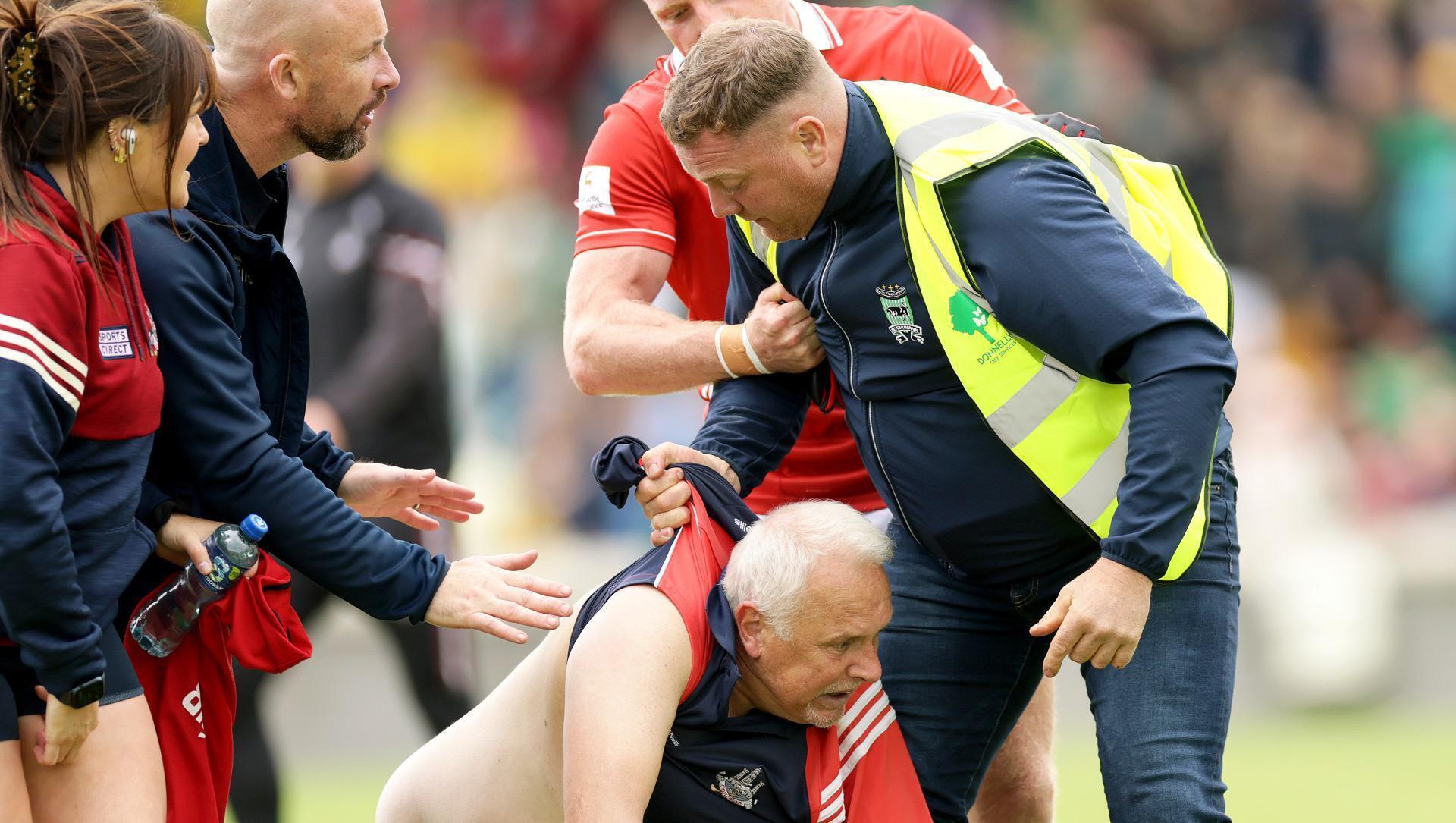
Cork GAA chief executive Kevin O’Donovan, physio Cliona O’Riordan and player Brian Hurley intervene as supporter Martin Lucey is restrained by a steward.. Pic: INPHO/Laszlo Geczo
“You can see the 80 or 90 Cork supporters that are probably here and have gone into the pitch,” gushed co-commentator and former star Colm O’Neill on RTÉ Radio 1 on Saturday. “I know some of the stewards are probably trying to get some of the Cork supporters… I think they want to try and mind the pitch.”
For a lot of us, this was the first report that Cork’s humble but able following attempted to join their heroes on the MacCumhaill Park sod after Saturday’s win over Donegal. As they did in Omagh in March when their win over Tyrone confirmed the end of their 10-year exodus from Division 1. As they did in Cavan 12 months before that when they doused a relegation flame.
It was natural that there was an instinct among the Donegal hosts to protect the newly-laid turf in Ballybofey. Following reconstruction, the surface was in wonderful shape having been out of commission for the year up to this point. But what one steward did in manhandling one fan went beyond the acceptable.
Those evocative images taken by Inpho’s Laszlo Geczo of Mallow’s Martin Lucey being restrained shouldn’t be remembered for the wrong of it but the right. Cork’s 14-season veteran Brian Hurley coming to the aid of the stricken man. One of inter-county football’s most exclusive bonds in manifestation.
Read More
It will likely serve as a rallying call as Cork became the first team to qualify for the All-Ireland quarter-finals. Being a dual Cork supporter this next while could be a financially costly exercise but at the same time a most valuable one. After a disheartening Munster final display, John Cleary’s men have regained trust with back-to-back wins.
It’s obvious the home steward had a maor, pardon the pun. It’s a faux pas beyond Tony Kelly being refused a seat by one of his own in Cusack Park for a league game in February 2017. An error graver than an injured Tom Parsons prevented from joining his victorious Mayo teammates after their 2019 Division 1 final win. Up there with the 2006 All-Ireland SHC final when celebrating Kilkenny fans were tripped and kicked as they attempted to get onto the Croke Park field afterwards.
It has gone the other way, of course. Donegal stewards intervened as peacemakers at the end of the county’s 2022 Division 1 game against Armagh in Letterkenny. But on this occasion Hurley, along with Cork GAA chief executive Kevin O’Donovan and physio Cliona O’Riordan, was genuinely defending one of his own.
“I know them all by name because they’re the guys who were up in Drogheda this year, the guys that were in Tyrone,” Cleary told colleague Maurice Brosnan on Saturday. “They’ve been following us when it maybe still isn’t fashionable to follow Cork football. So happy for them, a lot of them had tears in their eyes.”
Cleary knows them because he was once one of their merry band – and will be again when he steps down. He also knows many of them on a first-name basis because they too like him wore the red and white.
When Cork ended their 10-year wait to return to Division 1 in April, the faces among the few hundred that travelled north were familiar. Greyer around the temples yes, their smiles and laughter more defined by the lines that frame their faces true, but the same men who brought the county All-Ireland glory.
In April, defender Luke Fahy said: “A lot of past players, Graham Canty and those guys, will travel to Tyrone, (John) Miskella, Nicholas Murphy was there, you'd always see them at Cork games, no matter where it is, they'd be up on a terrace. I hope to be doing that in a couple of years’ time as well.”
In Cork football, you pay it forward and to a select tribe it’s evident just how precious it is. One member of that 2010 All-Ireland winning group respectfully declined an interview earlier this year as he hadn’t been going to away games as often as he had been. As if he had not been paying his membership dues so he denied himself speaking rights.
We’ve encountered the same among former Tipperary footballers. They see themselves as fans first and foremost and fans follow. They are faithful. When Cleary argued that Donegal “were a slight bit off guard after their performance in Killarney”, those travelling Cork backing would have been of the same mind.
Not us. We thought coming out of Ballybofey with an inexpensive defeat seven or eight days out from facing a winning team in an All-Ireland preliminary quarter-final was the best Cork could have hoped for.
The doubters and the believers. Never was Cork football’s latter group so indelibly linked as they were in Ballybofey on Saturday. Hurley and Lucey, player and supporter, one and the same.
john.fogarty@examiner.ie
Mark Coleman last week revealed that referee James Owens told Cork players it wasn’t his job to tell them it was the last play in the Munster final. It certainly wasn’t but there are high-profile instances of match officials informing the chasing team what they have remaining in additional time.
It’s not an issue in Gaelic football anymore because of the hooter but Mayo don’t need to be reminded of how they were caught out in the 2013 All-Ireland final defeat to Dublin. Sending a free over the bar, Cillian O’Connor assumed Mayo would be given another chance to score as referee Joe McQuillan told him there was 30 seconds remaining.
"There was absolutely no suggestion that it would be after the kick-out or anything like that,” insisted McQuillan. “I simply said, ‘There's 30 seconds left' and that was from the moment he asked me.
"I said it three times, I'm sure plenty of players heard me and I was on an open mic to all my match officials, including Dickie Murphy who was the overseer on HawkEye, so all of those can confirm what I said.
"Immediately after the game, some Mayo players said to me, ‘You said there was going to be another play.’ But I never said that because there is no such thing as that."
Cork’s footballers experienced the same fate against Mayo in the following year’s All-Ireland quarter-final when Colm O’Neill converted a free believing Cormac Reilly had informed him there would be time for another kick-out.
Owens, who returns to action in Thurles this weekend for the Clare-Dublin All-Ireland quarter-final, is not among the talkative referees. Perhaps players felt they couldn’t ask him. Either way, at least his silence ensured there would be no confusion in communication.
Watching Dublin send over fisted point after fisted point in Cavan on Sunday was enough to make you wonder if a) they were Armagh in disguise and b) why the Football Review Committee (FRC) chose not to do something about the lowest common denominator score in the game.
But later that afternoon came Sam Callinan’s decision to overplay the percentage in Omagh and send over a leading point for Mayo with his hand and not find Tommy Conroy for a palmed goal chance.
Call it what you want, an absence of audacity or a lack of killer instinct, but the chance to slip the pass to Conroy proved a haunting one. Ironically, it’s Mayo’s former manager Kevin McStay who is charged with overseeing the work left by Jim Gavin’s group.
“The FRC recommends that analysis be undertaken to assess the merits of allowing a score when the ball is hand-passed or fisted over the crossbar,” read their final report last year. “This review should carefully consider the potential impact on game dynamics, skill execution, and overall scoring patterns before any formal rule change is proposed – including the possible removal of the ability to score via hand pass or fist pass.”
Speaking to the Irish Examiner Gaelic football podcast in February, contributor, FRC member and another ex-Mayo boss James Horan said there wasn’t enough evidence to suggest its removal would boost the game. If that remains the case for McStay, enhancing the value of a goal may be the alternative.