Christy O'Connor Talking Points: Tyrone’s conversion rate from distance comes back to haunt them
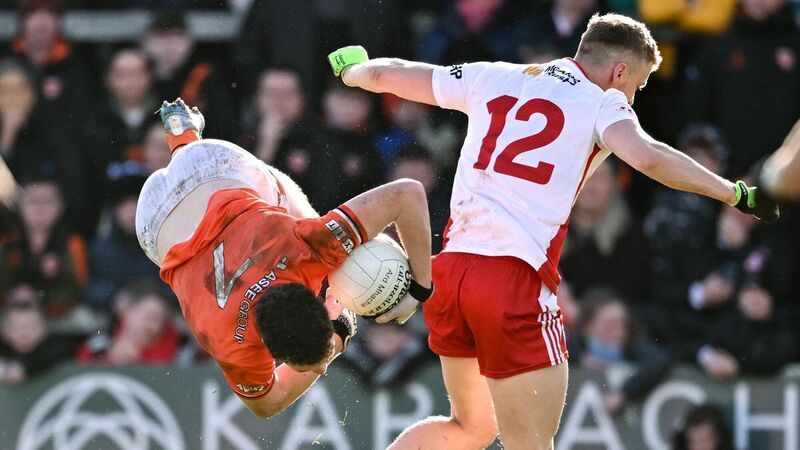
UP IN THE AIR: Armagh's Jarly Og Burns in action against Tyrone's Ben McDonnell. Pic: Ramsey Cardy/Sportsfile

It was always going to be a stretch for Niall Morgan, especially when he was kicking into a tricky breeze and particularly when the Tyrone goalkeeper was kicking across his body at such a difficult angle 38 metres from the Armagh goal and just ten metres in from the sideline.
Morgan had the accuracy, but his shot just dipped below the crossbar and was grabbed by Armagh goalkeeper Blaine Hughes. A 2-pointer at that stage, in the 67th minute, would have reduced the margin to one point. But Tyrone were level within a minute after a brilliant Ben McDonnell goal ultimately took the match to extra-time.
When Morgan stood over a ’45 at the end of extra-time, he had the chance to take the match to penalties, but his shot drifted wide just outside the post. Morgan appeared to have aggravated a hamstring injury by that stage of the match.
Injury had also curtailed his involvement during the league. Accuracy let Morgan down for that last chance, but one of the best long-range point scorers in the history of the game just wasn’t the weapon yesterday that Tyrone have relied on so often over the last decade.
Tyrone were heroic. They showed all the aggression, intent, appetite and desire that was absent for so much of the spring. Armagh was inevitably going to bring it out of them, but Tyrone’s issues around long-range scoring still came back to haunt them here.
Tyrone did nail two brilliant 2-pointers from Michael McKernan and the outstanding Conn Kilpatrick in the first half of extra-time, but Tyrone’s conversion rate from 2-pointers across the 90 plus minutes was just 16 per cent.
That wasn’t a major shock. In their last league game against Cork, Tyrone’s conversion rate from 2-pointers was just 11 per cent. In the entire league campaign, Tyrone raised just 12 orange flags, an average of just 1.2 per game.
Only six players raised orange flags during the league, but only one – Ethan Jordan – scored more than one 2-pointer. After missing three league games, Morgan’s total score in five league and championship games this year is just 0-2, one free and one ’45.
Jordan, who made his championship debut yesterday, struggled with his accuracy in the first half, especially from range. The swirling wind was a factor, but Tyrone have still missed 18 2-point attempts in their last two games.
Get that right though, and Tyrone could yet have a big say in this championship.
When Laois ended a 57-year wait to win the Leinster title in 2003, a sign was erected at the Laois end of the Barrow Bridge in Portarlington that was aimed at more than just the Laois supporters.
In a town only separated by the river Barrow, the sign was to remind their neighbours when they came into Portarlington from the Offaly side of just what Laois had achieved.
For long enough, Laois supporters in Portarlington had to listen to Offaly supporters coming into the town informing them of their historical superiority, especially when they were winning All-Irelands.
The Laois-Offaly border stretches for around 70km, but the rivalry has always been hottest in that belt in and around Portarlington. The lines have always been blurred by people crossing the water to live and work in the town, but there has always been deep links between both counties.
Willie Bryan, the first man to lift the Sam Maguire for Offaly, was born in Portlaoise. When Bryan won a Leinster minor title for Offaly in 1960, that side also included Martin Turley, whose son Leo was one of Laois’ best players in the 1990s.
Turley may have played for Offaly if his father’s playing career had worked out differently; after playing minor for Offaly for four years, Martin Turley was handed a 10-year ban in 1962 for playing rugby.
The year Offaly won that first All-Ireland in 1971, they overcame Laois in the Leinster semi-final. Laois had a solid team over the next decade, but they couldn’t crack their neighbours. When Offaly produced their greatest team in the late 1970s and early 1980s, some of their hardest battles were against Laois.
Offaly scraped past Laois by one score in the 1978 and 1979 provincial quarter-finals and in the 1981 Leinster final. When Offaly won probably the most famous All-Ireland ever in 1982, they almost came unstuck in the Leinster semi-final that year against Laois.
Prior to 2003, Laois had only won one championship match against Offaly in four decades – a Leinster quarter-final in 1990. That victory in 2003 was even more satisfying for Laois because Offaly had beaten them in the 2001 and 2002 championships.
Laois’s incredible journey in 2003 was nearly derailed before it even began when Offaly had them on the ropes in the drawn Leinster quarter-final before Laois narrowly won the replay.
“It was magic out there,” said Michael Lawlor after the drawn match, when his late goal saved Laois. “But you’re always going to have that with Laois and Offaly.”
Except that the magic has continued for Laois and it has died for Offaly. After losing only one of ten championship games in the four decades prior to 2003, Offaly have now failed to beat Laois in their last seven championship matches.
Offaly were expected to halt that trend on Saturday, but Laois’s thumping nine-point victory reminded their neighbours of their modern place in the relationship.
It was certainly a good weekend for the Laois supporters in and around Portarlington. And another bad weekend for the Offaly supporters just out the road.
When Cork and Meath met in the recent Division 2 league final, all the old stories from their epic rivalry between 1987-’90 were reheated and rehashed. Cork-Meath will always evoke special memories but one of the reasons their history dominates the discussion whenever they meet is because Cork have had so few footballing rivalries over the years.
Apart from the constant one with Kerry, the only two real rivalries Cork have had outside of Munster were that epoch defining rivalry with Meath, albeit over a short period, and against Dublin. Much of the Cork-Dublin history though, is rooted as far back as the 1890s and 1900s, and a handful of big Cork-Dublin games between 1983-2013.
Cork have had sporadic rivalries with Munster counties during various periods. For example, Cork and Clare met in five huge games between 1993-’97. Cork and Kerry have always dominated the narrative in Munster because they have been so successful but there have always been historical rivalries in the province - they just don’t get the same focus or attention because those counties haven’t been as successful.
The south-Tipperary and north-Waterford border has always been a rich footballing heartland, where the rivalry is further stoked with so many Waterford people from that area working in Clonmel.
The Cork-Limerick football relationship has a different dynamic, but it has really developed in the last 30 years. Of the sides 33 championship meetings, almost half (16) have come in the last three decades. Yesterday was the 6th Cork-Limerick championship match in ten years.
It might not be regarded as a rivalry – especially when one team has dominated the relationship – but the championship has still always been fuelled by silent rivalries that readily exist between certain teams at certain times.