How to make Colm O'Gorman's pull-apart potato bread rolls
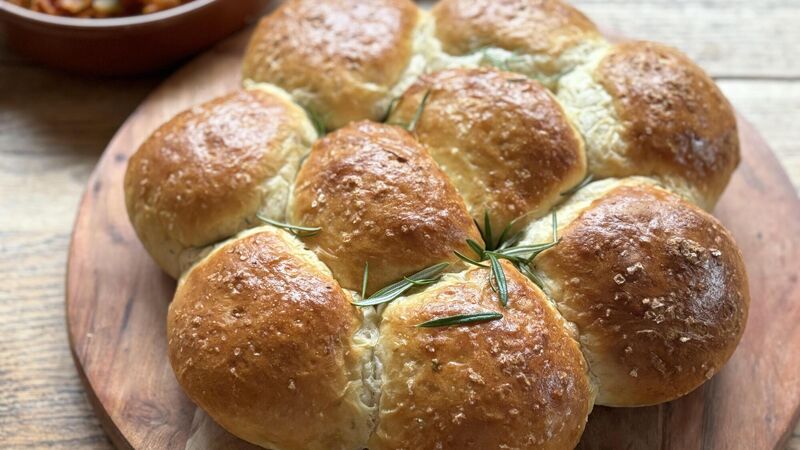
These fabulous bread rolls are perfect to serve with soups or stews, and they are wonderful for sandwiches, so perfect for school lunches.

These fabulous bread rolls are perfect to serve with soups or stews, and they are wonderful for sandwiches, so perfect for school lunches.
They also make wonderful burger buns. You might imagine that the addition of mashed potato to the dough would make this bread quite heavy, but on the contrary, these bread rolls have a super soft and pillowy texture, while also being substantial and satisfying to eat.
Some people are a little afraid of baking yeast bread, but this is quite a simple recipe so do not be intimidated.
It is easiest to prepare if you mix and knead the dough using a stand mixer or food processor with a dough attachment, but you can of course knead the dough by hand if you are familiar with that technique and prefer to do so.
Because these rolls have no preservatives, they are best eaten fresh, or within 24 hours of baking.
They do freeze very well if you find that you have a few left over or if you want to bake a big batch and freeze them to have them to hand for later.
Pull-apart potato bread rolls
These fabulous bread rolls are perfect to serve with soups or stews, and they are wonderful for sandwiches, so perfect for school lunches.
Servings
10Preparation Time
2 hours 15 minsCooking Time
25 minsTotal Time
2 hours 40 minsCourse
BakingIngredients
225g rooster potatoes
425g strong white flour
2tsp sugar
1 ½ tsp fine sea salt
7g instant dried yeast
A few sprigs of fresh rosemary
60g butter
125ml milk
1 large egg
To finish
1 egg
Splash of milk
Flaky sea salt
Method
Peel the potatoes, 225g should yield about 200g of peeled potatoes. Make sure to use Rooster potatoes, or any other quite floury potato. Do not use waxy potatoes as their texture will not work in this recipe. Cut the potatoes into quarters and place them in a small pan of boiling water. Cook until they are soft and cooked through, about 10 minutes should do it. Remove from the pan using a slotted spoon and reserve the cooking water.
If you have a potato ricer, use that to mash the potatoes. If you do not have one, you can use a masher, just make sure that the potatoes are smooth and have no lumps. Set the mashed potato aside to cool.
Wash and chop some of the rosemary, you need about a tablespoon to add to the dough. Set the remainder of the rosemary to one side for now.
Melt the butter and add it to a bowl along with 125ml of the reserved potato cooking water, the milk and the egg. Add the cooled mashed potato and whisk to combine.
Pop the flour, sugar, salt, yeast and chopped rosemary into the bowl of a stand mixer. Attach the dough hook and start up the mixer on a low speed to combine the dry ingredients.
Next, gradually add the wet mixture and run the mixer until the dough starts to come together, again this will only take a few minutes. Increase the mixer speed to medium for about eight minutes, until the dough starts to pull away from the sides of the bowl and becomes smooth and a little glossy. This dough should be smooth and soft, and a little sticky, but the consistency can vary a little depending upon the amount of moisture in your potatoes.
If you find that your dough is a little wet after eight minutes and has not come away from the sides of the bowl, turn off the mixer, add a few tablespoons of flour and crank the mixer back up to medium speed for a few more minutes.
Conversely, if your dough seems a little too dry, add some of the reserved potato cooking water a little at a time until the dough comes together properly.
Once the dough is ready, transfer it to a clean lightly-oiled bowl, cover it with some cling film and place it in a warm spot to prove until it doubles in size. This may take anything from one to two hours depending upon the temperature.
When the dough has doubled in size, turn it out onto a floured surface and gently knock it back. Do this by folding the dough back on itself a few times using the heels of your hands, until it is smooth, and all the air is knocked out of it.
Divide the dough into 100g portions – you should get about 10 from this quantity – and shape each portion of dough into a dinner roll. The easiest way to do this is to gently shape the piece of dough into a circle, and then fold it back into the centre to make a ball. Turn the ball of dough over so that it is seam side down, and gently rotate the dough using your fingertips to tuck the dough in and form a nice uniform sized round roll.
Pop each roll into a lightly oiled skillet or baking tray that is just big enough to take all the rolls comfortably. Repeat until you have finished forming all the rolls.
Lightly whisk the egg with a splash of milk. Brush the rolls with this egg wash, making sure to cover all exposed areas for a smooth even colour once they are baked. Sprinkle the rolls with some flaky sea salt and allow them to prove uncovered for 15 minutes.
Heat your oven to 175 Celsius. When the rolls have had their second proofing, pop them in the oven and bake for 25 minutes until they are well risen and golden.
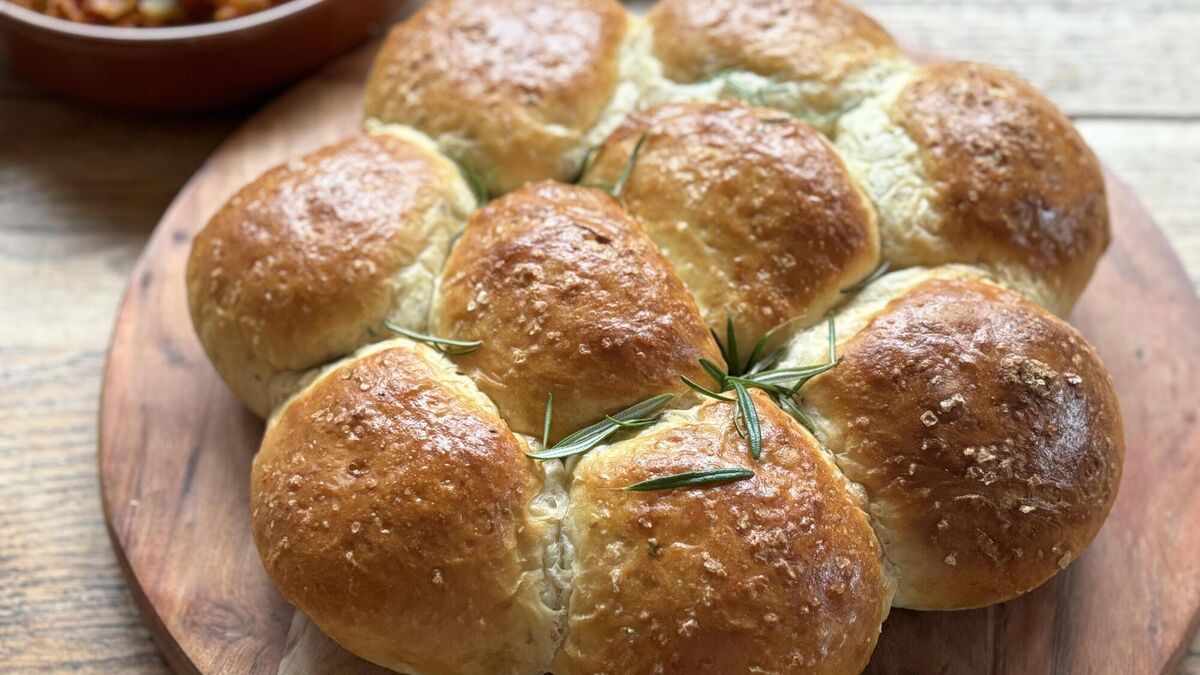
When they are baked, remove the rolls from the pan in one piece and allow them to cool a little on a wire rack. These rolls look wonderful served in a single piece on a bread board with some more fresh rosemary leaves scattered over the top. Everyone one will love pulling a roll away and helping themselves, and that batch bake finish helps to make sure that the sides of each roll are soft and fluffy and a joy to eat.