Rachel Martin: Standards must come top down
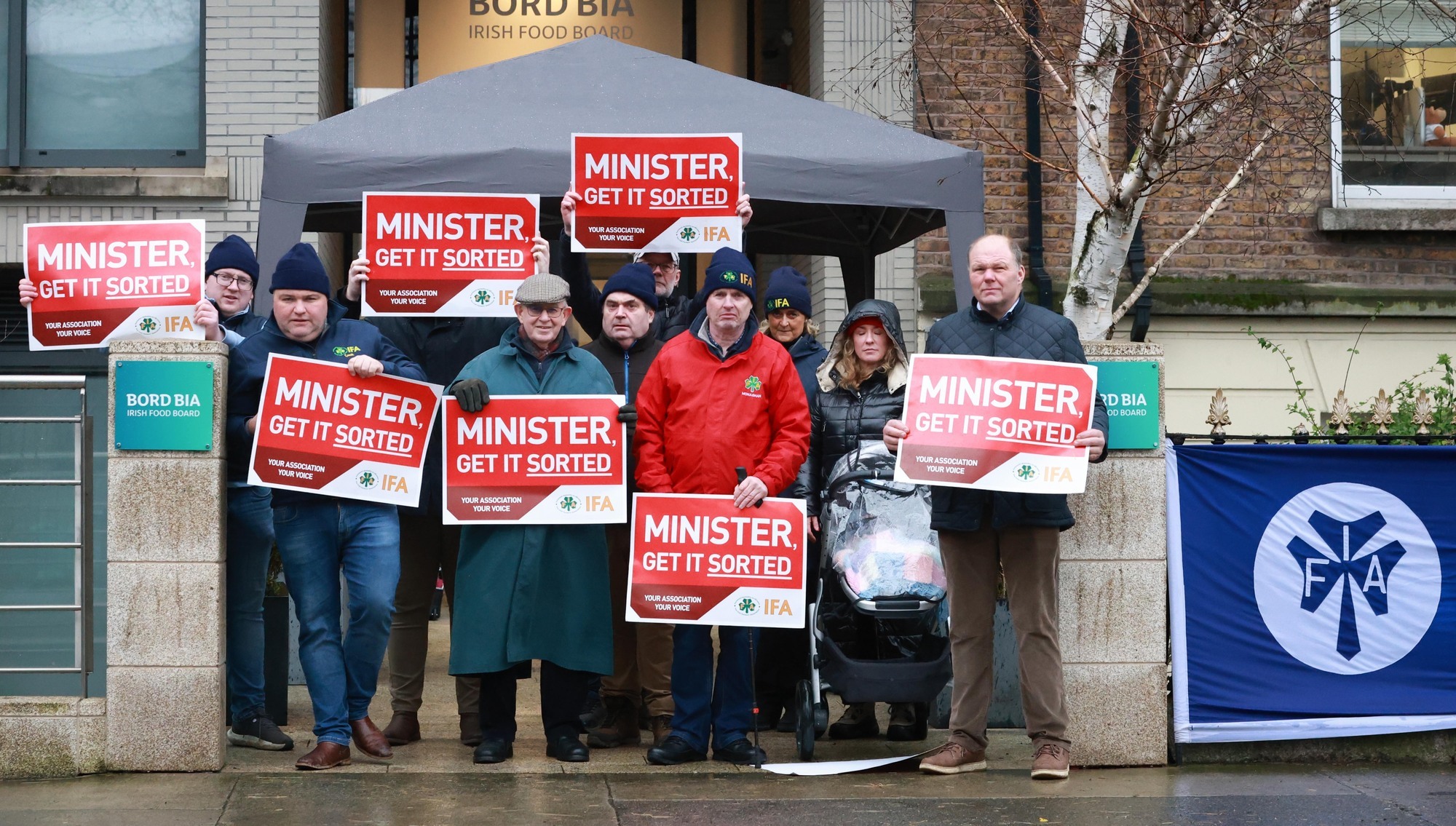
Around 20 members of the Irish Farmers' Association (IFA) protesting outside the offices of Bord Bia in Dublin against a decision not to remove Bord Bia Chairman Larry Murrin from his role. It follows news last week that Mr Murrin's company Dawn Farms has been using some Brazilian beef in its meat products. Picture: Sasko Lazarov/© RollingNews.ie

I used to think it would be a bad job to be caught in a supermarket with a trolley full of produce that didn’t align with what I wrote about for a living.
In reality, I doubt too many farmers in the local Spar are inspecting my basket for New Zealand lamb or Polish chicken. Still, it seems sensible to practise what you preach.
That expectation becomes much higher when making decisions that affect what thousands of others put in their baskets.
Bord Bia’s decision on Sunday evening to postpone meetings scheduled for this week to discuss new quality assurance standards was revealing, even if the organisation might prefer it wasn’t. We often talk about agri-food’s social licence with consumers, but in this instance, the buy-in that matters most is at the opposite end of the supply chain.
It showed, starkly, that the organisation must have the co-operation of farmers. If that co-operation evaporates, so too does the authority of the institution.
The postponed meetings were to discuss revised standards that farmers will be required to meet. At the crux of the issue: Farmers are being asked to sign up to ever-higher standards. It comes at the same time that it was revealed that the chairman of the body imports small amounts of Brazilian beef.
It should be stressed that importing Brazilian beef is not illegal. But it does raise difficult questions around where our food comes from. Bord Bia is charged with promoting food and drink of Irish origin and is part-funded by a farmer levy applied to all livestock slaughtered.
For many, this is an emotive debate. In Irish farmers’ eyes, Brazilian beef matters symbolically: Standards, deforestation, and optics all feed into hard stances. Of course, business is business, but that doesn’t mean you can’t set the standard you want to see others meeting. Processors will argue they need to segment markets, but that doesn’t explain why the value created by premium positioning rarely flows back to the producer.
Not every cut of Irish beef is premium. If it were, farmgate prices wouldn’t have spent most of the last 30 years in the doldrums. What’s missing is any acknowledgement that Irish farmers bear the cost of meeting these standards, while processors arbitrage those standards globally. The risk is asymmetrical.
Leadership is about setting the standard you expect others to meet.
I remember, years ago, eagerly watching an early series of The Apprentice, where aggressive haggling was treated as a virtue.
At home, it was different. My father would say: “It costs what it needs to cost. You can do it the cheap way, or you can do it the right way.”
That principle applies just as much to standards, sourcing, and credibility as it does to any other part of life.
It is a different story to import something Ireland cannot produce or is not self-sufficient in. But when it’s something we produce in abundance and high quality, it’s hard to defend.
Diversified sourcing is often presented as a neutral strategy; in reality, it insulates processors from risk while concentrating risk at farm level.
When processors hold pricing power while also having the power to switch origin overnight, farmers are left to absorb market volatility. Farmers have run out of patience for institutional tone-deafness. Trust starts at farm level — and standards must come top down.