Cork students put soil in the spotlight, winning Teagasc Special Award
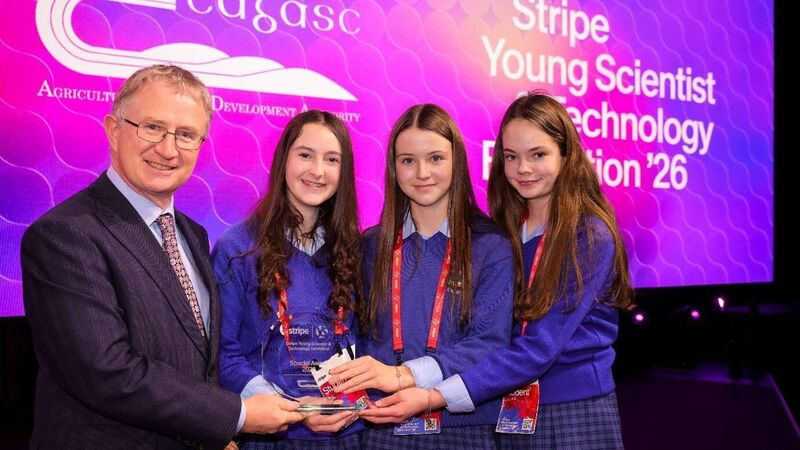
Director of Teagasc, Professor Frank O’Mara presenting the winners of the ‘Teagasc Special Award’ to recipients Méabh Dorgan, Katie Fitzgerald and Muireann Murphy of St Mary’s Secondary School, Mallow, at the recent Stripe Young Scientist and Technology Exhibition.
Second-year students Méabh Dorgan, Katie Fitzgerald and Muireann Murphy from St Mary’s Secondary School, Mallow, Co Cork, have been recognised for their outstanding scientific achievement at the Stripe Young Scientist and Technology Exhibition 2026.
The all-female team won the prestigious Teagasc Special Award for their innovative project investigating soil organic matter in North Cork.
The team impressed the judges with their project titled: ‘An Investigation into Soil Organic Matter in North Cork Using UAV RGB Imagery: Supporting the ‘4 per 1000’ Initiative and Climate Change Mitigation’.
The Teagasc ‘Special Award’ is presented annually to the project that best demonstrates a thorough understanding of the science of agriculture or food production, or the application of science to improve technologies in these fields.
The Teagasc Special Award was presented by Professor Frank O’Mara, director of Teagasc, who invited the students to visit a Teagasc research centre to learn more about work in this area.
“These students represent the next generation of scientific talent in Ireland,” said Professor O’Mara.
The team developed and presented their project under the guidance of their maths teacher, Rory Coote. Their entry stood out for its experimental design, clear methodology and potential real-world application.
This marks the second occasion on which a group mentored by Mr Coote has won the Teagasc Special Award. The team said they were inspired by an article they had read in their local newspaper.
“We decided to study the organic matter content of soil using low-cost unmanned aerial vehicles to collect red, green and blue images of selected soil sites in Co Cork,” said Ms Dorgan.
“We wanted to create an easy and efficient way for farmers to measure the organic matter content of different soils in Ireland,” added Ms Fitzgerald.
“Our study clearly shows the potential of UAV-derived RGB imaging and how targeted soil management could help farmers reduce costs,” said Ms Murphy.
Looking towards future development, the students hope to develop an app that would allow farmers to use a drone, which is connected to their phone, to identify where fertiliser is needed, increasing efficiency.
The Stripe Young Scientist and Technology Exhibition took place from January 7-10 this year.