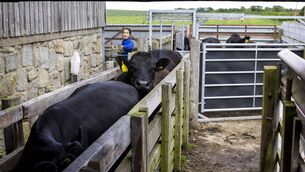
Less than 1% of farms in the country have a woman registered as an official partner, new figures have showed.
The data, obtained by the Women in Agriculture Stakeholders Group (WASG), shows that overall, just 1,258 farms out of 137,000 in the country have at least one female partner officially registered.
Limerick suckler farmer Hannah Quinn-Mulligan, who chairs the group, said the system has “let down a generation of women working on farms”.
Figures from the Central Statistics Office show that 70,000 women work on farms every day — “yet only 1,258 women are registered on an official partnership”, Ms Quinn-Mulligan said.
TAMS age limit
It was announced earlier this month that plans to limit the upper age at which women will be eligible for a higher rate of the Targeted Agricultural Modernisation Scheme (TAMS) payment to 55 have been scrapped.
The age limit has been increased to 66, which the WASG had lobbied for.
The average age of women farmers is 62 years of age.
The TAMS grant offers up to 40% of the cost of certain farm investments.
“We hope that the 60% TAMS grant for women up to 66 years of age will help to redress the situation for that generation of women who have spent their lives working on farms without the acknowledgment of the contribution to the family farm,” Ms Quinn-Mulligan continued.
“The last few weeks have highlighted failings across society when it comes to valuing women for their individual worth.
“We will continue to work to ensure that this does not happen on our watch.
“While Minister McConalogue has taken on board our proposed Common Agricultural Policy measures, there is still significant work to be done to address inclusivity, and Irish agriculture has the opportunity to be a shining example in society,” she said.
Her comments were echoed by the Irish Farmers’ Association representative for the group, Alice Doyle, who said that they “fully support the inclusion of women in partnerships and encourage more women to enter into partnerships”.
Succession farm partnerships
The WASG said the situation is different when it comes to succession farm partnerships, which provides a tax credit to incentivise the transfer of land to young farmers.
Figures show that 22 out of the 66 succession partnerships have at least one female member, which highlights that the “mindset for transferring land to women is gradually changing and moving in the right direction where women are considered an equal successor to men”.
The news was also welcomed by the Irish Creamery Milk Suppliers’ Association representative Vanessa Kiely O’Connor.
“I must admit to be taken aback by the current figure of less than 1% of women in a registered partnership,” Ms Kiely O’Connor said.
“On a positive note, I would be hopeful that this will change in the very near future; it is absolutely wonderful to see the succession partnership figures of 42%, as it shows a change to the old traditional mindset.”
As the deadline for registering official farm partnerships occurs tomorrow, February 11, the WASG is urging farmers and their families to consider the benefits of recognising the contribution that women play on farms and adding them to a farm partnership.
The WASG is made up of representatives from the IFA, ICMSA, the Irish Cattle and Sheep Farmers’ Association, the Irish Natura and Hill Farmers’ Association, and Macra na Feirme, among others.
The group is currently undertaking a national farm inclusivity survey with the University of Limerick.
Both men and women are encouraged to take part in the anonymous survey, which takes under five minutes to complete, as “their input will be invaluable in helping to shape future policy”, Ms Quinn-Mulligan said.
The chairwoman explained the survey will “help serve to benchmark the progress of the policy measures and provide an indication of the challenges faced by the farm community in terms of inclusivity”.