Donal Lenihan: Bar one decision, it's hard to disagree with Carley's calls
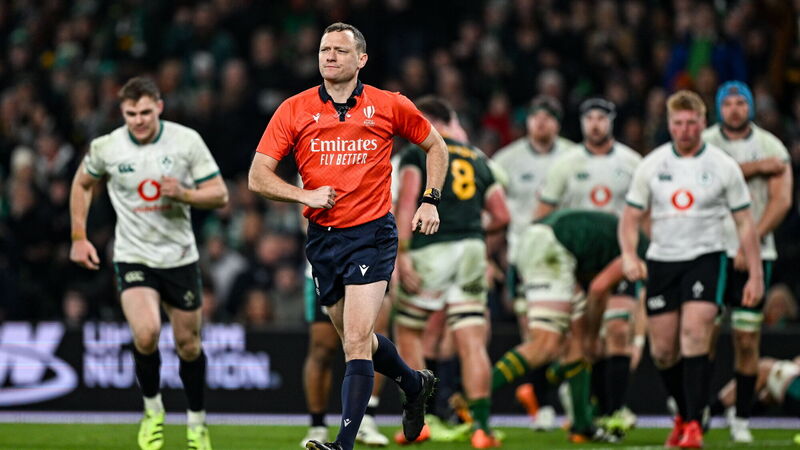
Ireland battled heroically against South Africa but this Test was no great advertisement for the sport. Pic: Ramsey Cardy/Sportsfile

In attempting to decipher what transpired at the Aviva Stadium on a beautiful autumnal afternoon on Saturday, the words of former Taoiseach Charles Haughey came flooding to mind - "grotesque, unbelievable, bizarre, unprecedented".
With a few months to go before the most difficult of all starts to a Six Nations campaign, an opening contest against the French in Paris, this game against the all conquering South African side amounted to the perfect audit of where Andy Farrell’s Irish team sit right now having dined at the top table for so long.
What transpired was a slug fest, the ultimate war of attrition spoiled by a plethora of yellow cards, with a 20 minute red thrown in for good measure, against a Springbok side intent in inflicting as much pain as possible at every scrum, line out maul and breakdown.
Farrell pretty much summed up my own thoughts on the final whistle when trying to make some sort of sense to what had just unfolded. In the post match press conference, he said “I haven’t seen a game like that ever. You think you’ve seen it all”.
In a brutal contest, with neither side was prepared to give an inch, there was always going to be consequences. For Ireland this manifested itself in the concession of four yellow cards and a 20 minute red for James Ryan. That’s what happens when you concede 18 penalties over the course of a game. 10 is the accepted norm if you want to win.
There was a time in the distant past when heroic defeats became the norm for Irish sides. This was different. Ireland were indeed heroic in defeat but this was different. In the most challenging of circumstances against a steamrolling South African pack, Ireland’s defensive grit and determination was off the charts.
To coincide only five points in a second half which Ireland somehow managed to outscore a totally dominant Springbok side 6-5, despite the fact it was played almost exclusively in Ireland’s half, was indeed unbelievable.
Approaching half-time with yellow cards being brandished like confetti at a wedding you not only worried that the game could get out of control but that Ireland were in danger of being on the receiving end of a hammering.
That Ireland managed to stay in the fight courtesy of key turnovers at crucial times from Caelan Doris, Ryan Baird, Cian Prendergast and Paddy McCarthy who, once again, made a big contribution off the bench despite getting a yellow card for yet another scrum infringement, somehow helped keep Ireland’s line intact.
In the circumstances, it was no surprise that referee Matthew Carley was the main source of ire from the bulk of Irish supporters I ran into immediately after the game. For me, with the exception his failure to issue a yellow card to Sacha Feinberg-Mngomezulu for a high hit on Tommy O Brien seven minutes into the game, it was hard to disagree with the majority of his calls.
In fact Ryan was lucky not to receive a straight red for his reckless clean out of Malcolm Marx at a ruck in the build up to what would otherwise have been a try for Tadhg Beirne. Having that score chalked off was a huge turning point.
By issuing a referred yellow, Ryan’s maximum sanction could only be upgraded to a 20 minute red by the foul play review officer which was just as well. The officials would have been justified in issuing a permanent red there and then. It was that kind of match.
Having received two red cards in successive matches against France and Italy, the South African management made it very clear during the week that they felt the Springboks were being unfairly treated by officials.
Did this have an impact? The fact that Rassie’s men didn’t see a yellow card until the final two minutes of this contest would suggest it did but such was their dominance in the contact area, Ireland were often left with no choice, especially around the scrum and driving mauls, but resort to illegal means to stem the tide.
The biggest problem on a difficult day was Ireland’s failure to come to terms with the sheer power of the Springbok scrum. I wrote on these pages last Saturday how South Africa use this ultra powerful weapon to break their opponents, both physically and mentally.
Such was their dominance in this facet, they used it as a weapon of mass destruction. Even when Ireland were down to the bare bones, reduced to 12 players at one stage with the necessity to shift Bundee Aki from midfield to shore up the scrum, the visitors still refused to let the ball go beyond Jasper Wiese’s feet at No 8.
It looked at one stage as if a message was transferred from the side line, via winger Canan Moodie, to shift the ball wide off an incessant series of scrums under the Irish posts in order to exploit the space available out wide. The Springbok forwards were having none of that nonsense.
When you consider they were without first choice loose head prop Ox Nche, a nominee for world player of the year, you fear what additional carnage they might have inflicted had he been on board.
As a spectacle, it doesn’t make for great viewing when South Africa win penalty after penalty for collapses and opted for yet another scrum. There were so many scrum resets in the opening half, it took an hour to complete.
Quite how Ireland restricted South Africa to one try in an extraordinary second half says everything about their grit, determination and unity of purpose with their refusal to yield in the most testing of circumstances. That togetherness must count for something come Six Nations.
Suffice to say, there’s no love lost between these two highly competitive squads. As if things weren’t bad enough already, that rivalry will become even more intense after this explosive encounter.
Despite the clear disharmony from the stands with the way the game played out, I guarantee you when South Africa return to Dublin again this time next year, tickets will be like gold dust.
That said, World Rugby badly need to revisit the process around how the officials manage the game, the delays in making decisions and the lack of momentum that ensues as a result. Despite the heroics, it was no great advertisement for the game.